


Page 92 - IMO-2-3
P. 92
Innovative Medicines & Omics                                             Bioactivities of Commelina diffusa


            antimicrobial  properties.  However,  the  relatively  lower   samples were administered at doses of 100 and 200 mg/kg
            efficacy compared to conventional antibiotics may be due   body weight. Five minutes after acetic acid administration,
            to variations in extraction efficiency, the concentration   each mouse was observed for a 10-min period, during
            of active compounds, or synergistic interactions among   which the number of writhes was recorded. The results are
            phytochemicals that were not fully optimized in this study.  shown in Figure 1.

            3.2. Central analgesic activity                      A remarkably strong analgesic effect was demonstrated
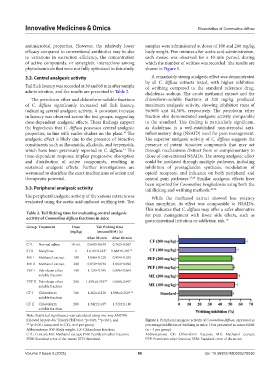
                                                               by all  C. diffusa extracts tested, with higher inhibition
            Tail flick latency was recorded at 30 and 60 min after sample   of writhing compared to the standard reference drug,
            administration, and the results are presented in Table 2.  diclofenac sodium. The crude methanol extract and the
              The petroleum ether and chloroform-soluble fractions   chloroform-soluble fractions at 200  mg/kg produced
            of  C. diffusa significantly increased tail flick latency,   maximum analgesic activity, showing inhibition rates of
            indicating central analgesic activity. A consistent increase   56.96% and 64.56%, respectively. The petroleum ether
            in latency was observed across the test groups, suggesting   fraction also demonstrated analgesic activity comparable
            dose-dependent analgesic effects. These findings support   to the standard. This finding is particularly significant,
            the hypothesis that C. diffusa possesses central analgesic   as diclofenac is a well-established non-steroidal anti-
            properties, in line with earlier studies on the plant.  The   inflammatory drug (NSAID) used for pain management.
                                                     26
            analgesic effect is likely due to the presence of bioactive   The superior analgesic activity of C. diffusa suggests the
            constituents such as flavonoids, alkaloids, and terpenoids,   presence of potent bioactive compounds that may act
            which have been previously reported in C. diffusa.  The   through mechanisms distinct from or complementary to
                                                     14
            time-dependent response implies progressive absorption   those of conventional NSAIDs. The strong analgesic effect
            and distribution of active compounds, resulting in   could be mediated through multiple pathways, including
            sustained analgesic effects. Further investigations are   inhibition of prostaglandin synthesis, modulation of
            warranted to elucidate the exact mechanisms of action and   opioid receptors, and influence on both peripheral and
            therapeutic potential.                             central pain pathways. 27,28  Similar analgesic effects have
                                                               been reported for Commelina benghalensis using both the
            3.3. Peripheral analgesic activity                 tail flicking and writhing methods. 29,30
            The peripheral analgesic activity of the various extracts was   While the methanol extract showed less potency
            evaluated using the acetic acid-induced writhing test. Test   than morphine, its effect was comparable to NSAIDs.
                                                               This indicates that C. diffusa may offer a safer alternative
            Table 2. Tail flicking time for evaluating central analgesic   for pain management with fewer side effects, such as
            activity of Commelina diffusa fractions in mice    gastrointestinal irritation or addiction risk. 10

            Group Treatment     Dose      Tail flicking time
                               (mg/kg)    (mean±SEM) (s)
                                      After 30 min   After 60 min
            CTL  Normal saline  10 mL  0.698±0.039  0.762±0.097
            STD  Morphine        2    1.616±0.223*  1.688±0.201**
            ME I  Methanol extract   100  1.006±0.120  0.914±0.109
            ME II Methanol extract  200  0.850±0.034  1.064±0.096
            PEF I  Petroleum ether   100  1.128±0.195  0.896±0.064
                 soluble fraction
            PEF II Petroleum ether   200  1.878±0.353**  0.888±0.097
                 soluble fraction
            CF I  Chloroform    100   1.262±0.228  1.998±0.250***
                 soluble fraction
            CF II  Chloroform   200   1.342±0.167  1.320±0.116
                 soluble fraction
            Note: Statistical significance was calculated using one-way ANOVA
            followed bypost‑hoc Tukey’s HSD test. *p<0.05, **p<0.01, and   Figure 1. Peripheral analgesic activity of Commelina diffusa, expressed as

            ***p<0.001 compared to CTL; n=5 per group.         percentage inhibition of writhing in mice. Data presented as mean±SEM
            Abbreviations: BW: Body weight; CF: Chloroform fraction;   (n = 5 per group).
            CTL: Control; ME: Methanol extract; PEF: Petroleum ether fraction;   Abbreviations: CF: Chloroform fraction; ME: Methanol extract;
            SEM: Standard error of the mean; STD: Standard.    PEF: Petroleum ether fraction; SEM: Standard error of the mean.


            Volume 2 Issue 3 (2025)                         86                          doi: 10.36922/IMO025270030

