


Page 34 - ITPS-5-2
P. 34
28    INNOSC Theranostics and Pharmacological Sciences, 2022, Vol. 5, No. 2            Madhavamurthy et al.
                          A                       B                        C


                                      D                        E


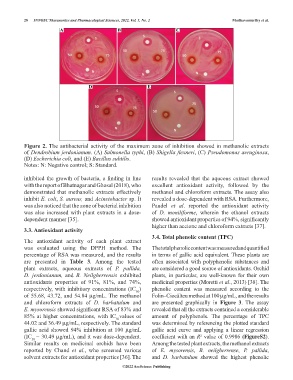
           Figure 2. The antibacterial activity of the maximum zone of inhibition showed in methanolic extracts
           of Dendrobium jerdonianum. (A) Salmonella typhi, (B) Shigella flexneri, (C) Pseudomonas aeruginosa,
           (D) Escherichia coli, and (E) Bacillus subtilis.
           Notes: N: Negative control; S: Standard.

           inhibited the growth of bacteria, a finding in line   results revealed  that  the aqueous extract  showed
           with the report of Bhatnagar and Ghosal (2018), who   excellent  antioxidant  activity, followed  by the
           demonstrated  that  methanolic  extracts  effectively   methanol and chloroform extracts. The assay also
           inhibit E. coli, S. aureus, and Acinetobacter sp. It   revealed a dose-dependent with RSA. Furthermore,
           was also noticed that the zone of bacterial inhibition   Paudel  et al. reported the antioxidant  activity
           was also increased with plant extracts in a dose-    of  D. moniliforme, wherein the ethanol extracts
           dependent manner [35].                               showed antioxidant properties of 94%, significantly
                                                                higher than acetone and chloroform extracts [37].
           3.3. Antioxidant activity
                                                                3.4. Total phenolic content (TPC)
           The antioxidant  activity  of each plant extract
           was evaluated  using  the  DPPH method.  The         The total phenolic content was measured and quantified
           percentage of RSA was measured, and the results      in terms of gallic acid equivalent. These plants are
           are presented in  Table  3.  Among the tested        often associated with polyphenolic substances and
           plant  extracts,  aqueous  extracts  of  P.  pallida,   are considered a good source of antioxidants. Orchid
           D. jerdonianum, and  B. Neilgherrensis  exhibited    plants,  in particular,  are  well-known  for their  own
           antioxidants  properties  of 91%, 81%, and  74%,     medicinal properties (Moretti et al., 2013) [38]. The
           respectively, with inhibitory concentrations (IC )   phenolic content was measured according to the
                                                          50
           of 55.68, 43.72, and 54.84 μg/mL. The methanol       Folin–Ciocâlteu method at 100 μg/mL, and the results
           and chloroform  extracts  of  D. barbatulum and      are presented graphically in  Figure  3. The  assay
           E. mysorensis showed significant RSA of 83% and      revealed that all the extracts contained a considerable
           85% at higher concentrations,  with IC values of     amount of polyphenols.  The percentage of  TPC
                                                 50
           44.02 and 36.49 μg/mL, respectively. The standard    was determined by referencing the plotted standard
           gallic acid showed 94% inhibition at 100 μg/mL       gallic  acid  curve and  applying  a  linear  regression
           (IC = 30.49 μg/mL), and it was dose-dependent.       coefficient with an R² value of 0.9986 (FigureS2).
              50
           Similar  results on medicinal  orchids have been     Among the tested plant extracts, the methanol extracts
           reported by Chand  et al., who screened various      of  E. mysorensis,  B. neilgherrense,  P. pallida,
           solvent extracts for antioxidant properties [36]. The   and  D. barbatulum showed the highest phenolic

                                                    ©2022 AccScience Publishing

