


Page 57 - ITPS-7-1
P. 57
INNOSC Theranostics and
            Pharmacological Sciences                                          Management and maintenance of oral health


            radiological features demonstrating progressive bone   Therefore, the International Task Force on Osteonecrosis
            destruction (both exposed and unexposed) [3-5] . Common   of the Jaw recommends that during invasive oral surgery,
            signs and symptoms of MRONJ include exposed necrotic   patients should have their anti-resorptive therapy
            bone, sinus tract or fistula, recurring abscesses, gingival   withheld until soft-tissue healing occurs . Another
                                                                                                   [33]
            swelling, bad breath, loosening of teeth, jaw fracture,   equally important recommendation includes initiating
            sinus pain, and numbness or dysesthesia of the lower lip.   MRONJ prevention before, during, and after the end of
            Diagnosis of MRONJ is considered when exposed bone   antiresorptive therapy [6,10,26,27,33-36]  (Table  1). For low-risk
            in the maxillofacial region does not heal within 8 weeks   patients, the same recommendations apply to preventive
            in a patient treated with an antiresorptive agent [1-7] . While   dental visits, maintaining optimal oral health aligned
            MRONJ is reported as a rare adverse event in patients with   with general population standards. However, for cancer
            osteoporosis, its incidence is higher in cancer patients   patients, the dental checks will be more stringent.
            with bone metastases or malignant hypercalcemia (up to
            1  –  10% of patients) [8,9] . However, even in patients with   2. Systematic review methods
            osteoporosis, there is an increased risk of MRONJ following   We conducted a literature review to compile practical
            oral surgical therapies. For this reason, an evaluation of   guidelines for health-care professionals regarding the
            the route of administration of antiresorptive drugs, the   management and maintenance of oral health in patients
            duration of treatment, and the drug withdrawal period are   at risk of MRONJ. The search for scientific articles
            essential to prevent post-operative MRONJ in this patient   was conducted on medical databases such as PubMed,
            category .  The  pathophysiology  of  MRONJ  remains   Cochrane, and Google Scholar on October 23, 2023. The
                   [10]
            incompletely understood, with oral microbiota and dental   keywords used were “Prevention and MRONJ,” “Oral
            infections considered central to its development [11-14] .   hygiene and MRONJ,” and “Microbiota and MRONJ”. In
            Since the initial reporting of MRONJ more than 20 years   addition, a manual search was conducted to improve the
            ago, attention has been directed toward the association   article pool. The search strategy is summarized in Table 2.
            between tooth extraction and adverse events in patients   After preliminary screening and removal of duplicates,
            already receiving ONJ-related medications [15,16] . Recently,   the abstracts and titles of articles were assessed to
            dentoperiodontal and peri-implant infections have been   determine eligibility for further evaluation. The selected
            highlighted as key local risk factors for MRONJ, often
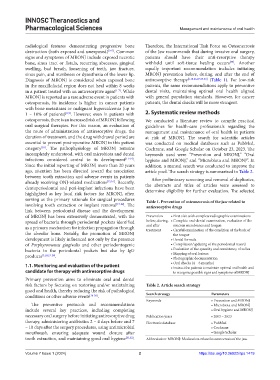
            serving as the primary rationale for surgical procedures   Table 1. Prevention of osteonecrosis of the jaw related to
            involving  tooth  extraction  or  implant  removal [17-22] .  The   antiresorptive drugs
            link between periodontal disease and the development
            of MRONJ has been extensively demonstrated, with the   Prevention   • First visit with complete radiographic examinations
            spread of bacteria through periodontal pockets identified   before, during,  •  Complete oral‑dental examination, evaluation of the
                                                                           mucous membranes and tongue
            as a primary mechanism for infection propagation through   and after   •  Careful examination of the condition of the back of
                                                               treatment
            the  alveolar  bone.  Notably,  the  promotion  of  MRONJ      the tongue
            development is likely influenced not only by the presence     • Dental formula
            of  Porphyromonas  gingivalis and other periodontogenic       • Compilation/updating of the periodontal record
            bacteria in the periodontal pockets but also by IgG           • Evaluation of the quantity and consistency of saliva
            products [3,18,23-26] .                                       • Mapping of oral lesions
                                                                          • Photographic documentation
                                                                          • Oral checks (4 – 6 months)
            1.1. Monitoring and evaluation of the patient                 •  Instruct the patients to maintain optimal oral health and
            candidate for therapy with antiresorptive drugs                to recognize possible signs and symptoms of MRONJ
            Primary prevention aims to eliminate oral and dental
            risk factors by focusing on restoring and/or maintaining   Table 2. Article search strategy
            good oral health, thereby reducing the risk of pathological
            conditions or other adverse events [26-30] .       Search strategy             Parameters
                                                               Keywords                    • Prevention and MRONJ
              The preventive protocols and recommendations                                 • Microbiota and MRONJ
            include several key practices, including completing                            • Oral hygiene and MRONJ
            necessary oral surgery before initiating antiresorptive drug   Publication years  • 2003 – 2023
            therapy, administering antibiotics 2 – 4 days before and 7   Electronic database  • PubMed
            – 10 days after the surgery procedures, using antimicrobial                    • Cochrane
            mouthwash, ensuring adequate wound closure after                               • Google Scholar
            tooth extraction, and maintaining good oral hygiene [31,32] .   Abbreviation: MRONJ: Medication-related osteonecrosis of the jaw.


            Volume 7 Issue 1 (2024)                         2                         https://doi.org/10.36922/itps.1419

