


Page 16 - ITPS-7-4
P. 16
INNOSC Theranostics and
            Pharmacological Sciences                                                  Neurobiology of gaming disorder


            of  diseases  were  guided  by  epidemiologic,  clinical,  and   purpose of Internet use has been explicitly identified as
            neurobiological studies, which reflect growing scientific   gaming. In such cases, the term “GD,” instead of the term
            evidence about the similarities of GD with substance-  “Internet addiction,” is used to describe research results
            related and other addictive disorders.  Initially, GD was   on Internet addiction. In addition, this review excludes
                                           5,6
            considered a subtype of Internet addiction, but a review of   studies focusing on GD with comorbid conditions. Table 1
            the scientific literature on gaming revealed that excessive   provides brief explanations for the technical terms related
            gaming tends to be distinct and more likely to lead to   to brain imaging techniques.
            serious  consequences  independently.  Furthermore,
                                            7-9
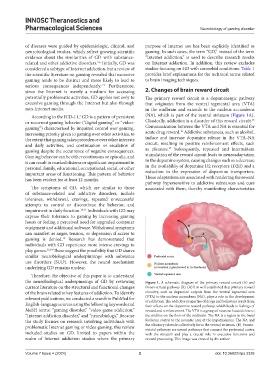
            since the Internet is merely a medium for accessing   2. Changes of brain reward circuit
            potentially problematic activities, GD applies not only to   The primary reward circuit is a dopaminergic pathway
            excessive gaming through the Internet but also through   that originates from the ventral tegmental area (VTA)
            non-Internet media.                                in the midbrain and extends to the nucleus accumbens
              According to the ICD-11,  GD is a pattern of persistent   (NA), which is part of the ventral striatum (Figure 1A).
                                   4
                                                                                                            15
            or recurrent gaming behavior (“digital gaming” or “video-  Classically, addiction is a disorder of this reward circuit.
            gaming”) characterized by impaired control over gaming,   Communication between the VTA and NA is essential for
                                                                              16
            increasing priority given to gaming over other activities, to   acute drug reward.  Addictive substances, such as alcohol,
            the extent that gaming takes precedence over other interests   induce and increase dopamine release in the VTA–NA
            and  daily  activities,  and  continuation  or  escalation  of   circuit,  resulting in positive reinforcement  effects,  such
                                                                         15
            gaming despite the occurrence of negative consequences.   as  pleasure.   Subsequently, repeated  and  intermittent
            Gaming behavior can be either continuous or episodic, and   stimulation of the reward circuit leads to neuroadaptation
            it can result in marked distress or significant impairment in   in the dopamine system, causing changes such as a decrease
            personal, family, educational, occupational, social, or other   in the availability of dopamine D2 receptors (D2R) and a
            important areas of functioning. This pattern of behavior   reduction in the expression of dopamine transporters.
            has been evident for at least 12 months.           These adaptations are associated with rendering the reward
                                                               pathway hypersensitive to addictive substances and cues
              The symptoms of GD, which are similar to those   associated with them, thereby manifesting characteristics
            of  substance-related  and  addictive  disorders,  include
            tolerance, withdrawal, cravings, repeated unsuccessful
            attempts to control or discontinue the behavior, and
            impairment in daily function. 10,11  Individuals with GD may
            express their tolerance to gaming by increasing gaming
            hours or feeling a perceived need for upgraded computer
            equipment and additional software. Withdrawal symptoms
            can manifest as anger, tension, or depression if access to
                            12
            gaming is denied.  Research has demonstrated that
            individuals with GD experience more intense cravings to
            play games. 13,14  These suggest the possibility that GD shares
            similar neurobiological underpinnings with substance
            use disorders (SUD). However, the neural mechanism
            underlying GD remains unclear.
              Therefore, the objective of this paper is to understand
            the neurobiological underpinnings of GD by reviewing   Figure 1. A schematic diagram of the primary reward circuit (A) and
            current literature on the structural and functional changes   fronto-striatal pathway (B). (A) It is well established that primary reward
            of the brain related to key features of addiction. To identify   circuitry, such as dopamine outputs from the ventral tegmental area
            relevant publications, we conducted a search in PubMed for   (VTA) to the nucleus accumbens (NA), plays a role in the development
                                                               of addiction. The addictive properties of drugs and behaviors result from
            English-language sources using the following keywords and   their effects on the dopamine reward pathway, which leads to feelings of
            MeSH terms: “gaming disorder,” “video game addiction,”   reward and reinforcement. The VTA is a group of neurons located close to
            “Internet addiction disorder,” and “neurobiology.” Because   the midline on the floor of the midbrain. The NA is a region in the basal
            the study focuses on research involving individuals with   forebrain rostral to the preoptic area of the hypothalamus. The NA and
            problematic Internet gaming or video gaming, this review   the olfactory tubercle collectively form the ventral striatum. (B)  Fronto-
                                                               striatal pathways are neural pathways that connect the prefrontal cortex
            included studies on GD, limited to papers within the   with the striatum and play a crucial role in executive functions and
            realm of Internet addiction studies where the primary   reward processing. This image was created by the author.


            Volume 7 Issue 4 (2024)                         2                                doi: 10.36922/itps.3326

