


Page 37 - JCAU-5-2
P. 37
Journal of Chinese
            Architecture and Urbanism                                   Industrial space renewal in Hong Kong and Shanghai


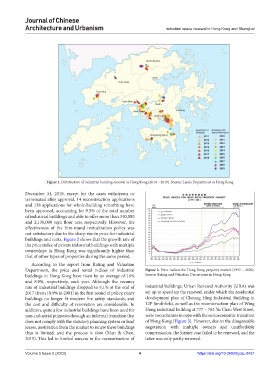
                     Figure 1. Distribution of industrial building renewal in Hong Kong (2010 – 2019). Source: Lands Department in Hong Kong

            December 31, 2019, except for the cases withdrawn or
            terminated after approval, 14 reconstruction applications
            and 138 applications for whole-building retrofitting have
            been approved, accounting for 9.5% of the total number
            of industrial buildings and able to offer more than 340,000
            and  2,130,000  sqm  floor  area  respectively.  However,  the
            effectiveness of the first-round revitalization policy was
            not satisfactory due to the sharp rise in price for industrial
            buildings and rents. Figure 2 shows that the growth rate of
            the price index of private industrial buildings with multiple
            ownerships in Hong Kong was significantly higher than
            that of other types of properties during the same period.
              According to the report from Rating and Valuation
            Department, the price and rental indices of industrial   Figure 2. Price indices for Hong Kong property market (1997 – 2020).
            buildings in Hong Kong have risen by an average of 16%   Source: Rating and Valuation Department in Hong Kong
            and  8.9%,  respectively,  each  year.  Although  the  vacancy
            rate of industrial buildings dropped to 6.1% at the end of   industrial buildings. Urban Renewal Authority (URA) was
            2017 (from 10.9% in 2001) in the first round of policy, many   set up to speed up the renewal, under which the residential
            buildings  no  longer fit modern  fire safety  standards,  and   development plan of Cheung Hing Industrial Building in
            the cost and difficulty of renovation are considerable. In   12P Smithfield, as well as the reconstruction plan of Wing
            addition, quite a few industrial buildings have been used for   Hong industrial building at 777 – 783 Yu Chau West Street,
            non-industrial purposes through an informal transition that   were two schemes to cope with the socioeconomic transition
            does not comply with the statutory planning system or land   of Hong Kong (Figure 3). However, due to the disagreeable
            leases, motivation from the market to renew these buildings   negotiation with multiple owners and unaffordable
            thus is limited, and the process is slow (Xian & Chen,   compensation, the former case failed to be renewed, and the
            2015). This led to limited success in the reconstruction of   latter was only partly renewed.


            Volume 5 Issue 2 (2023)                         4                        https://doi.org/10.36922/jcau.0431

