


Page 38 - JCAU-5-2
P. 38
Journal of Chinese
            Architecture and Urbanism                                   Industrial space renewal in Hong Kong and Shanghai


              The Hong Kong SAR government announced to restart
            the  “Industrial  Building  Revitalization” plan in October
            2018, in its Chief Executive’s 2018 Policy Address based on
            the review of the effectiveness of the first round of policies,
            known as “Industrial Building Revitalization Policy 2.0.”
            The policy aims to stabilize the price of industrial buildings
            and to improve market motivation for renewal. The second
            round of measures relaxed the rate of increase in the floor
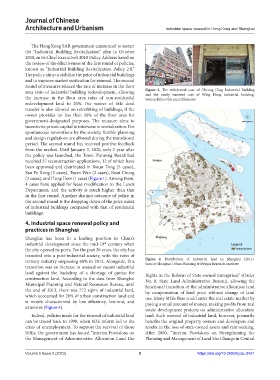
            area ratio of industrial building redevelopment, allowing   Figure  3.  The withdrawal case of Cheung Hing Industrial Building
                                                               and the partly renewed case of Wing Hong industrial building.
            the increase in the floor area ratio of non-residential   Source: https://hk.on.cc/hk/news/
            redevelopment land to 20%. Fee waiver of title deed
            transfer is also allowed on retrofitting of buildings, if the
            owner provides no less than 10% of the floor area for
            government-designated purposes. The measure aims to
            incentivize private capital to intervene in revitalization. For
            spontaneous renovations by the society, flexible planning
            and design regulations are allowed during the transitional
            period. The second round has received positive feedback
            from the market. Until January 3, 2020, only 1 year after
            the policy was launched, the Town Planning Board had
            received 37 reconstruction applications, 12 of which have
            been approved and distributed in Kwun Tong (5  cases),
            San Po Kong (2 cases), Tsuen Wan (2 cases), Kwai Chung
            (2 cases), and Hung Hom (1 case) (Figure 1). Among them,
            4 cases have applied for lease modification to the Lands
            Department, and the activity is much higher than that
            in the first round. Another distinct outcome of policy in
            the second round is the dropping down of the price index
            of industrial buildings compared with that of residential
            buildings.
            4. Industrial space renewal policy and
            practices in Shanghai
            Shanghai  has been  in a  leading position  in  China’s
            industrial development since the mid-19  century when
                                             th
            the city opened its ports. For the past 30 years, the city has
            transited into a post-industrial society, with the ratio of
            tertiary industry surpassing 60% in 2012. Alongside, this   Figure  4.  Distribution of industrial land in Shanghai (2011).
                                                               Source: Shanghai Urban Planning & Design Research Institute
            transition was an increase in unused or vacant industrial
            land  against  the  backdrop  of  a  shortage  of  quotas  for   Rights in the Reform of State-owned Enterprises” (Order
            construction land. According to the data from Shanghai   No.  8,  State  Land  Administrative  Bureau),  allowing  the
            Municipal Planning and Natural Resources Bureau, until   functional transition of the administrative allocation land
            the end of 2013, there was 772 sqkm of industrial land,   by compensation of land price without change of land
            which accounted for 26% of urban construction land and   use. Many SOEs thus could enter the real estate market by
            is  mostly  characterized  by  low  efficiency,  low-end,  and   paying a small amount of money, making profits from real
            extensive (Figure 4).                              estate development projects on administrative allocation
              Indeed, policies made for the renewal of industrial land   land. Such renewal of industrial land, however, primarily
            can be traced back to 1998, when SOE reform led to the   benefits the original property owners and developers and
            crisis of unemployment. To support the survival of those   results in the loss of state-owned assets and rent-seeking.
            SOEs, the government has issued “Interim Provisions on   After  2000,  “Interim  Provisions  on Strengthening  the
            the Management of Administrative Allocation Land Use   Planning and Management of Land Use Change in Central


            Volume 5 Issue 2 (2023)                         5                        https://doi.org/10.36922/jcau.0431

