


Page 111 - JCAU-6-2
P. 111
Journal of Chinese
            Architecture and Urbanism                                           Development protection of ethnic villages


            consultations,  we  formulated  a  targeted  classification   the Baodian Temple. These newer constructions exhibited
            and renovation scheme for the first batch of renovated   chaotic architectural features and adhered to different
            buildings. Our study also involved devising strategies   construction standards, making it difficult to reflect the
            conducive to cultural inheritance, heritage preservation,   living habits and cultural customs of the local residents. The
            and  village  regeneration  in  the  area.  Throughout  the   construction of resettlement houses prioritized the rapid
            renovation design process, we ensured the feasibility of   resettlement of residents, leading to an original planning
            renovation projects during the renovation design process.   approach that failed to reflect the features of the Tibetan
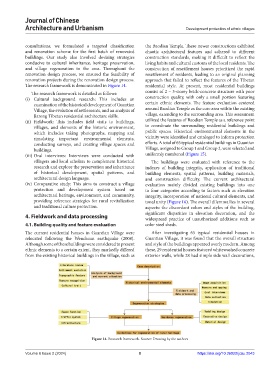
            The research framework is demonstrated in Figure 14.  residential style. At present, most residential buildings
              The research framework is detailed as follows:   consist of 2 – 3-storey brick-concrete structure with poor
            (i)  Cultural background research: This includes an   construction quality, with only a small portion featuring
               examination of the historical development of Guantian   certain ethnic elements. The feature evaluation centered
               Village, the evolution of settlements, and an analysis of   around Baodian Temple as the core area within the existing
               Jiarong Tibetan residential architecture skills.  village, extending to the surrounding area. This assessment
            (ii)  Fieldwork:  This  includes  field  visits  to  buildings,   utilized the features of Baodian Temple as a reference point
               villages, and elements of the historic environment,   to coordinate  the surrounding  residential  buildings and
               which includes taking photographs, mapping and   public spaces. Historical environmental elements in the
               simulating  important  environmental  elements,   vicinity were identified and cataloged to inform protection
               conducting surveys, and creating village spaces and   efforts. A total of 65 typical residential buildings in Guantian
               buildings.                                      Village, assigned to Group 1 and Group 2, were selected and
            (iii) Oral interviews: Interviews were conducted with   uniformly numbered (Figure 15).
               villagers and local scholars to complement historical   The buildings were evaluated with reference to the
               research and explore the preservation and inheritance   indexes of building integrity, application of traditional
               of historical development, spatial patterns, and   building elements, spatial patterns, building materials,
               architectural design language.                  and construction difficulty. The current architectural
            (iv)  Comparative study: This aims to construct a village   evaluation mainly divided existing buildings into one
               protection and development system based on      to four categories according to factors such as elevation
               architectural heritage, environment, and community,   integrity, incorporation of national cultural elements, and
               providing reference strategies for rural revitalization   tonal unity (Figure 16). The overall dilemma lies in several
               and traditional culture protection.             aspects: the discordant colors and styles of the building,
                                                               significant disparities in elevation decoration, and the
            4. Fieldwork and data processing                   widespread practice of unauthorized additions such as
            4.1. Building quality and feature evaluation       color steel sheds.
            The current residential houses in Guantian Village were   After investigating 65 typical residential houses in
            relocated following the Wenchuan earthquake (2008).   Guantian Village, it was found that the overall structure
            Although some of these buildings were considered to present   and style of the buildings appeared overly modern. Among
            ethnic elements to a certain extent, they markedly differed   these, 29 residential houses featured whitewashed concrete
            from the existing historical buildings in the village, such as   exterior walls, while 28 had simple side wall decorations,


                                        Figure 14. Research framework. Source: Drawing by the authors


            Volume 6 Issue 2 (2024)                         8                        https://doi.org/10.36922/jcau.2043

