


Page 90 - JCAU-6-2
P. 90
Journal of Chinese
            Architecture and Urbanism                                             Residential urban heritage space study


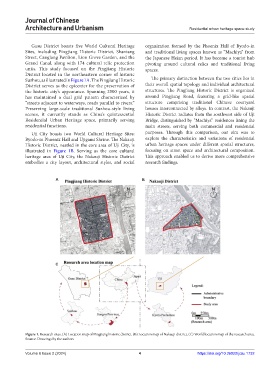
              Gusu District boasts five World Cultural Heritage   organization formed by the Phoenix Hall of Byodo-in
            Sites, including Pingjiang Historic District, Shantang   and traditional living spaces known as “Machiya” from
            Street, Canglang Pavilion, Lion Grove Garden, and the   the Japanese Heian period. It has become a tourist hub
            Grand  Canal,  along  with  174  cultural  relic  protection   pivoting around cultural relics  and traditional  living
            units. This study focused on the Pingjiang Historic   spaces.
            District located in the northeastern corner of historic
            Suzhou, as illustrated in Figure 1A. The Pingjiang Historic   The primary distinction between the two cities lies in
            District serves as the epicenter for the preservation of   their overall spatial topology and individual architectural
            the historic city’s appearance. Spanning 2500  years, it   structures. The Pingjiang Historic District is organized
            has maintained a dual grid pattern characterized by   around Pingjiang Road, featuring a grid-like spatial
            “streets adjacent to waterways, roads parallel to rivers.”   structure comprising traditional Chinese courtyard
            Preserving large-scale traditional Suzhou-style living   houses interconnected by alleys. In contrast, the Nakauji
            scenes, it currently stands as China’s quintessential   Historic District radiates from the southwest side of Uji
            Residential Urban Heritage space, primarily serving   Bridge, distinguished by “Machiya” residences lining the
            residential functions.                             main streets, serving  both commercial and  residential

              Uji City boasts two World Cultural Heritage Sites:   purposes. Through this comparison, our aim was to
            Byodo-in Phoenix Hall and Ujigami Shrine. The Nakauji   explore  the  characteristics  and  variations  of residential
            Historic District, nestled in the core area of Uji City, is   urban heritage spaces under different spatial structures,
            illustrated in  Figure  1B. Serving as the core cultural   focusing on street space and architectural composition.
            heritage area of Uji City, the Nakauji Historic District   This approach enabled us to derive more comprehensive
            embodies a city layout, architectural styles, and social   research findings.


                         A                                   B


                         C


            Figure 1. Research sites. (A) Location map of Pingjiang historic district. (B) Location map of Nakauji district. (C) World location map of the research area.
            Source: Drawings by the authors


            Volume 6 Issue 2 (2024)                         4                        https://doi.org/10.36922/jcau.1732

