


Page 136 - JCAU-7-1
P. 136
Journal of Chinese
            Architecture and Urbanism                                             Development of the Thirteen Factories


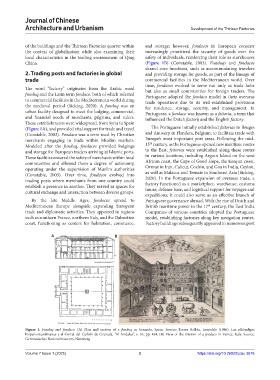
            of the buildings and the Thirteen Factories quarter within   and storage; however,  fondacos in European contexts
            the  context  of  globalization  while  also  examining  their   increasingly prioritized the security of goods over the
            local characteristics in the trading environment of Qing   safety of individuals, reinforcing their role as storehouses
            China.                                             (Figure  1B) (Constable, 2003).  Funduqs and  fondacos
                                                               shared core functions, such as accommodating travelers
            2. Trading posts and factories in global           and providing storage for goods, as part of the lineage of
            trade                                              commercial facilities in the Mediterranean world. Over
                                                               time,  fondacos  evolved  to  serve  not  only  as  trade  hubs
            The  word  “factory”  originates  from  the  Arabic  word   but also as small communities for foreign traders. The
            funduq and the Latin term fondaco, both of which referred   Portuguese adopted the fondaco model in their overseas
            to commercial facilities in the Mediterranean world during   trade operations due to its well-established provisions
            the medieval period (Sicking, 2020). A  funduq was an   for residence, storage, security, and management. In
            urban facility designed to meet the lodging, commercial,   Portuguese, a fondaco was known as a feitoria, a term that
            and financial needs of merchants, pilgrims, and rulers.   influenced the Dutch factorij and the English factory.
            These establishments were widespread, from Syria to Spain
            (Figure 1A), and provided vital support for trade and travel   The Portuguese initially established feitorias in Bruges
            (Constable, 2003). Fondaco was a term used by Christian   and Antwerp in Flanders, Belgium, to facilitate trade with
            merchants engaging in trade within Muslim markets.   Europe’s most important port areas. Following the mid-
                                                                 th
            Modeled after the  funduq,  fondacos provided lodgings   15  century, as the Portuguese opened new maritime routes
            and storage for European traders arriving at Islamic ports.   to the East,  feitorias were established along these routes
            These facilities ensured the safety of merchants within local   in various locations, including Arguin Island on the west
            communities and allowed them a degree of autonomy,   African coast, the Cape of Good Hope, the Kenyan coast,
            operating under the supervision of Muslim authorities   Ormuz in Iran, Calicut, Cochin, and Goa in India, Ceylon,
            (Constable, 2003). Over time,  fondacos evolved into   as well as Malacca and Ternate in Southeast Asia (Sicking,
            trading posts where merchants from one country could   2020). In the Portuguese expansion of overseas trade, a
            establish a presence in another. They served as spaces for   factory functioned as a marketplace, warehouse, customs
            cultural exchange and interaction between diverse groups.  house, defense base, and logistical support for voyages and
                                                               expeditions; it could also serve as an effective branch of
              By the late Middle Ages,  fondacos spread to     Portuguese governance abroad. With the rise of Dutch and
            Mediterranean Europe alongside expanding European   British maritime power in the 17  century, the East India
                                                                                          th
            trade and diplomatic activities. They appeared in regions   Companies of various countries adopted the Portuguese
            such as southern France, northern Italy, and the Dalmatian   model, establishing factories along key navigation routes.
            coast, functioning as centers for habitation, commerce,   Factory buildings subsequently appeared in numerous port


                       A                          B


            Figure  1.  Funduq  and  fondaco. (A) Plan and section of a  funduq in Granada, Spain. Source: Torres Balbás, Leopoldo (1946). Las alhóndigas
            hispanomusulmanas y el Corral del Carbón de Granada. “Al-Andalus”, v. XI; pp. 464. (B) View of the interior of a fondaco in Venice, Italy. Source:
            Germanisches Nationalmuseum, Nürnberg


            Volume 7 Issue 1 (2025)                         3                        https://doi.org/10.36922/jcau.3676

