


Page 56 - JCAU-7-1
P. 56
Journal of Chinese
            Architecture and Urbanism                                          Tourist perception of calligraphic landscape


            Table 1. Frequently used words in web texts about   Table 1. (Continued)
            calligraphic landscape perception
                                                               High-frequency words     Time         TF-IDF
            High-frequency words    Time          TF-IDF       Location                  41         0.001255745
            Calligraphy              506         0.002025134   Theme                     41         0.00132827
            Scenic area              332         0.004595631   Famous                    39         0.001148361
            History                  206         0.002921228   Period                    39         0.001148361
            Check-in                 194         0.00288783    Space                     38         0.001586702
            Culture                  190         0.002828287   Square                    38         0.001249443
            Shaoxing                 175         0.004679413   Old street                36         0.001379534
            Museum                   171         0.003161618   City wall                 35         0.001341213
            China                    164         0.003032195
            Xi’an                    163         0.004460368   such locations serves to construct personal memories,
            Hometown                 160         0.004483359   reproduce local collective memory, reinforce self-identity,
            Architecture             144         0.002882468   and  build  collective identity (Shao &  Wang,  2023).  The
            Art                      129         0.002536326   ultra-popularity of heritage tourism destinations reflects
            Take photos              125         0.002291242   the re-explosion of the long-term accumulation and
                                                               inheritance of urban historical memory and traditional
            Park                     106         0.002597746   culture. The act of “punching cards” digitally embodies a
            Place                    104         0.001811155   sense of place.
            Former residence          99         0.002559754
            Atmosphere                98         0.001876285   4.2. Calligraphic landscape perception semantic
            Wang xizhi                94         0.002327978   network
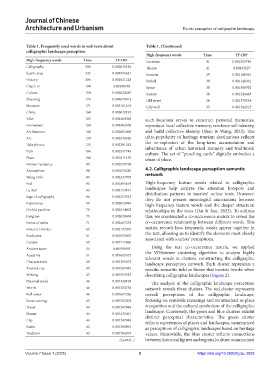
            Feel                      93         0.001895619   High-frequency  feature  words  related  to  calligraphic
            Lu Xun                    93         0.003153161   landscapes help analyze  the  attention hotspots  and
                                                               distribution patterns in tourists’ online texts. However,
            Sage of calligraphy       86         0.002353323   they do not present meaningful associations between
            Experience                80         0.002023944   high-frequency feature words and the deeper structural
            Orchid pavilion           79         0.002914802   relationships in the texts (Dai & Xue, 2022). To address
            Jiangnan                  75         0.002028604   this, we constructed a co-occurrence matrix to reveal the
            Forest of steles          71         0.002407252   co-occurrence relationship between different words. This
            Historic District         65         0.002137205   matrix records how frequently words appear together in
            Bookstore                 61         0.001976207   the text, allowing us to identify the elements most closely
                                                               associated with tourists’ perceptions.
            Garden                    59         0.001715366
            Ancient town              54         0.00195693      Using the text co-occurrence matrix, we applied
            Academy                   51         0.001605575   the VOSviewer clustering algorithm to analyze highly
                                                               relevant  words in  clusters,  constructing the  calligraphic
            Characteristic            49         0.001295472   landscape perception network. Each cluster represents a
            Ancient city              49         0.001587445   specific semantic field or theme that tourists invoke when
            Writing                   47         0.001593533   describing calligraphic landscapes (Figure 2).
            National trend            46         0.001428198     The analysis of the calligraphic landscape perception
            Worth                     46         0.001258754   network reveals three clusters. The red cluster represents
            Bell tower                46         0.001697226   overall perceptions of the calligraphic landscape,
            Stone carving             45         0.001502202   focusing on symbolic meanings and summarized as place
            Travel                    44         0.001247948   recognition and the cultural symbolism of the calligraphic
            Master                    44         0.001425461   landscape. Conversely, the green and blue clusters exhibit
                                                               distinct perceptual characteristics. The green cluster
            City                      44         0.001247948   reflects experiences of places and landscapes, summarized
            Ruins                     42         0.001380963   as perceptions of calligraphic landscapes based on heritage
            Tradition                 42         0.001286373   values. Meanwhile, the blue cluster reflects connections
                                                    (Cont'd...)   between historical figures and regional culture, summarized

            Volume 7 Issue 1 (2025)                         5                        https://doi.org/10.36922/jcau.3825

