


Page 126 - JCAU-7-2
P. 126
Journal of Chinese
            Architecture and Urbanism                                      Heritage tourism: Personal and collective factors


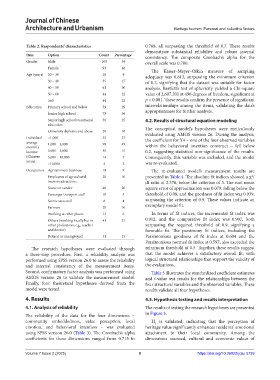
            Table 2. Respondents’ characteristics              0.768, all surpassing the threshold of 0.7. These results
                                                               demonstrate substantial reliability and robust internal
            Item     Option                Count  Percentage   consistency. The composite Cronbach’s alpha for the
            Gender   Male                   109      54        overall scale was 0.780.
                     Female                  93      46
                                                                 The Kaiser–Meyer–Olkin measure of sampling
            Age (years)  20 – 30             18      9         adequacy was 0.813, surpassing the minimum criterion
                     30 – 40                 35      17        of 0.7, signifying that the dataset was suitable for factor
                     40 – 50                 61      30        analysis. Bartlett’s test of sphericity yielded a Chi-square
                     50 – 60                 44      22        value of 2,607.201 at 496 degrees of freedom, significant at
                     ≥60                     44      22        p < 0.001. These results confirm the presence of significant
            Education  Primary school and below  59  29        interrelationships among the items, validating the data’s
                                                               appropriateness for further analysis.
                     Junior high school      73      36
                     Senior high school/vocational   50  25    4.2. Results of structural equation modeling
                     education
                     University diploma and above  20  10      The conceptual model’s hypotheses were meticulously
            Individual   <1,000              55      27        evaluated using AMOS version  26. During the analysis,
                                                               the coefficient for Y4 – one of the four observed variables
            average   1,000 – 3,000          99      49
            monthly                                            within  the  behavioral  intention  construct  –  fell  below
            income   3,001 – 5,000           30      15        0.2, suggesting  statistical non-significance  of the  results.
            (Chinese   5,001 – 10,000        14      7         Consequently, this variable was excluded, and the model
            yuan)
                     >10,000                 4       2         was re-evaluated.
            Occupation  Agritainment business  19    9           The re-evaluated model’s measurement results are
                     Employees of agricultural   20  10        presented in Table 4. The absolute fit indices showed a χ /
                                                                                                            2
                     tourism attractions                       df ratio of 2.376, below the criterion of 3. The root mean
                     Souvenir vendor         40      20        square error of approximation was 0.079, falling below the
                     Passenger transport staff  10   5         threshold of 0.08, and the goodness of fit index was 0.939,
                     Scenic area staff       8       4         surpassing the criterion of 0.9. These values indicate an
                     Farmers                 20      10        exemplary model fit.
                     Working at other places  13     6           In terms of fit indices, the incremental fit index was
                     Others (working locally but in   41  21   0.912, and the comparative fit index was 0.907, both
                     other professions, e.g., teacher          surpassing the required threshold of 0.9, signifying a
                     and doctor)                               favorable fit. The parsimony fit indices, including the
                     Retired or unemployed   31      15        Parsimonious goodness of fit index at 0.604 and the
                                                               Parsimonious normed fit index at 0.597, also exceeded the
              The research hypotheses were evaluated through   minimum threshold of 0.5. Together, these results suggest
            a three-step procedure. First, a reliability analysis was   that the model achieves a satisfactory overall fit, with
            performed using SPSS version 26.0 to assess the reliability   logical structural relationships that support the validity of
            and internal consistency of the measurement items.   the evaluations.
            Second, confirmatory factor analysis was performed using   Table 5 illustrates the standardized coefficient estimates
            AMOS  version  26  to  validate  the  measurement  model.   and t-value test results for the relationships between the
            Finally, four theoretical hypotheses derived from the   four structural variables and the observed variables. These
            model were tested.                                 results validate all four hypotheses.
            4. Results                                         4.3. Hypothesis testing and results interpretation

            4.1. Analysis of reliability                       The results of testing the research hypotheses are presented
            The reliability of the data for the four dimensions –   in Figure 3.
            community embeddedness, value perception, local      H  is validated, indicating that the perception of
                                                                   1
            emotion, and behavioral intention – was evaluated   heritage value significantly enhances residents’ emotional
            using SPSS version 26.0 (Table 3). The Cronbach’s alpha   attachment  to their  local community.  Among  the
            coefficients for these dimensions ranged from 0.715 to   dimensions assessed, cultural and economic values of


            Volume 7 Issue 2 (2025)                         8                        https://doi.org/10.36922/jcau.5739

