


Page 43 - JCBP-1-2
P. 43
Journal of Clinical and
            Basic Psychosomatics                                              Thyroid hormones and psychiatric disorders


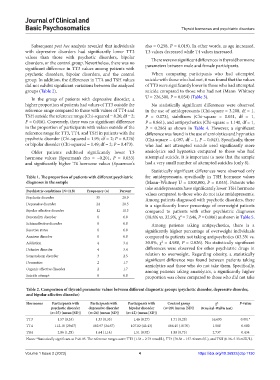
              Subsequent post hoc analysis revealed that individuals   rho = 0.258, P = 0.019). In other words, as age increased,
            with depressive disorders had significantly lower TT3   T3 values decreased while T4 values increased.
            values  than those with psychotic disorders, bipolar   There were no significant differences in thyroid hormone
            disorders, or the control group. Nevertheless, there was no   parameters between male and female participants.
            significant difference in TT3 values among patients with
            psychotic disorders, bipolar disorders, and the control   When  comparing  participants  who  had  attempted
            group. In addition, the differences in TT4 and TSH values   suicide with those who had not, it was found that the values
            did not exhibit significant variations between the analyzed   of TT3 were significantly lower in those who had attempted
            groups (Table 2).                                  suicide compared to those who had not (Mann–Whitney

              In the group of patients with depressive disorder, a   U = 226,500, P = 0.034) (Table 3).
            higher proportion of patients had values of TT3 outside the   No statistically significant differences were observed
            reference range compared to those with values of TT4 and   in the use of antidepressants (Chi-square = 3.208, df = 1,
            TSH outside the reference range (Chi-squared = 8.26; df = 2;   P  =  0.073), stabilizers (Chi-square = 0.031, df = 1,
            P = 0.016). Conversely, there was no significant difference   P = 0.861), and antipsychotics (Chi-square = 1.140, df = 1,
            in the proportion of participants with values outside of the   P  = 0.286) as shown in  Table 4. However, a significant
            reference range for TT3, TT4, and TSH in patients with the   difference was found in the use of anxiolytics and hypnotics
            psychotic disorder (Chi-squared = 1.95; df = 2; P = 0.376)   (Chi-square = 4.097, df = 1, P = 0.043). Specifically, those
            or bipolar disorder (Chi-squared = 1.49; df = 2; P = 0.473).  who had not attempted suicide used significantly more
              Older patients exhibited significantly lower T3   anxiolytics and hypnotics compared to those who had
            hormone values (Spearman’s rho = −0.201,  P  = 0.033)   attempted suicide. It is important to note that the sample
            and significantly higher T4 hormone values (Spearman’s   had a very small number of attempted suicides (only 8).
                                                                 Statistically significant differences were observed only
            Table 1. The proportion of patients with different psychiatric   for antidepressants, specifically in TSH hormone values
            diagnoses in the sample                            (Mann–Whitney U = 1300,000, P = 0.035). Patients who
                                                               take antidepressants have significantly lower TSH hormone
            Psychiatric conditions (N=118)  Frequency (n)  Percent  values compared to those who do not take antidepressants.
            Psychotic disorder            35         29.9      Among patients diagnosed with psychotic disorders, there
            Depressive disorder           24         20.5      is a significantly lower percentage of overweight patients
            Bipolar affective disorder    12         10.3      compared to patients with other psychiatric diagnoses
                                                                              2
            Personality disorder          8          6.8       (18.8% vs. 32.9%, χ  = 7.646, P = 0.006) as shown in Table 5.
            Schizoaffective disorder      8          6.8         Among patients taking antipsychotics, there is a
            Reactive states               8          6.8       significantly higher percentage of overweight individuals
            Anxious disorder              8          6.8       compared to patients not taking antipsychotics (63.3% vs.
                                                                      2
            Addiction                     4          3.4       30.8%, χ  = 4.988, P = 0.026). No statistically significant
            Delusive disorder             4          3.4       differences were observed for other psychiatric drugs in
            Somatoform disorder           3          2.5       relation to overweight. Regarding obesity, a statistically
            Dementias                     2          1.7       significant difference was found between patients taking
                                                               anxiolytics and those who do not take them. Specifically,
            Organic affective disorder    2          1.7       among patients  taking  anxiolytics,  a significantly higher
            Suicide attempt               8          6.8       proportion was obese compared to those who did not take


            Table 2. Comparison of thyroid parameter values between different diagnostic groups (psychotic disorder, depressive disorder,
            and bipolar affective disorder)
            Hormones   Participants with   Participants with   Participants with   Control group   χ   2  P‑value
                       psychotic disorder   depressive disorder   bipolar disorder   (n=20) (mean [SD])  (Kruskal‑Wallis test)
                      (n=35) (mean [SD])  (n=24) (mean [SD])  (n=12) (mean [SD])
            TT3           1.57 (0.35)     1.33 (0.33)     1.46 (0.27)     1.71 (0.28)      16.693      0.001*
            TT4         112.18 (29.67)   102.97 (24.67)  107.82 (42.43)  106.45 (18.70)    1.508        0.680
            TSH           2.06 (1.28)     1.64 (1.14)     1.51 (0.92)     1.80 (0.75)      2.737        0.434
            Notes: *Statistically significant at P≤0.05. The reference ranges were: TT3 (1.34 – 2.73 nmol/L), TT4 (78.38 – 157.40 nmol/L), and TSH (0.38–5.33 mIU/L).


            Volume 1 Issue 2 (2023)                         4                        https://doi.org/10.36922/jcbp.1130

