


Page 44 - JCBP-1-2
P. 44
Journal of Clinical and
            Basic Psychosomatics                                              Thyroid hormones and psychiatric disorders


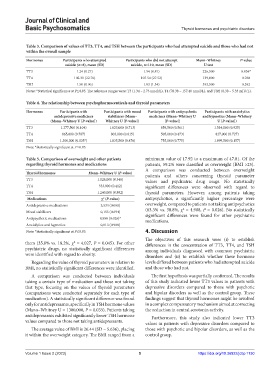
            Table 3. Comparison of values of TT3, TT4, and TSH between the participants who had attempted suicide and those who had not
            within the overall sample
            Hormones        Participants who attempted   Participants who did not attempt   Mann–Whitney   P‑value
                             suicide (n=8), mean (SD)    suicide, n=110, mean (SD)      U test
            TT3                   1.24 (0.27)                 1.54 (0.81)              226,500          0.034*
            TT4                  102.31 (22.76)              107.54 (27.52)            139,000          0.760
            TSH                   1.50 (0.96)                 1.93 (1.34)              353,500          0.392
            Notes: *Statistical significance at P≤0.05. The reference ranges were: T3 (1.34 – 2.73 nmol/L), T4 (78.38 – 157.40 nmol/L), and TSH (0.38 – 5.33 mIU/L).
            Table 4. The relationship between psychopharmaceuticals and thyroid parameters

            Hormones       Participants with   Participants with mood   Participants with antipsychotic   Participants with anxiolytics
                        antidepressive medicines   stabilizers (Mann–  medicines (Mann–Whitney U   and hypnotics (Mann–Whitney
                      (Mann–Whitney U [P‑value])  Whitney U [P‑value])  [P‑value])            U [P‑value])
            TT3            1.277,500 (0.104)    1.623,000 (0.713)    659,500 (0.561)        1.534,000 (0.925)
            TT4            865,000 (0.787)      803,000 (0.815)      505,000 (0.473)         827,000 (0.727)
            TSH            1.300,000 (0.035*)   1.835,500 (0.476)    755,000 (0.775)        1.899,500 (0.157)
            Note: *Statistically significant at P≤0.05.


            Table 5. Comparison of overweight and other patients   minimum value of 17.92 to a maximum of 47.81. Of the
            regarding thyroid hormones and medications         patients, 59.2% were classified as overweight (BMI >25).
                                                               A  comparison was conducted between overweight
            Thyroid hormones           Mann–Whitney U (P‑value)  patients and others concerning thyroid parameter
            TT3                           1.026,000 (0.348)    values and psychiatric drug usage. No statistically
            TT4                            553,000 (0.412)     significant differences were  observed with  regard  to
            TSH                           1.240,000 (0.892)    thyroid  parameters.  However,  among  patients  taking
             Medications                    χ  (P‑value)       antipsychotics, a significantly higher percentage were
                                             2
            Antidepressive medications      3,534 (0.060)      overweight, compared to patients not taking antipsychotics
                                                                               2
            Mood stabilizers                0,155 (0.694)      (63.3% vs. 30.8%, χ  = 4.988, P = 0.026). No statistically
                                                               significant differences were found for other psychiatric
            Antipsychotic medications      4,988 (0.026)*      medications.
            Anxiolytics and hypnotics       0,013 (0.908)
            Note: *Statistically significant at P≤0.05.        4. Discussion
                                                               The objectives of this research were (i) to establish
            them (35.8% vs. 18.2%, χ  = 4.027, P = 0.045). For other   differences in the concentration of TT3, TT4, and TSH
                                2
            psychiatric drugs, no statistically significant differences   among  individuals  diagnosed  with  common  psychiatric
            were identified with regard to obesity.            disorders and (ii) to establish whether these hormone
              Regarding the value of thyroid parameters in relation to   levels differed between patients who had attempted suicide
            BMI, no statistically significant differences were identified.  and those who had not.
              A  comparison  was  conducted  between  individuals   The first hypothesis was partially confirmed. The results
            taking a certain type of medication and those not taking   of this study indicated lower TT3 values in patients with
            that type, focusing on the values of thyroid parameters   depressive  disorders  compared to  those  with psychotic
            (comparisons were conducted separately for each type of   and bipolar disorders as well as the control group. These
            medication). A statistically significant difference was found   findings suggest that thyroid hormones might be involved
            only for antidepressants, specifically in TSH hormone values   in a complex compensatory mechanism aimed at correcting
            (Mann–Whitney U = 1300,000, P = 0.035). Patients taking   the reduction in central serotonin activity.
            antidepressants exhibited significantly lower TSH hormone   Furthermore, this study also indicated lower TT3
            values compared to those not taking antidepressants.  values in patients with depressive disorders compared to

              The average value of BMI is 26.44 (SD = 5.636), placing   those with psychotic and bipolar disorders, as well as the
            it within the overweight category. The BMI ranged from a   control group.


            Volume 1 Issue 2 (2023)                         5                        https://doi.org/10.36922/jcbp.1130

