


Page 18 - JCBP-2-2
P. 18
Journal of Clinical and
            Basic Psychosomatics                                                   Allostatic overload in the medically ill


            while sociodemographic variables, DSM-5 and DCPR-R   DCPR-R AO were more likely to receive psychotherapy,
            diagnoses, were included in the model if they reached the   at least once in life (Table 2), and had significantly higher
            statistically significance threshold in the binary regressions.   rates of at least one DSM-5 diagnosis, with reference to
            Sex and age were entered in the model as covariates. The   major depressive episode or major depressive disorder
            coefficient of determination R-squared was calculated as a   and panic disorder. Similarly, DCPR-R diagnoses were
            goodness-of-fit measure. 31,30  Multicollinearity was deemed   more represented among subjects with AO, with particular
            not to be problematic for the dataset since the tolerance   reference to DCPR-R illness behavior diagnoses (which
            index ranged from 0.93 to 0.96 and variable inflation   include: a. health anxiety: with AO n = 9, 2.68% vs. without
            factors ranged from 1.01 to 1.07. 30               AO n = 9, 8.65%; b. disease phobia: with AO n = 3, 0.89% vs.

              The two-sided significance level was set at p < 0.05. The   n = 3, 2.88%; c. hypochondriasis: with AO n = 3, 0.89% vs.
            Statistical Package for the Social Sciences (Version 20.0)   without AO n = 4, 3.84%; d. thanatophobia: with AO n = 3,
            was used in the analyses.                          0.89% vs. without AO n = 1, 0.96%; e. illness denial: with
                                                               AO n = 9, 2.68% vs. without AO n = 8, 7.69%; f. persistent
            3. Results                                         somatization: with AO n = 15, 4.47% vs. without AO n = 8,
                                                               7.69%; g. conversion symptoms: with AO n = 3, 0.89% vs.
              Four hundred and thirty-nine patients were       without  AO n  =  5,  4.80%;  h.  anniversary  reaction:  with
            enrolled. At the time of the study, the subjects were aged   AO n = 7, 2.08% vs. without AO n = 8, 7.69%), DCPR-R
            51.26 ± 15.07 years (Levene’s test for age: 0.16, P = 0.682).   psychological manifestations (which include: a. secondary
            Most of the subjects were females (n = 361, 82.23%), married   somatic symptoms: with AO n = 2, 0.59% vs. without AO
            (n = 287, 65.37%), employed (n = 260, 59.22%), and had high   n = 0; b. irritable mood: with AO n = 17, 2.07% vs. without
            school education (n = 211, 48.06%). A total of 39 subjects   AO n = 15, 14.42%), DCPR-R demoralization, and DCPR-R
            (8.88%) had a diagnosis of blood cancer, 200 (45.55%) had   Type A behavior (Table 3).
            a diagnosis of systemic sclerosis, and 200 (45.55%) had a
            diagnosis of migraine. Among them, a total of 104 (23.69%)   Based on the multiple logistic regression analysis, females
            subjects had a diagnosis of DCPR-R AO, which was   and unmarried subjects were more likely to face DCPR-R
            distributed among  the three  clinical  populations  without   AO. They were also at higher risk of satisfying a DSM-5
            statistically significant difference (Table  1). Comparing   diagnosis of major depressive episode or major depressive
            subjects with or without DCPR-R AO, no difference was   disorder and at higher risk of presenting DCPR-R diagnoses
            found for age (49.12 ± 14.55 versus 51.93 ± 15.18 years, t    in the cluster of illness behavior and demoralization
                                                        (df)
                                                                            2
            = 1.66 (437) , P = 0.096, d = −0.188). Females were distributed   (x 2 (df)  = 43.43 , R  = 0.142, P < 0.001) (Table 4).
                                                                         (5)
            almost equally in the two AO categories. However, males   4. Discussion
            not suffering from AO were twice as many as those who did
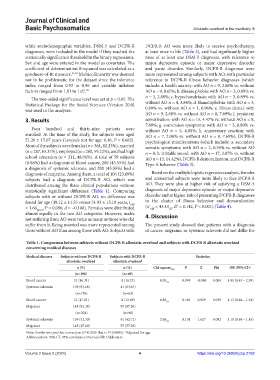
            suffer from it. Being married was more represented among   The present study showed that patients with a diagnosis
            those without AO than among those with AO. Subjects with   of cancer, migraine, or systemic sclerosis did not differ for

            Table 1. Comparison between subjects without DCPR‑R allostatic overload and subjects with DCPR‑R allostatic overload
            concerning medical diseases

            Medical diseases  Subjects without DCPR‑R   Subjects with DCPR‑R        Statistics
                             allostatic overload  allostatic overload
                                  n (%)              n (%)        Chi‑square    P     Z     Phi    OR (95% CI) a
                                                                          (df)
                                 (n=190)             (n=49)
            Blood cancer        31 (16.31)           8 (16.32)       0.00      0.999  -0.086  0.000  1.01 (0.43 – 2.39)
                                                                        (1)
            Systemic sclerosis   159 (83.68)        41 (83.67)
                                 (n=176)             (n=63)
            Blood cancer        31 (17.61)           8 (12.69)       0.82 (1)  0.365  0.829  0.059  1.13 (0.84 – 1.54)
            Migraine            145 (82.38)         55 (87.30)
                                 (n=304)             (n=96)
            Systemic sclerosis  159 (52.30)         41 (42.71)       2.68      0.101  1.627  0.082  1.10 (0.84 – 1.45)
                                                                        (1)
            Migraine            145 (47.69)         55 (57.29)
            Note: Bonferroni post hoc correction (P≤0.05/6 that is P≤0.0083).  Adjusted for age.
                                                      a
            Abbreviations: 95% CI: 95% confidence interval; OR: Odds ratio.

            Volume 2 Issue 2 (2024)                         4                        https://doi.org/10.36922/jcbp.2758

