


Page 19 - JCBP-2-2
P. 19
Journal of Clinical and
            Basic Psychosomatics                                                   Allostatic overload in the medically ill


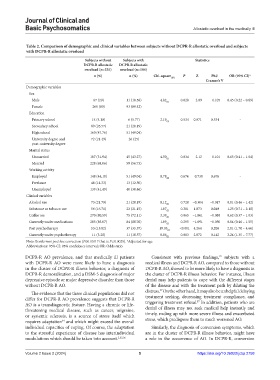
            Table 2. Comparison of demographic and clinical variables between subjects without DCPR‑R allostatic overload and subjects
            with DCPR‑R allostatic overload
                                     Subjects without   Subjects with               Statistics
                                     DCPR‑R allostatic   DCPR‑R allostatic
                                     overload (n=335)  overload (n=104)
                                         n (%)          n (%)     Chi‑square (df)  P  Z    Phi/    OR (95% CI) a
                                                                                         Cramer’s V
            Demographic variables
             Sex
               Male                      67 (20)       11 (10.58)    4.82     0.028  −2.09  −0.105  0.45 (0.22 – 0.89)
                                                                        (1)
               Female                   268 (80)       93 (89.42)
             Education
               Primary school           14 (4.18)       6 (5.77)     2.19 (3)  0.534  0.071  0.534     -
               Secondary school         89 (26.57)     21 (20.19)
               High school             160 (47.76)     51 (49.04)
               University degree and    72 (21.49)      26 (25)
               post-university degree
             Marital status
               Unmarried               107 (31.94)     45 (43.27)    4.50 (1)  0.034  −2.12  −0.101  0.65 (0.41 – 1.04)
               Married                 228 (68.06)     59 (56.73)
             Working activity
               Employed                148 (44.18)     51 (49.04)    0.78     0.676  −0.738  0.676     -
                                                                        (2)
               Freelance                48 (14.33)     13 (12.50)
               Unemployed              139 (41.49)     40 (38.46)
            Clinical variables
             Alcohol use                73 (21.79)     21 (20.19)    0.12     0.728  −0.304  −0.017  0.81 (0.46 – 1.42)
                                                                        (1)
             Substance or tobacco use   56 (16.71)     22 (21.15)    1.07     0.301  1.073  0.049  1.25 (0.71 – 2.18)
                                                                        (1)
             Coffee use                270 (80.59)     75 (72.11)    3.39     0.065  −1.861  −0.088  0.62 (0.37 – 1.03)
                                                                        (1)
             Currently under medications  285 (85.07)  84 (80.76)    1.09     0.295  −1.091  −0.050  0.84 (0.46 – 1.55)
                                                                        (1)
             Past psychotherapy         53 (15.82)     37 (35.57)    19.05 (1)  <0.001  4.264  0.208  2.81 (1.70 – 4.66)
             Currently under psychotherapy  11 (3.28)  11 (10.57)    8.86     0.003  2.872  0.142  3.24 (1.35 – 7.77)
                                                                        (1)
                                                       a
            Note: Bonferroni post hoc correction (P≤0.05/17 that is P≤0.0029).  Adjusted for age.
            Abbreviations: 95% CI: 95% confidence interval; OR: Odds ratio.
            DCPR-R AO prevalence, and that medically ill patients   Consistent with previous findings,  subjects with a
                                                                                              13
            with  DCPR-R  AO  were  more  likely  to  have  a  diagnosis   medical illness and DCPR-R AO, compared to those without
            in the cluster of DCPR-R illness behavior, a diagnosis of   DCPR-R AO, showed to be more likely to have a diagnosis in
            DCPR-R demoralization, and a DSM-5 diagnosis of major   the cluster of DCPR-R illness behavior. For instance, illness
            depressive episode or major depressive disorder than those   denial may help patients to cope with the different stages
            without DCPR-R AO.                                 of the disease and with the treatment path by diluting the
                                                                     37
              The evidence that the three clinical populations did not   distress.  On the other hand, it may also be unhelpful delaying
            differ for DCPR-R AO prevalence suggests that DCPR-R   treatment seeking, decreasing treatment compliance, and
                                                                                     37
            AO is a transdiagnostic feature. Having a chronic or life-  triggering treatment refusal.  In addition, patients who are
            threatening medical disease, such as cancer, migraine,   denial of illness may not seek medical help instantly and
            or systemic sclerosis, is a source of stress itself which   timely, ending up with more severe illness and exacerbated
            requires adaptation  and which might exceed the overall   stress, which predispose them to much worsened AO.
                           34
            individual capacities of coping. Of course, the adaptation   Similarly, the diagnosis of conversion symptoms, which
            to the stressful experience of disease has interindividual   are in the cluster of DCPR-R illness behavior, might have
            modulations which should be taken into account. 5,35,36  a  role  in  the  occurrence  of  AO.  In  DCPR-R,  conversion


            Volume 2 Issue 2 (2024)                         5                        https://doi.org/10.36922/jcbp.2758

