


Page 35 - JCBP-2-2
P. 35
Journal of Clinical and
            Basic Psychosomatics                                            Cognitive modulation of baroreceptor afferents


            Table 1. Descriptive statistics of task performance (N = 47)
            Variable                              No load                                 WM load
                                        Systole             Diastole             Systole             Diastole
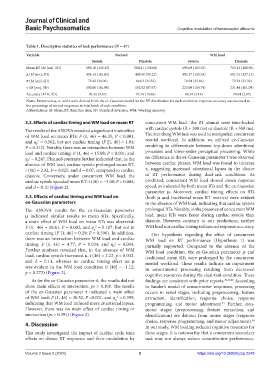
            Mean RT (M [ms], SD)      590.10 (145.32)     580.21 (136.06)      695.69 (183.36)     713.13 (188.96)
            μ (M [ms], SD)            454.14 (101.65)     440.60 (95.22)       492.57 (115.36)     501.01 (127.13)
            σ (M [ms], SD)            72.42 (34.06)        64.03 (32.32)       74.94 (25.86)        72.29 (33.39)
            τ (M [ms], SD)            150.66 (101.90)     152.92 (87.67)       223.09 (114.74)     231.44 (101.09)
            Accuracy (M %, SD)         96.32 (9.67)        95.76 (10.68)        98.34 (2.14)        98.64 (2.05)
            Notes: Parameters μ, σ, and τ were derived from the ex-Gaussian model for the RT distribution for each condition; response accuracy was assessed as
            the percentage of correct responses in total trials of each condition.
            Abbreviations: M: Mean; RT: Reaction time; SD: Standard deviation; WM: Working memory.

            3.2. Effects of cardiac timing and WM load on mean RT  concurrent WM load. The RT stimuli were time-locked
            The results of the ANOVA revealed a significant main effect   with cardiac systole (R + 300 ms) or diastole (R + 550 ms).
            of WM load on mean RTs: F (1, 46) = 46.35, P < 0.001,   The Sternberg WM task was used to manipulate concurrent
            and η p  = 0.502, but not cardiac timing (F [1, 46] = 1.04;   mental workload. In addition, we utilized ex-Gaussian
                 2
            P = 0.312). Notably, there was an interaction between WM   modeling to differentiate between top-down attentional
            load and cardiac timing: F (1, 46) = 15.08; P < 0.001; and   processes  and  lower-order  perceptual  processing.  While
            η p  = 0.247. Planned contrasts further indicated that, in the   no difference in the ex-Gaussian parameter τ was observed
             2
            absence of WM load, cardiac systole prolonged mean RT,   between cardiac phases, WM load was found to increase
            t (46) = 2.32, P = 0.025, and d = 0.07, compared to cardiac   τ, suggesting increased attentional lapses in the choice
            diastole.  Conversely,  under  concurrent WM  load,  the   of RT performance during dual-task conditions. As
            cardiac systole speeded mean RT: t (46) = −3.00; P = 0.004;   predicted, concurrent WM load slowed down response
            and d = 0.10 (Figure 2).                           speed, as indicated by both mean RTs and the ex-Gaussian
                                                               parameter  μ. Moreover, cardiac timing effects on RTs
            3.3. Effects of cardiac timing and WM load on      (both  μ and traditional mean RT metrics) were evident
            ex-Gaussian parameters                             in the absence of WM load, indicating that cardiac systole
            The  ANOVA results for  the  ex-Gaussian  parameter   prolonged RTs. Notably, in the presence of concurrent WM
            μ indicated similar results to mean RTs. Specifically,   load, mean RTs were faster during cardiac systole than
            a main effect of WM load on mean RTs was observed:   diastole. However, contrary to our predictions, neither
            F (1,  46) = 10.61, P = 0.002, and η  = 0.187, but not in   WM load nor cardiac timing influenced response accuracy.
                                          2
                                         p
            cardiac timing (F [1, 46] = 0.29; P = 0.590). In addition,   Our  hypothesis  regarding  the  effect  of  concurrent
            there was an interaction between WM load and cardiac   WM load on RT performance (Hypothesis 1) was
            timing:  F  (1, 46) = 4.77;  P = 0.034; and  η p  = 0.094.   partially supported. Compared to the absence of the
                                                  2
            Further analyses revealed that, in the absence of WM   WM load condition, the ex-Gaussian parameter  μ and
            load, cardiac systole increased μ, t (46) = 2.22, p = 0.032,   traditional mean RTs were prolonged by the concurrent
            and  d = 0.14, whereas no cardiac timing effect on  μ   mental  workload. These  results  indicate  an impairment
            was evident in the WM load condition (t [46] = -1.12;   in sensorimotor processing resulting from decreased
            p = 0.272) (Figure 2).
                                                               cognitive resources during the dual-task condition. These
              As for the ex-Gaussian parameter σ, the results did not   findings are consistent with prior reports. 30,31,48  According
            show main effects or interaction, ps > 0.198. The results   to Sander’s model of sensorimotor responses, processing
            of the ex-Gaussian parameter  τ indicated a main effect   occurs in  serial  stages,  including  preprocessing, feature
                                                   2
            of WM load: F (1, 46) = 30.52, P <0.001, and η  = 0.399,   extraction, identification, response choice, response
                                                  p
            indicating that WM load induced more attentional lapses.   programming, and motor adjustment.  Further, non-
                                                                                               53
            However, there was no main effect of cardiac timing or   motor stages (preprocessing, feature extraction, and
            interaction (ps > 0.391) (Figure 2).               identification) are distinct from motor stages (response
                                                               choice, response programming, and motor adjustment).
                                                                                                            54
            4. Discussion                                      In our study, WM loading reduced cognitive resources for
            This study investigated the impact of cardiac cycle time   these stages. It is noteworthy that a concurrent secondary
            effects on choice RT responses and their modulation by   task  may not  always  reduce  sensorimotor  performance.


            Volume 2 Issue 2 (2024)                         5                        https://doi.org/10.36922/jcbp.2248

