


Page 36 - JCBP-2-2
P. 36
Journal of Clinical and
            Basic Psychosomatics                                            Cognitive modulation of baroreceptor afferents


                        A                                   B


                        C                                   D


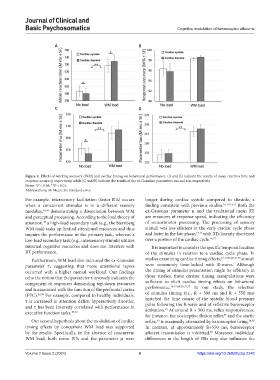
            Figure 2. Effects of working memory (WM) and cardiac timing on behavioral performance. (A and B) indicate the results of mean reaction time and
            response accuracy, respectively, while (C and D) indicate the results of the ex-Gaussian parameters mu and tau, respectively.
            Notes: *P < 0.05; **P < 0.01.
            Abbreviations: M: Mean; SE: Standard error.
            For example, intersensory facilitation (faster RTs) occurs   longer during cardiac systole compared to diastole, a
            when a concurrent stimulus is in a different sensory   finding consistent with previous studies. 16-19,31,35  Both the
            modality, 55,56  demonstrating a dissociation between WM   ex-Gaussian parameter  μ and the traditional mean RT
            and perceptual processing. According to the load theory of   are measures of response speed, indicating the efficiency
            attention,  a high-load secondary task (e.g., the Sternberg   of sensorimotor processing. The processing of sensory
                   48
            WM task) tasks up limited attentional resources and thus   stimuli was less efficient in the early cardiac cycle phase
            impairs the performance in the primary task, whereas a   and faster in the late phase, 14,15  with RTs linearly shortened
            low-load secondary task (e.g., intersensory stimuli) utilizes   over a portion of the cardiac cycle. 16,17
            minimal cognitive resources and does not interfere with   It is important to consider the specific temporal location
            RT performance.                                    of the stimulus in relation to a cardiac cycle phase. In
              Furthermore, WM load also increased the ex-Gaussian   studies examining cardiac timing effects, 14-19,24,25,31,35  stimuli
            parameter  τ, suggesting  that more  attentional  lapses   were commonly time-locked with R-waves. Although
            occurred  with  a  higher  mental  workload.  Our  findings   the timing of stimulus presentation might be arbitrary in
            echo the notion that the parameter τ inversely indicates the   those studies, those cardiac timing manipulations were
            component of responses demanding top-down resources   sufficient to elicit cardiac timing effects on behavioral
            and is associated with the function of the prefrontal cortex   performance. 14-19,24-25,31,35  In our study, the selection
            (PFC). 29,30  For example, compared to healthy individuals,   of stimulus timing (i.e., R + 300 ms and R + 550 ms)
            τ is increased in attention deficit hyperactivity disorder,   matched the time course of the systolic blood pressure
            and τ has been inversely correlated with performance in   pulse following the R-wave and of reflexive baroreceptor
                                                               activation.  At around R + 300 ms, reflex responsiveness,
                                                                       16
            executive function tasks. 40-42
                                                               for instance, the nociceptive flexion reflex  and the startle
                                                                                                57
              Our second hypothesis about the modulation of cardiac   reflex,  is maximally attenuated by baroreceptor firing. 58,59
                                                                    19
            timing effects by concurrent WM load was supported   In contrast, at approximately R+550 ms, baroreceptor
            by the results. Specifically, in the absence of concurrent   afferent transmission is inhibited.  Moreover, individual
                                                                                          59
            WM load, both mean RTs and the parameter  μ were   differences in the length of IBIs may also influence the
            Volume 2 Issue 2 (2024)                         6                        https://doi.org/10.36922/jcbp.2248

