


Page 8 - JCBP-2-2
P. 8
Journal of Clinical and
            Basic Psychosomatics                                                     Burnout interventions in residency


              In China, burnout has been a long-standing problem   departments  indicate  a high incidence  of burnout.
            within the medical field. Since 2010, there has been a steady   A cross-sectional survey of 1743 residents from 14 hospitals
            increase  in  research  focused  on  burnout  among  Chinese   in seven Chinese provinces reported that 78.3% of the
            doctors.  Notably, the burnout level among residents is   surveyed residents met the criteria of burnout, indicating
                  8
            significantly high, owing primarily to a lack of proper and   a  prevalent  and  even  pressing  burnout  problem  among
            systematic interventions.  Medical graduates who undertake   Chinese residents.  Dyrbye and Shanafelt demonstrated
                                                                              6
                               2
            clinical training often  experience a heightened  incidence   that the burnout rate among residents was higher than
            of burnout.  Interestingly, investigations into the causes of   that of the non-medical population, although statistics
                     9
                                                                                        7
            burnout reveal that burnout among residents is not solely   varied among different studies.  Regional differences were
                                 10
            linked to their stress level.  Instead, standardized training   also observed, as some regions in China reported a lower
            programs significantly impact their burnout levels. 11  prevalence of burnout among medical students. 12
              This article aims to summarize, compare, and analyze   2.1. Methods for collecting burnout data
            relevant studies on burnout during residency education.
            By focusing on key insights from influential literature, this   The  level  of  burnout  is  usually  measured  using
            article intends to raise awareness surrounding burnout   standardized scales, with the Maslach Burnout Inventory
                                                               (MBI)  being  the  most  influential  one,  developed  by
            among residents and advocate for increased research and   Maslach and Jackson in 1981.  The MBI has three versions:
                                                                                      1
            measures addressing this issue. Based on existing literature,   the MBI-Human Services Survey (MBI-HSS), the
            the prevalent occurrence of burnout among residents   MBI-Educators Survey (MBI-ES), and the MBI-General
            hampers the attainment of favorable results in standardized   Survey  (MBI-GS).   Statistics  reveal  that  currently,  more
                                                                              13
            residency education. Conversely, the standardized residency   than 90% of studies related to burnout use these MBI
            training model may also have an interactive effect on   versions as the measurement tool.  Developed by the
                                                                                            14
            residents’ burnout situations. Therefore, it is theoretically   pioneers of the burnout concept, the MBI holds strong
            and practically significant to understand the current   scientific and statistical validity and reliability, ensuring
            research status of burnout among residents and to propose   its advantageous position as a research tool and leading
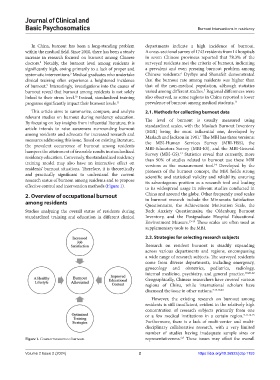
            effective control and intervention methods (Figure 1).  to its widespread usage in relevant studies conducted in
            2. Overview of occupational burnout                China and around the globe. Other frequently used scales
                                                               in burnout research include the Minnesota Satisfaction
            among residents                                    Questionnaire, the Achievement Motivation Scale, the
            Studies analyzing the overall status of residents during   Beck Anxiety Questionnaire, the Oldenburg Burnout
            standardized training and education in different clinical   Inventory, and the Postgraduate Hospital Educational
                                                               Environment Measure. 15-19  These scales are often used as
                                                               supplementary tools to the MBI.
                                                               2.2. Strategies for selecting research subjects
                                                               Research on resident burnout is steadily expanding
                                                               across various departments and regions, encompassing
                                                               a wide range of research subjects. The surveyed residents
                                                               come from diverse departments, including emergency,
                                                               gynecology  and  obstetrics,  pediatrics,  radiology,
                                                               internal medicine, psychiatry, and general practice. 18,20-22
                                                               Geographically, Chinese researchers have covered various
                                                               regions of China, while international scholars have
                                                               discussed the issue in other nations. 7,15,18,23
                                                                 However, the existing research on burnout among
                                                               residents is still insufficient, evident in the relatively high
                                                               concentration of research subjects primarily from one
                                                               or a few medical institutions in a certain region. 3,11,12,15
                                                               Furthermore, there is a lack of multi-center and multi-
                                                               disciplinary collaborative research, with a very limited
                                                               number  of  studies  having  inadequate  sample  sizes  or
                                                                              6,8
            Figure 1. Countermeasures to burnout.              representativeness.  These issues may affect the overall

            Volume 2 Issue 2 (2024)                         2                        https://doi.org/10.36922/jcbp.1153

