


Page 19 - JCBP-2-4
P. 19
Journal of Clinical and
            Basic Psychosomatics                                             Stigma in maintenance hemodialysis patients


            Table 1. (Continued)                               Table 2. Stigma scores in MHD patients
            Variables                          Mean±SD/n (%)   Variables                        Values (mean±SD)
            Serum phosphorus (mmol/L)             2.12±0.68    Stigma (total)                     43.09±14.95
            Parathyroid hormone (pg/mL)         342.39±290.38  Internalized stigma                     25.91±9.26
            Albumin (g/L)                         38.41±2.93   Enacted stigma                          17.19±6.72
            Prealbumin (g/L)                      321.92±66.28  Abbreviations: MHD: Maintenance hemodialysis; SD: Standard
            Triglyceride (mmol/L)                 1.99±1.57    deviation.
            Cholesterol (mmol/L)                  3.74±1.20
                                                               Table 3. Correlation between the total score of stigma and
            Dialysis adequacy indicators
                                                               each domain of the short‑form health survey (SF‑36)
             Kt/V                                 1.27±0.25
                                                               Domains                    r               P
             URR                                  68.13±7.09
                                                               Physical functioning     −0.078           0.406
             BDI                                  18.11±12.15
             BAI                                  9.41±9.85    Role-physical            −0.140           0.134
                                                               Bodily pain              −0.212           0.023*
            Note: Data are presented as mean±standard deviation (SD) or n (%).
            Abbreviations: BAI: Beck Anxiety Inventory; BDI: Beck Depression   General health  −0.232    0.012*
            Inventory; URR: Urea reduction ratio.              Vitality                 −0.231           0.013*
                                                               Social functioning       −0.319           0.000*
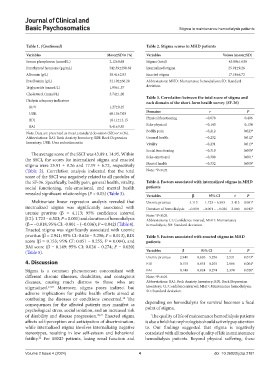
              The average score of the SSCI was 43.09 ± 14.95. Within
            the SSCI, the scores for internalized stigma and enacted   Role-emotional   −0.308           0.001*
            stigma were 25.91 ± 9.26 and 17.19 ± 6.72, respectively   Mental health     −0.332           0.000*
            (Table 2). Correlation analysis indicated that the total   Note: *P<0.05.
            score of the SSCI was negatively related to all modules of
            the SF-36. Specifically, bodily pain, general health, vitality,   Table 4. Factors associated with internalized stigma in MHD
            social functioning, role-emotional, and mental health   patients
            revealed significant relationships (P < 0.05) (Table 3).  Variables    β      95% CI     t    P
              Multivariate linear regression analysis revealed that   Uremic pruritus  4.113  1.723 – 6.503  3.413  0.001*
            internalized stigma was significantly associated with   Duration of hemodialysis  −0.018  −0.001 – −0.036  2.060  0.042*
            uremic pruritus (β = 4.113; 95% confidence interval   Note: *P<0.05.
            [CI]: 1.723 – 6.503; P = 0.001) and duration of hemodialysis   Abbreviations: CI: Confidence interval; MHD: Maintenance
            (β = −0.018; 95% CI: -0.001 – (−0.036); P = 0.042) (Table 4).   hemodialysis; SD: Standard deviation.
            Enacted stigma was significantly associated with uremic
            pruritus (β = 2.941; 95% CI: 0.626 – 5.256; P = 0.013), BDI   Table 5. Factors associated with enacted stigma in MHD
            score (β = 0.153; 95% CI: 0.051 – 0.255; P = 0.004), and   patients
            BAI score (β = 0.149; 95% CI: 0.024 – 0.274; P = 0.020)
            (Table 5).                                         Variables       β       95% CI      t      P
                                                               Uremic pruritus  2.941  0.626 – 5.256  2.521  0.013*
            4. Discussion                                      BDI            0.153  0.051 – 0.255  2.986  0.004*
            Stigma is a common phenomenon concomitant with     BAI            0.149  0.024 – 0.274  2.374  0.020*
            different chronic illnesses, disabilities, and contagious   Note: *P<0.05.
            diseases,  causing  much  distress  to  those  who  are   Abbreviations: BAI: Beck Anxiety Inventory; BDI: Beck Depression
            stigmatized. 17,18  Moreover, stigma poses indirect but   Inventory; CI: Confidence interval; MHD: Maintenance hemodialysis;
            adverse implications for public health efforts aimed at   SD: Standard deviation.
            combating the diseases or conditions concerned.  The
                                                     19
            consequences for the affected patients may manifest as   depending on hemodialysis for survival becomes a focal
            psychological stress, social isolation, and an increased risk   point of stigma.
            of disability and disease progression. 20,21  Enacted stigma   The quality of life of maintenance hemodialysis patients
            affects self-perception and anticipation of discrimination,   is also a field that nephrologists should actively pay attention
            while internalized stigma involves internalizing negative   to. Our findings suggested that stigma is negatively
            stereotypes, resulting in low self-esteem and behavioral   correlated with all modules of quality of life in maintenance
            futility.   For  ESRD  patients,  losing  renal  function  and   hemodialysis patients. Beyond physical suffering, these
                 22

            Volume 2 Issue 4 (2024)                         4                               doi: 10.36922/jcbp.2181

