


Page 24 - JCBP-2-4
P. 24
Journal of Clinical and
            Basic Psychosomatics                                                Genetic factors and personality disorders


            of engaging in heroin use, which could potentially result in   characteristics of individuals with heroin dependence. In
            alterations to their personality. The clinical manifestation   comparison to control subjects, the individuals with heroin
            of addiction primarily revolves around mood and impulse-  dependence exhibited elevated scores for personality traits
            control dysregulation  while heroin dependence has a   related to novelty seeking and harm avoidance. In addition,
                             12
            negative effect on impulse control.  People with specific   a variation in the gene responsible for producing catechol-
                                        13
            personality characteristics, such as a tendency for risk-  O-methyltransferase  (COMT)  has  been  demonstrated  to
            taking  behaviors,  may  demonstrate  a  predisposition   impact human executive cognition and the functioning of
                                                 14
            towards heroin use. For instance, a prior study  indicated   the prefrontal cortex and this influence is likely due to its
            that antisocial personality disorder was the only domain   effect on prefrontal dopamine signaling.  Moreover, the
                                                                                                22
                                                                                                      23
            where a cumulative risk was observed for heroin overdose.   COMT gene can play a role in personality traits.  Certain
            Antisocial personality disorder is frequently identified as   variations (polymorphisms) of the COMT gene can result
            the  predominant comorbid diagnosis among individuals   in different levels of enzyme activity, leading to variations
            with substance abuse issues. 15,16  Furthermore, it is crucial   in dopamine regulation.
            to emphasize that an individual’s personality traits may   Collectively, our goal was to investigate single nucleotide
            influence their preference for a particular drug. A previous   polymorphisms (SNPs) of  COMT and those related
            study  has identified a specific externalizing dimension   to stress, as well as their relationship with personality
                17
            that distinguishes heroin users from those who use alcohol,   disorders among women with heroin dependence.
            marijuana, and cocaine. This suggests that certain personality
            traits may be associated with a higher likelihood of choosing   2. Methods
            heroin over other substances. Nevertheless, it remains   The study protocol was authorized by the review boards
            uncertain which specific personality traits have an impact   at the Shanghai Mental Health Center (SHMC), School
            on the preference for heroin over other substances.   of Medicine, Shanghai Jiao Tong University. The research
            Furthermore, the use of heroin may be linked to several   adhered to the principles outlined in the Declaration of
            personality  disorders,  such as  schizoid,  depressive,  and   Helsinki. All patients gave their informed consent, prior
            paranoid personalities. Schizoid and depressive personality   to participating in  the study.  Furthermore,  meticulous
            disorders have been found to be associated with feelings   records were kept to document the number of interviews
            of loneliness, and individuals experiencing loneliness may   conducted with each patient for precise record-keeping.
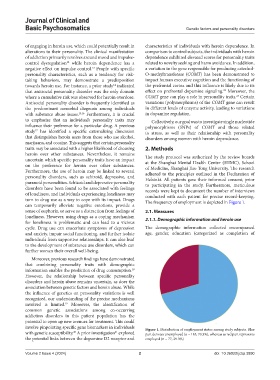
            turn to drug use as a way to cope with its impact. Drugs   The frequency of employment is depicted in Figure 1.
            can temporarily alleviate negative emotions, provide a
            sense of euphoria, or serve as a distraction from feelings of   2.1. Measures
            loneliness. However, using drugs as a coping mechanism   2.1.1. Demographic information and heroin use
            for loneliness is problematic and can lead to a vicious
            cycle.  Drug  use  can  exacerbate  symptoms  of  depression   The demographic information collected encompassed
            and anxiety, impair social functioning, and further isolate   age,  gender, education  (categorized  as  completion of
            individuals from supportive relationships. It can also lead
            to the development of substance use disorders, which can
            further worsen their overall well-being.
              Moreover, previous research findings have demonstrated
            that combining personality traits with demographic
            information enables the prediction of drug consumption.
                                                         18
            However, the relationship between specific personality
            disorders and heroin abuse remains uncertain, as does the
            association between genetic factors and heroin abuse. While
            the influence of genetics on personality variations is well
            recognized, our understanding of the precise mechanisms
            involved is limited.  Moreover, the identification of
                             19
            common genetic associations among co-occurring
            addiction  disorders  in  this  patient  population  has  the
            potential to open up new avenues for treatment. This could
            involve pinpointing specific gene biomarkers in individuals   Figure 1. Distribution of employment status among study subjects. Blue
            with genetic susceptibility.  A prior investigation  explored   part denotes unemployed (n = 185, 70.3%), whereas as red part represents
                                                  21
                                20
            the potential links between the dopamine D2 receptor and   employed (n = 77, 29.3%)
            Volume 2 Issue 4 (2024)                         2                               doi: 10.36922/jcbp.3890

