


Page 37 - JCBP-2-4
P. 37
Journal of Clinical and
            Basic Psychosomatics                                          Core depressive symptoms of peripartum women


            A                      B                       C                         D


            E                      F                        G                         H


                                    I                       J


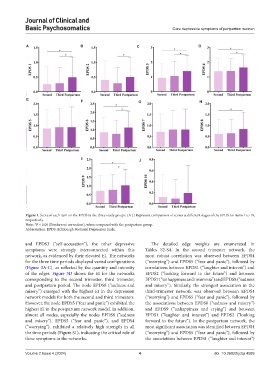
            Figure 1. Score of each item on the EPDS in the three study groups. (A-J) Represent comparison of scores at different stages of the EPDS for items 1 to 10,
            respectively.
            Note: *P < 0.05 (Bonferroni correction), when compared with the postpartum group.
            Abbreviation: EPDS: Edinburgh Postnatal Depression Scale.


            and EPDS3 (“self-accusation”), the other depressive   The detailed edge weights are enumerated in
            symptoms were strongly interconnected within this   Tables S2-S4. In the second trimester network, the
            network, as evidenced by their elevated EI. The networks   most  robust correlation  was observed between  EPDS4
            for the three time periods displayed varied configurations   (“worrying”) and EPDS5 (“fear and panic”), followed by
            (Figure 3A-C), as reflected by the quantity and intensity   correlations between EPDS1 (“laughter and interest”) and
            of the edges.  Figure  3D shows the EI for the networks   EPDS2 (“looking forward to the future”) and between
            corresponding to  the second trimester, third  trimester,   EPDS7 (“unhappiness and insomnia”) and EPDS8 (“sadness
            and postpartum period. The node EPDS8 (“sadness and   and misery”). Similarly, the strongest association in the
            misery”) emerged with the highest EI in the depression   third-trimester network was observed between EPDS4
            network models for both the second and third trimesters.   (“worrying”) and EPDS5 (“fear and panic”), followed by
            However, the node EPDS5 (“fear and panic”) exhibited the   the associations between EPDS8 (“sadness and misery”)
            highest EI in the postpartum network model. In addition,   and EPDS9 (“unhappiness and crying”) and between
            almost  all  nodes,  especially  the  nodes  EPDS8  (“sadness   EPDS1 (“laughter and interest”) and EPDS2 (“looking
            and misery”), EPDS5 (“fear and panic”), and EPDS4   forward to the future”). In the postpartum network, the
            (“worrying”), exhibited a relatively high strength in all   most significant association was identified between EPDS4
            the time periods (Figure S1), indicating the critical role of   (“worrying”) and EPDS5 (“fear and panic”), followed by
            these symptoms in the networks.                    the associations between EPDS1 (“laughter and interest”)


            Volume 2 Issue 4 (2024)                         4                               doi: 10.36922/jcbp.4089

