


Page 106 - JCBP-3-1
P. 106
Journal of Clinical and
            Basic Psychosomatics                                              Serotonin syndrome unexpected medication


            the absence of nystagmus, clonus, jerkiness, tremors, or   no adverse effects recurred, proving it less likely to be the
            akathisia.  Furthermore,  the  mental  status  examination   primary cause of our patient’s complaints. Phentermine
            demonstrated considerable  improvement,  as evidenced   may have affected this patient’s serotonin levels; however,
            by the return to baseline attention without agitation.   no evidence  of serotonin  syndrome  occurring with
                                                                                                    9
            Cyproheptadine  was  discontinued,  and  duloxetine  was   phentermine administration currently exists.  This does
            resumed at a dose of 30 mg on day 5. The patient continued   exclude a theoretical mechanism, but phentermine is
            to improve clinically and was discharged on day 6.  unlikely to be the primary offending agent. Given the
                                                               patients’ long-term compliance with bupropion before
            3. Discussion                                      symptoms appeared, it is also unlikely to be the cause of the
            Serotonin syndrome is a potentially fatal condition resulting   symptoms. To our knowledge, there are only three reported
            from excessive serotonergic activity. It is characterized   cases demonstrating serotonin syndrome in conjunction
            by somatic, autonomic, and cognitive symptoms,     with bupropion toxicity, and none of these were caused
                                                                                19
            including altered mental status, autonomic instability, and   by bupropion alone.  Finally, on the Naranjo Adverse
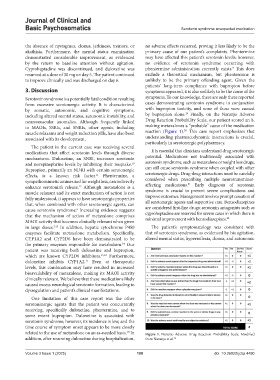
            neuromuscular anomalies. Although frequently linked   Drug Reaction Probability Scale, our patient scored an 8,
            to MAOIs, SSRIs, and SNRIs, other agents, including   making metaxalones a “probable” cause of the medication
                                                                               20
            muscle relaxants and weight reduction pills, have also been   reaction (Figure  1).   This  case  report  emphasizes  that
            associated with its development.                   understanding  pharmacodynamic  interactions is crucial,
                                                               particularly in serotonergic polypharmacy.
              The patient in the current case was receiving several
            medications that affect serotonin levels through diverse   It is essential that clinicians understand drug serotonergic
            mechanisms. Duloxetine, an SNRI, increases serotonin   potential.  Medications  not  traditionally  associated  with
            and norepinephrine levels by inhibiting their reuptake.    serotonin syndrome, such as metaxalone or weight loss drugs,
                                                         10
            Bupropion, primarily an NDRI with certain serotonergic   can still cause serotonin syndrome when coupled with other
            effects, is a known risk factor.  Phentermine, a   serotonergic drugs. Drug-drug interactions must be carefully
                                          11
            sympathomimetic amine used for weight loss, can indirectly   considered when prescribing multiple neurotransmitter-
                                                                                 21
            enhance serotonin’s release.  Although metaxalone is a   affecting medications.  Early diagnosis of serotonin
                                   12
            muscle relaxant and its exact mechanism of action is not   syndrome is crucial to prevent severe complications and
            fully understood, it appears to have serotonergic properties   improve outcomes. Management involves prompt cessation of
            that, when combined with other serotonergic agents, can   all serotonergic agents and supportive care. Benzodiazepines
            cause serotonin syndrome.  Increasing evidence suggests   are considered first-line drugs; serotonin antagonists such as
                                  6
            that the mechanism of action of metaxalone comprises   cyproheptadine are reserved for severe cases in which there is
                                                                                                 22
            MAOI activity that becomes clinically relevant when given   minimal improvement with benzodiazepines.
            in large doses.  In addition, hepatic cytochrome P450   The patient’s symptomatology was consistent with
                        5,13
            enzymes facilitate metaxalone metabolism. Specifically,   that of serotonin syndrome, as evidenced by his agitation,
            CYP1A2  and  CYP2D6  have  been  demonstrated  to  be   altered mental status, hyperreflexia, clonus, and autonomic
            the  primary  enzymes  responsible  for  metabolism.   Our
                                                     14
            patient was receiving both duloxetine and bupropion,
            which are known CYP2D6 inhibitors. 15,16  Furthermore,
                                     17
            duloxetine inhibits CYP1A2.  Even at therapeutic
            levels, this combination may have resulted in increased
            bioavailability of metaxalone, making its MAOI activity
            clinically relevant. We believe that these medications likely
            caused excess neurological serotonin formation, leading to
            dysregulation and patient’s clinical manifestations.
              One  limitation of  this  case  report  was  the  other
            serotoninergic agents that the patient was concurrently
            receiving, specifically duloxetine, phentermine, and to
            some  extent  bupropion. Duloxetine  is associated  with
            serotonin syndrome; however, its incidence is low, and the
            time course of symptom onset appears to be more closely
            related to the use of metaxalone on an as-needed basis.  In   Figure  1. Naranjo Adverse Drug Reaction Probability Scale. Modified
                                                       18
            addition, after resuming duloxetine during hospitalization,   from Naranjo et al. 20

            Volume 3 Issue 1 (2025)                        100                              doi: 10.36922/jcbp.4490

