


Page 111 - JCBP-3-1
P. 111
Journal of Clinical and
            Basic Psychosomatics                                         Concerns about COVID-19 vaccination and AE rate


            Table 1. Comparison of prevalence of selected AEs after administration of the first dose of BNT162b2 (Comirnaty) (registration
            study cohort vs. our cohort)
            AE         AE prevalence among   AE prevalence among   P-value (Fisher’s   AE prevalence among   AE prevalence among
                    <55-year-olds in registration   <55-year-olds in our   exact test, two-sided) >55-year-olds in registration  >55-year-olds in our
                       study (n=10,889) (%)  study (n=453) (%)              study (n=7,971) (%)  study (n=143) (%)
                                                    a
                                                                                                        a
            Fatigue          47               175 (41)    0.008*  0.48**          34               45 (31)
            Headache         42               123 (29)    0.000*  0.70**          25               33 (23)
            Arthralgia       11               63 (15)     0.034*  0.053**          9               20 (14)
            Chills           14                28 (7)     0.000*  0.48**           6                6 (4)
            Vomiting          4                10 (2)     0.044*  0.004**          8                6 (4)
                 a
            Notes:  : Data are presented as n (%); *: Comparison of AE prevalence among 16 – 55-year-olds (1) in the registration study versus 18 – 55-year-old
            HCWs in our study; **: Comparison of AE prevalence among >55-year-olds (1) in the registration study versus >55-year-old; HCWs in our study; The
            significance level was set at 5% (P<0.05).
            Abbreviations: AE: Adverse event; HCW: Health care workers.

                                                               the pivotal study ; this was unexpected due to the high
                                                                             2,5
                                                               proportion of women in our sample and previous reports
                                                               of greater prevalence of side effects in (younger) women
                                                               than men.  The proportion of women and men was half
                                                                       16
                                                               in registration studies, and the results for both sexes are
                                                               always published together.  Therefore, in samples such as
                                                                                    2
                                                               ours,  with  a  significantly  higher  proportion  of  women,
                                                               the side effects should have been more than in samples
                                                               with  a 50/50 sex  distribution.  In a survey of German
                                                               hospital staff, approximately 4.4% – 13.1% (vaccinated
                                                               with Comirnaty and Moderna) of participants were sick
                                                               for at least 1 day due to side effects after the first mRNA
                                                                          21
                                                               vaccine dose.  Thus, considering the high workload of
                                                               hospital staff, measures should be taken to reduce the rate
                                                               of side effects. 21,22  Our sample may have had high positive
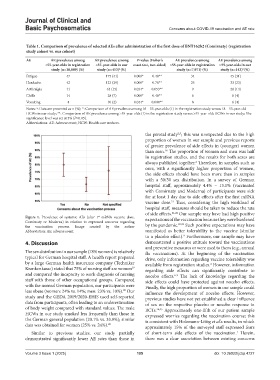
            Figure  1. Prevalence of systemic AEs (after 1   mRNA vaccine dose,   expectations of the vaccination because they were burdened
                                           st
            Comirnaty or Moderna) in relation to expressed concerns regarding   22,23
            the  vaccination  process.  Image  created  by  the  author   by the pandemic.   Such positive expectations may have
            Abbreviation: AE: adverse event.                   manifested as better tolerability to the vaccine (similar
                                                               to a placebo effect).  Furthermore, our sample may have
                                                                               9
            4. Discussion                                      demonstrated a positive attitude toward the vaccinations
                                                               and preventive measures or were used to them (e.g., annual
            The sex distribution in our sample (78% women) is relatively   flu vaccinations). At the beginning of the vaccination
            typical for German hospital staff. A health report prepared   drive, only information regarding vaccine tolerability was
            by a large German health insurance company (Techniker   available from registration studies.  However, information
                                                                                          2
            Krankenkasse) stated that 75% of nursing staff are women    regarding  side effects  can significantly  contribute  to
                                                         19
            and compared the incapacity to work diagnosis of nursing   nocebo  effects.  The lack of knowledge regarding the
                                                                           6-9
            staff with those of other occupational groups. Compared   side effects could have protected against nocebo effects.
            with the normal German population, our participants were   Finally, the high proportion of women in our sample could
            less obese (women: 24% vs. 14%; men: 23% vs. 10%).  Our   influence  the  development  of  nocebo effects.  However,
                                                     20
            study and the GEDA 2019/2020-EHIS used self-reported   previous studies have not yet established a clear influence
            data from participants, often leading to an underestimation   of sex on the respective placebo or nocebo response in
            of body weight compared with standard values. The male   RCTs. 24,25  Approximately one-fifth of our patient sample
            HCWs in our study smoked less frequently than those in   expressed worries regarding the vaccination course; this
            the German general population (20.1% vs. 33.9%); similar   is consistent with Holzmann-Littig et al.’s results, in which
            data was obtained for women (25% vs. 24%). 20      approximately 15% of the surveyed staff expressed fears
              Similar to previous studies, our study partially   of short-term side effects of the vaccination.  Herein,
                                                                                                      1
            demonstrated  significantly  lower  AE  rates  than  those  in   there  was  a  clear  association  between  existing  concerns

            Volume 3 Issue 1 (2025)                        105                              doi: 10.36922/jcbp.4727

