


Page 96 - JCBP-3-1
P. 96
Journal of Clinical and
            Basic Psychosomatics                                              Functional neurological movement disorders


            with a distinctive set of predisposing factors at play.  It has
                                                     3
            been reported that patients with psychogenic movement
            disorder reported higher rates of childhood trauma,
            specifically greater emotional abuse and physical neglect,
            greater fear associated with traumatic events, and a greater
            number of traumatic episodes compared with healthy
            volunteers.  However, ongoing physical or psychological
                     2
            traumas, infections, and medical disorders may precipitate
            functional disorders.   General  cognitive  functions are
                             4,5
            found to be normal in patients with functional movement
            disturbances  in  contrast  to  psychogenic  non-epileptic
                   6,7
            seizures.  About 15% of patients referred to outpatient
            neurological  clinics  are  suffering  from  neurological
            functional disorders.  These patients are often discovered
                             8
            to present additional symptoms from other organ systems
            such  as  the  gastrointestinal  system,  heart,  and  lungs.
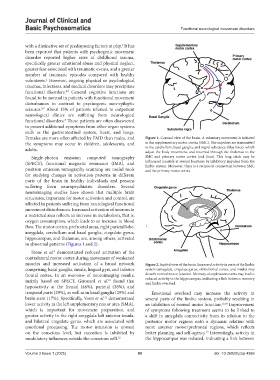
            Females are more often affected by FMD than males, and   Figure 1. Coronal view of the brain. A voluntary movement is initiated
            the symptoms may occur in children, adolescents, and   in the supplementary motor cortex (SMC). The impulses are transmitted
            adults.                                            to the cerebellum, basal ganglia, and nigral substance (blue lines), which
                                                               adjust the body movement, and returned through the thalamus to the
              Single-photon  emission  computed  tomography    SMC and primary motor cortex (red lines). This long circle may be
            (SPECT), functional magnetic resonance (fMR), and   influenced possibly at several locations by inhibitory impulses from the
                                                               limbic system. Moreover, there is a reciprocal connection between SMC
            positron emission tomography scanning are useful tools   and the primary motor cortex.
            for studying changes in activation patterns in different
            parts of the brain in healthy individuals and persons
            suffering from neuropsychiatric disorders. Several
            neuroimaging studies have shown that multiple brain
            structures, important for motor activation and control, are
            affected in patients suffering from neurological functional
            movement disturbances. Increased activation of neurons in
            a restricted area reflects an increase in metabolism, that is,
            oxygen consumption, which leads to an increase in blood
            flow. The motor cortex, prefrontal areas, right parietal lobe,
            amygdala, cerebellum and basal ganglia, cingulate gyrus,
            hippocampus, and thalamus, are, among others, activated
            in abnormal patterns (Figures 1 and 2).
              Stone  et al.  demonstrated reduced activation of the
                        9
            contralateral motor cortex during movement of weakened
            muscles and increased activation of a broad network   Figure 2. Sagittal view of the brain. Increased activity in parts of the limbic
            comprising basal ganglia, insula, lingual gyri, and inferior   system (amygdala, cingulate gyrus, orbitofrontal cortex, and insula) may
            frontal cortex. In an overview of neuroimaging results,   disturb normal motor function. Memory of unpleasant events may lead to
                                               10
            mainly based on SPECT, Girouard  et al.  found that   reduced activity in the hippocampus, indicating a link between memory
                                                               and limbic overload.
            hypoactivity at the frontal (46%), parietal (38%), and
            temporal parts (29%), as well as in basal ganglia (29%) and   Emotional overload may increase the activity in
            brain stem (17%). Specifically, Voon et al.  demonstrated   several parts of the limbic system, probably resulting in
                                             11
            lower activity in the left supplementary motor area (SMA),   an inhibition of normal motor function. 13,14  Improvement
            which is important for movement preparation, and   of symptoms following treatment seems to be linked to
            greater activity in the right amygdala left anterior insula,   a shift in amygdala connectivity from its relation to the
            and  bilateral  cingulate  gyrus,  which  are  associated  with   posterior  motor  regions  onto  a  dynamic  relation  with
            emotional processing. The motor intension is normal   more anterior motor/prefrontal regions, which reflects
                                                                                         15
            on the conscious level, but execution is inhibited by   better planning and self-agency.  Interestingly, activity in
            modulatory influences outside the conscious will. 12  the hippocampus was reduced, indicating a link between

            Volume 3 Issue 1 (2025)                         90                              doi: 10.36922/jcbp.4369

