


Page 98 - JCBP-3-1
P. 98
Journal of Clinical and
            Basic Psychosomatics                                              Functional neurological movement disorders


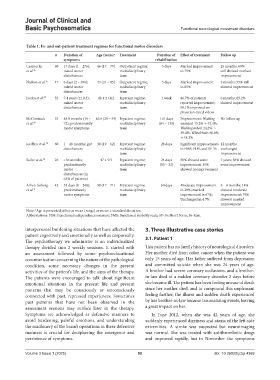
            Table 1. In- and out-patient treatment regimes for functional motor disorders
                        n   Duration of   Age (years) a  Treatment  Duration of   Effect of treatment  Follow up
                            symptoms                               rehabilitation
            Czarnecki    60  17 days (1 – 276);   46 (17 – 79)  Outpatient regime;   5 days  Marked improvement   25 months; 60%
            et al. 26       mixed motor             multidisciplinary         in 75%           still showed marked
                            disturbances            team                                       improvement
            Nielsen et al. 25  47  6 days (2 – 480);   44 (21 – 85)  Outpatient regime;   5 days  Marked improvement   3 months; 55% still
                            mixed motor             multidisciplinary         in 65%           showed improvement
                            disturbances            team
            Jacobs et al. 27  32  7.4 years (±10.3);   49.1 ± 14.2  Inpatient regime;   1 week  86.7% of patients   6 months; 69.2%
                            mixed motor             multidisciplinary         reported improvement;   showed improvement
                            disturbances            team                      59.1% improved on
                                                                              physician-rated videos
            McCormack    33  48.8 months (19 –   40.8 (20 – 59) Inpatient regime;   101 days    Improvement: Walking   No follow up
            et al. 29       72); predominantly      multidisciplinary   (84 – 130)  unaided: 15.2% → 42.4%;
                            motor symptoms          team                      Walking aided: 24.2% →
                                                                              39.4%; Wheelchair: 60.6%
                                                                              → 18.2%
            Jordbru et al. 28  60  1 – 48 months; gait   38 (19 – 62)  Inpatient regime;   28 days  Significant improvements  12 months;
                            disturbances            multidisciplinary         in FMS, FIM, and SF-36  unchanged
                                                    team                                       improvement
            Saifee et al. 30  26  >36 months;   47 ± 9.5  Inpatient regime;   24 days    58% showed some   7 years; 58% showed
                            predominantly           multidisciplinary   (15 – 32)  improvement; 35%   some improvement
                            motor                   team                      showed no improvement
                            disturbances (in
                            63% of patients)
            Arlien-Søborg   42  53 days (0 – 240);   39 (17 – 71)  Inpatient regime;   60 days  Moderate improvement  3 – 6 months; 14%
            et al. 31       predominantly           multidisciplinary         in 28%; marked   showed moderate
                            motor symptoms          team                      improvement in 67%;   improvement; 79%
                                                                              Unchanged in 4.7%   showed marked
                                                                                               improvement
            Note:  Age is presented either as mean (range) or mean ± standard deviation.
                a
            Abbreviations: FIM: Functional independence measure; FMS: Functional mobility scale; SF-36: Short Form, 36-item.

            interpersonal burdening situations that have affected the   3. Three illustrative case stories
            patient cognitively and emotionally as well as corporeally.
            The  psychotherapy we  administer is  an individualized   3.1. Patient 1
            therapy divided into 2  weekly sessions. It started with   This patient has no family history of neurological disorders.
            an assessment followed by some psychoeducational   Her mother died from colon cancer when the patient was
            communication concerning the nature of the pathological   only 15 years of age. Her father suffered from depression
            condition, some necessary  changes in  the present   and committed suicide  when she was  24  years of  age.
            activities of the patient’s life, and the aims of the therapy.   A brother had severe coronary occlusions, and a brother-
            The patients were encouraged to talk about significant   in-law died of a sudden coronary disorder 2 days before
            emotional situations in the present life and present   she became ill. The patient has been feeling unease of death
            patterns that may be consciously or unconsciously   since her mother died, and to compound this unpleasant
            connected with past, repressed experiences. Sometimes   feeling further, the illness and sudden death experienced
            past patterns that have not been observed in the   by her brother-in-law became traumatizing events, leaving
            assessment sessions may surface later in the therapy.   a great impact on her.
            Symptoms are acknowledged as defensive manners to    In June 2012, when she was 42  years of age, she
            avoid  burdening,  painful  emotions,  and  understanding   suddenly experienced dizziness and ataxia of the left-side
            the machinery of the brain’s operations in these defensive   extremities. A  stroke was suspected but neuroimaging
            manners is crucial for deciphering the emergence and   was normal. She was treated with antithrombotic drugs
            persistence of symptoms.                           and improved rapidly, but in November the symptoms


            Volume 3 Issue 1 (2025)                         92                              doi: 10.36922/jcbp.4369

