


Page 66 - JCBP-3-3
P. 66
Journal of Clinical and
            Basic Psychosomatics                                            Depression and chronic pancreatitis: MR study


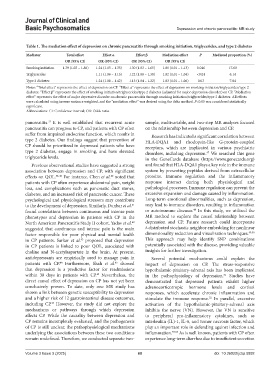
            Table 1. The mediation effect of depression on chronic pancreatitis through smoking initiation, triglycerides, and type 2 diabetes
            Mediator         Total effect    Effect α      Effect β   Mediation effect  P  Mediated proportion (%)
                             OR (95% CI)   OR (95% CI)   OR (95% CI)   OR (95% CI)
            Smoking initiation  1.39 (1.03 – 1.86)  1.24 (1.15 – 1.35)  1.30 (1.03 – 1.65)  1.06 (1.01 – 1.13)  0.046  17.60
            Triglycerides                 1.11 (1.06 – 1.15)  1.22 (1.08 – 1.38)  1.02 (1.01 – 1.04)  <0.01  6.14
            Type 2 diabetes               1.24 (1.08 – 1.42)  1.13 (1.04 – 1.22)  1.03 (1.01 – 1.06)  0.03  7.84
            Notes: “Total effect” represents the effect of depression on CP. “Effect α” represents the effect of depression on smoking initiation/triglycerides/type 2
            diabetes. “Effect β” represents the effect of smoking initiation/triglycerides/type 2 diabetes (adjusted for major depression disorder) on CP. “Mediation
            effect” represents the effect of major depressive disorder on chronic pancreatitis through smoking initiation/triglycerides/type 2 diabetes. All effects
            were calculated using inverse variance weighted, and the “mediation effect” was derived using the delta method. P<0.05 was considered statistically
            significant.
            Abbreviations: CI: Confidence interval; OR: Odds ratio.

                      37
            pancreatitis.  It is well established that recurrent acute   sample, multivariable, and two-step MR analyses focused
            pancreatitis can progress to CP, and patients with CP often   on the relationship between depression and CP.
            suffer from impaired endocrine function, which results in   Research has indicated a significant correlation between
            type 2 diabetes. Our findings suggest that prevention of   HLA-DQA1 and rhodopsin-like G-protein-coupled
            CP should be prioritized in depressed patients who have   receptors, which are implicated in various psychiatric
            type  2 diabetes, engage in smoking, and have elevated   disorders, including depression.  We searched this gene
                                                                                         47
            triglyceride levels.                               in the  GeneCards database (https://www.genecards.org)
              Previous observational studies have suggested a strong   and found that HLA-DQA1 plays a key role in the immune
            association between depression and CP, with significant   system by presenting peptides derived from extracellular
            effects on QOL. 38-40  For instance, Chen et al.  noted that   proteins.  Immune  regulation  and  the  inflammatory
                                                40
            patients with CP often experience abdominal pain, weight   response  interact  during  both  physiological  and
            loss, and complications such as pancreatic  duct stones,   pathological processes. Immune regulation can prevent the
            diabetes, and an increased risk of pancreatic cancer. These   excessive expansion and damage caused by inflammation.
            psychological and physiological stressors may contribute   Long-term emotional abnormalities, such as depression,
                                                         41
            to the development of depression. Similarly, Dunbar et al.    may lead to immune disorders, resulting in inflammation
                                                                                   48
            found correlations between continuous and intense pain   or autoimmune diseases.  In this study, we utilized the
            phenotypes and depression in patients with CP in the   MR method to explore the causal relationship between
            North American Pancreatitis Study II cohort. Yadav et al.    depression  and  CP. Future research could  incorporate
                                                         42
            suggested that continuous and intense pain is the main   t-distributed stochastic neighbor embedding for nonlinear
            factor  responsible  for  poor  physical  and  mental  health   dimensionality reduction and visualization techniques. 49,50
            in CP patients. Sarkar  et al.  proposed that depression   This approach may help identify SNP combinations
                                   43
            in CP patients is linked to poor QOL, associated with   potentially associated with the disease, providing valuable
            choline and N-acetylaspartate in the brain. At present,   insights for further investigation.
            antidepressants are empirically used to manage pain in   Several potential mechanisms could explain the
            patients with CP.  Furthermore, Shah  et al.  showed   impact of depression on CP. The stress-responsive
                          44
                                                  45
            that depression is a predictive factor for readmissions   hypothalamic-pituitary-adrenal axis has  been implicated
            within 30  days in patients with CP.  Nevertheless, the   in the  pathophysiology  of depression.  Studies have
                                          45
                                                                                                51
            direct causal effect of depression on CP has not yet been   demonstrated that depressed patients exhibit higher
            conclusively proven. To date, only one MR study has   adrenocorticotropic  hormone levels and cortisol
            shown a link between genetic susceptibility to depression   responses, which accelerate chronic inflammation and
            and a higher risk of 12 gastrointestinal disease outcomes,   stimulate the immune response.  In parallel, excessive
                                                                                          52
            including  CP.  However, the study  did not explore the   activation of the  hypothalamic-pituitary-adrenal  axis
                       46
            mechanisms or pathways through which depression    inhibits  the  nerve  (VN).  However,  the  VN  is  sensitive
            affects CP. While the causality between depression and   to peripheral pro-inflammatory cytokines, such as
            CP remains incompletely evaluated, and the pathogenesis   interleukin (IL)-1, IL-6, and tumor necrosis factor, which
            of CP is still unclear, the pathophysiological mechanisms   play an important role in defending against infection and
            underlying the associations between these two conditions   inflammation. 53,54  As is well known, patients with CP often
            remain undefined. Therefore, we conducted separate two-  experience long-term diarrhea due to insufficient secretion


            Volume 3 Issue 3 (2025)                         60                              doi: 10.36922/jcbp.5892

