


Page 6 - JCTR-10-2
P. 6
100                       Dinaki et al. | Journal of Clinical and Translational Research 2024; 10(2): 99-111
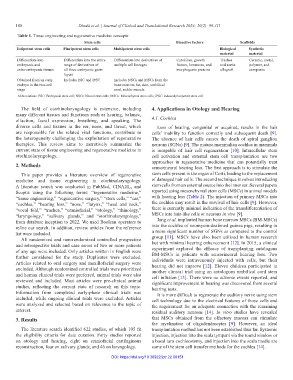
        Table 1. Tissue engineering and regenerative medicine concepts
                                    Stem cells                             Bioactive factors         Scaffolds
        Totipotent stem cells  Pluripotent stem cells  Multipotent stem cells                Biological   Synthetic
                                                                                             material    material
        Differentiate into   Differentiate into the entire   Differentiate into derivatives of   Cytokines, growth   Trachea   Ceramic, metal,
        embryonic and       range of derivatives of   multiple cell lineages  factors, hormones, and   and aortic   polymer, and
        extra-embryonic tissues  all three embryonic germ                  morphogenic proteins  allograft  composite
                            layers
        Obtained from an early   Includes ESC and iPSC  Includes NSCs and MSCs from the
        embryo in the two-cell                   bone marrow, fat, skin, umbilical
        stage                                    cord, and/or muscle
        Abbreviations: ESC: Embryonic stem cell; NSCs: Neural stem cells; MSCs: Mesenchymal stem cells; iPSC: induced pluripotent stem cell.


          The  field  of  otorhinolaryngology  is  extensive,  including   4. Applications in Otology and Hearing
        many different tissues and functions such as hearing, balance,
        olfaction,  facial  expression,  breathing,  and  speaking.  The   4.1. Cochlea
        diverse  cells  and  tissues  in  the  ear,  nose,  and  throat,  which   Loss  of  hearing,  congenital  or  acquired,  results  in  the  hair
        are  responsible  for  the  related  vital  functions,  contribute  to   cells’  inability  to  function  correctly  and  subsequent  death  [9].
        the heterogeneity challenging the exploitation of regenerative   The  absence  of  hair  cells  causes  the  death  of  spiral  ganglion
        therapies.  This  review  aims  to  narratively  summarize  the   neurons (SGNs) [9]. The mature mammalian cochlea in mammals
        current state of tissue engineering and regenerative medicine in   is  incapable  of  hair  cell  regeneration  [10].  Intracellular  stem
        otorhinolaryngology.                                    cell  activation  and  external  stem  cell  transplantation  are  two
                                                                approaches  in  regenerative  medicine  that  can  potentially  treat
        2. Methods                                              sensorineural hearing loss. The first approach is to stimulate the

          This  paper  provides  a  literature  overview  of  regenerative   stem cells present in the organ of Corti, leading to the replacement
        medicine  and  tissue  engineering  in  otorhinolaryngology.   of damaged hair cells. The second technique involves introducing
        A  literature  search  was  conducted  in  PubMed,  CINAHL,  and   stem cells from an external source into the inner ear. Several papers
        Scopus  using  the  following  terms:  “regenerative  medicine,”   reported using mesenchymal stem cells (MSCs) in animal models
        “tissue engineering,” “regenerative surgery,” “stem cells,” “ear,”   with hearing loss (Table 2). The injection of primary MSCs into
        “cochlea,”  “hearing  loss,”  “nose,”  “larynx,”  “head  and  neck,”   the cochlea may result in the survival of hair cells [9]. However,
        “vocal  fold,”  “trachea,”  “craniofacial,”  “otology,”  “rhinology,”   there is currently minimal indication of the transdifferentiation of
        “laryngology,”  “salivary  glands,”  and  “otorhinolaryngology,”   MSCs into hair-like cells or neurons in vivo [9].
        from database inception to 2022. We used Boolean operators to   Jang et al. implanted human bone marrow MSCs (BM-MSCs)
        refine our search. In addition, review articles from the reference   into the cochlea of neomycin-deafened guinea pigs, resulting in
        list were included.                                     a more significant number of SGNs as compared to the control
          All  randomized  and  non-randomized  controlled  prospective   group  [11].  MSCs  have  also  been  utilized  in  human  research
        and retrospective trials and case series of two or more patients   but with minimal hearing enhancement [12]. In 2015, a clinical
                                                                experiment  explored  the  efficacy  of  transplanting  autologous
        of any age were included. Only articles written in English were   BM-MSCs  in  patients  with  sensorineural  hearing  loss.  Two
        further  considered  for  the  study.  Duplicates  were  excluded.   individuals  were  intravenously  injected  with  cells,  but  their
        Articles related to oral surgery and maxillofacial surgery were   hearing  did  not  improve  [12].  Eleven  children  participated  in
        excluded. Although randomized controlled trials were prioritized   another clinical trial using an autologous umbilical cord stem
        and human clinical trials were preferred, animal trials were also   cell infusion [13]. There were no adverse events reported, and
        reviewed  and  included.  Most  articles  were  pre-clinical  animal   significant improvement in hearing was discovered from several
        studies,  reflecting  the  current  state  of  research  on  this  topic.   hearing tests.
        Information  from  completed  early-phase  clinical  trials  was   It is more difficult to regenerate the auditory nerve using stem
        included,  while  ongoing  clinical  trials  were  excluded. Articles   cell technology due to the electrical features of those cells and
        were analyzed and selected based on relevance to the topic of   the requirement for an adequate connection with the remaining
        interest.                                               residual  auditory  neurons  [14].  In vitro studies have revealed
        3. Results                                              that  MSCs  obtained  from  the  olfactory  mucosa  can  stimulate
                                                                the  myelination  of  oligodendrocytes  [9].  However,  an  ideal
          The literature search identified 622 studies, of which 105 fit   transplantation method has not been established thus far. Systemic
        the  eligibility  criteria  for  data  curation.  Forty  studies  reported   injection, injection into the scala tympani via the round window or
        on  otology  and  hearing,  eight  on  craniofacial  cartilaginous   a basal turn cochleostomy, and injection into the scala media are
        reconstruction, four on salivary glands, and 46 on laryngology.  some of the stem cell transfer methods for the cochlea [14].
                                                 DOI: https://doi.org/10.36922/jctr.22.00151

