


Page 9 - JCTR-10-2
P. 9
Dinaki et al. | Journal of Clinical and Translational Research 2024; 10(2): 99-111   103
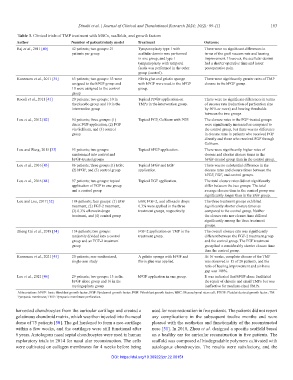
        Table 3. Clinical trials of TMP treatment with MSCs, scaffolds, and growth factors
        Author                 Number of patients/study model  Treatment              Outcome
        Raj et al., 2011 [40]  42 patients; two groups: 21   Tympanoplasty type 1 with   There were no significant differences in
                               patients per group          acellular dermis was performed   terms of the graft success rate and hearing
                                                           in one group, and type 1    improvement. However, the acellular dermis
                                                           tympanoplasty with temporal   had a shorter operative time and lesser
                                                           fascia was performed in the other   postoperative pain.
                                                           group (control).
        Kanemaru et al., 2011 [35]  63 patients; two groups: 53 were   Fibrin glue and gelatin sponge   There were significantly greater rates of TMP
                               assigned to the bFGF group and   with bFGF were used in the bFGF   closure in the bFGF group.
                               10 were assigned to the control   group.
                               group
        Roosli et al., 2011 [41]  20 patients; two groups: 10 in   Topical PDGF application on   There were no significant differences in terms
                               the placebo group and 10 in the   TMPs in the intervention group.  of success rate (reduction of perforation size
                               intervention group                                      by 50% or more) and hearing thresholds
                                                                                       between the two groups.
        Lou et al., 2012 [42]  94 patients; three groups: (1)   Topical FGF, Gelfoam with FGF.  The closure rates in the FGF-treated groups
                               direct FGF application, (2) FGF                         were significantly increased as compared to
                               via Gelfoam, and (3) control                            the control group, but there was no difference
                               group                                                   in closure rates in patients who received FGF
                                                                                       directly and those who received FGF through
                                                                                       Gelfoam.
        Lou and Wang, 2015 [33]  93 patients; two groups:   Topical bFGF application.  There were significantly higher rates of
                               randomized into control and                             closure and shorter closure times in the
                               bFGF-treated groups                                     bFGF-treated group than in the control group.
        Lou et al., 2016 [43]  86 patients; three groups:(1) EGF,   Topical bFGF and EGF   There was no substantial difference in the
                               (2) bFGF, and (3) control group  application.           closure rates and closure times between the
                                                                                       bFGF, EGF, and control groups.
        Lou et al., 2016 [44]  97 patients; two groups: topical   Topical EGF application.  The total closure rates did not significantly
                               application of EGF in one group                         differ between the two groups. The total
                               and a control group                                     average closure time in the control group was
                                                                                       significantly longer than in the EGF group.
        Lou and Lou, 2017 [32]  184 patients; four groups: (1) EGF   EGF, FGF-2, and ofloxacin drops   The three treatment groups exhibited
                               treatment, (2) FGF-2 treatment,   0.3% were applied in the three   significantly shorter closure times as
                               (3) 0.3% ofloxacin drops    treatment groups, respectively.  compared to the control group. Neither
                               treatment, and (4) control group                        the closure rate nor closure time differed
                                                                                       significantly among the three treatment
                                                                                       groups.
        Zheng Cai et al., 2018 [34]  134 patients; two groups:   FGF-2 application on TMP in the   The overall closure rate was significantly
                               randomly divided into a control   treatment group.      different between the FGF-2 treatment group
                               group and an FGF-2 treatment                            and the control group. The FGF treatment
                               group                                                   group had a considerably shorter closure time
                                                                                       than the control group.
        Kanemaru et al., 2021 [45]  20 patients; non-randomized,   A gelatin sponge with bFGF and   At 16 weeks, complete closure of the TMP
                               single-arm study            fibrin glue was applied.    was observed in 15 of 20 patients, and the
                                                                                       ratio of hearing improvement and air-bone
                                                                                       gap was 100%.
        Lou et al., 2021 [46]  29 patients; two groups: 13 in the   bFGF application in one group.  It was indicated that bFGF alone facilitated
                               bFGF alone group and 16 in the                          the repair of chronic and small TMPs but was
                               myringoplasty group                                     ineffective for medium-sized TMPs.
        Abbreviations: bFGF: basic fibroblast growth factor; EGF: Epidermal growth factor; FGF: Fibroblast growth factor; MSC: Mesenchymal stem cell; PDGF: Platelet-derived growth factor; TM:
        Tympanic membrane; TMP: Tympanic membrane perforation.

        harvested chondrocytes from the auricular cartilage and created a   used for nose restoration in five patients. The patients did not report
        gelatinous chondroid matrix, which was then injected into the nasal   any  complications  in  the  subsequent  twelve  months  and  were
        dorsa of 75 patients [50]. The gel hardened to form a neo-cartilage   pleased with the aesthetics and functionality of the reconstructed
        within a few weeks, and the cartilages were still functional after   nose [51]. In 2018, Zhou et al. designed a specific scaffold based
        6 years. Autologous nasal septal chondrocytes were used in human   on a healthy ear for auricular reconstruction in five patients. The
        exploratory trials in 2014 for nasal alar reconstruction. The cells   scaffold was composed of biodegradable polymers cultivated with
        were cultivated on collagen membranes for 4 weeks before being   autologous  chondrocytes.  The  results  were  satisfactory,  and  the
                                                 DOI: https://doi.org/10.36922/jctr.22.00151

