


Page 30 - JCTR-10-3
P. 30
204                       Gupta et al. | Journal of Clinical and Translational Research 2024; 10(3): 201-208
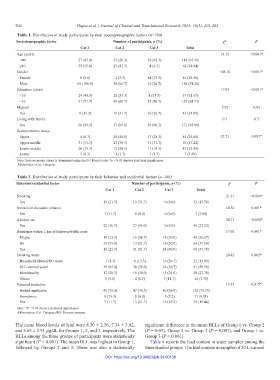
        Table 1. Distribution of study participants by their sociodemographic factors (n=180)
        Sociodemographic factor                  Number of participants, n (%)                  χ 2           P
                                   Cat 1          Cat 2          Cat 3          Total
        Age (years)                                                                            33.12        <0.001*
         <40                      27 (45.0)      35 (58.3)      56 (93.3)     118 (65.56)
         ≥40                      33 (55.0)      25 (41.7)       4 (6.7)       62 (34.44)
        Gender                                                                                 108.16       <0.001*
         Female                    0 (0.0)        2 (3.3)       44 (73.3)      46 (25.56)
         Male                     60 (100.0)     58 (96.7)      16 (26.7)     134 (74.44)
        Education (class)                                                                      17.09        <0.001*
         <10                      29 (48.3)      20 (33.3)      8 (13.3)       57 (31.67)
         ≥10                      31 (51.7)      40 (66.7)      52 (86.7)     123 (68.33)
        Migrant                                                                                5.92          0.05
         Yes                       8 (13.3)      19 (31.7)      16 (26.7)      43 (23.89)
        Living with family                                                                      0.7          0.7
         Yes                      56 (93.3)      57 (95.0)      58 (96.7)     171 (95.00)
        Socioeconomic status
         Upper                     4 (6.7)       24 (40.0)      17 (28.3)      45 (25.00)      23.21        0.001*
         Upper middle             31 (51.7)      23 (38.3)      31 (51.7)      85 (47.22)
         Lower middle             20 (33.3)      12 (20.0)      11 (18.3)      43 (23.89)
         Lower                     5 (8.3)        1 (1.7)        1 (1.7)        7 (3.89)
        Note: Socioeconomic status is determined using the BG Prasad scale; *p < 0.05 denotes statistical significance.
        Abbreviation: Cat: Category.

        Table 2. Distribution of study participants by their behavior and residential factors (n=180)
        Behavior/residential factor                      Number of participants, n (%)            χ 2         P
                                              Cat 1       Cat 2        Cat 3         Total
        Smoking                                                                                  21.51      <0.001*
         Yes                                 13 (21.7)    19 (31.7)    0 (0.0)     32 (17.78)
        Smokeless chewable tobacco                                                               14.56      0.001*
         Yes                                 7 (11.7)     0 (0.0)      0 (0.0)      7 (3.89)
        Alcohol use                                                                              34.71      <0.001*
         Yes                                 22 (36.7)    27 (45.0)    0 (0.0)     49 (27.22)
        Residence within 1 km of highway/traffic zone                                            17.92      0.001*
         Maybe                               14 (23.3)    16 (26.7)   18 (30.0)    48 (26.67)
         No                                  33 (55.0)    13 (21.7)   18 (30.0)    64 (35.56)
         Yes                                 13 (21.7)    31 (51.7)   24 (40.0)    68 (37.78)
        Drinking water                                                                           20.42      0.002*
         Household filtered/RO water          1 (1.7)     8 (13.3)    16 (26.7)    25 (13.89)
         20 L-canned water                   39 (65.0)    30 (50.0)   22 (36.7)    91 (50.56)
         Municipality                        17 (28.3)    18 (30.0)   15 (25.0)    50 (27.78)
         Others                               3 (5.0)     4 (6.7)      7 (11.7)     14 (7.78)
        Personal protective                                                                      12.33      0.015*
         No/not applicable                   45 (75.0)    47 (78.3)   40 (69.0)    132 (73.33)
         Sometimes                           8 (13.3)     0 (0.0)      3 (5.2)      11 (6.11)
         Yes                                 7 (11.7)     13 (21.7)   15 (25.9)    35 (19.44)
        Note: *P < 0.05 denotes statistical significance.
        Abbreviation: Cat: Category; RO: Reverse osmosis.

        The mean blood levels of lead were 8.50 ± 2.36, 7.34 ± 3.02,   significant difference in the mean BLLs of Group 1 vs. Group 2
        and 5.65 ± 2.91 µg/dL for Groups 1, 2, and 3, respectively. The   (P = 0.03), Group 2 vs. Group 3 (P = 0.007), and Group 1 vs.
        BLLs among the three groups of participants were statistically   Group 3 (P < 0.001).
        significant (P < 0.001). The mean BLL was highest in Group 1,   Table 4 reports the lead content in water samples among the
        followed by Groups  2 and 3.  There was also a statistically   three studied groups. The lead content in samples of 20 L-canned

                                              DOI: https://doi.org/10.36922/jctr.23.00130

