


Page 31 - JCTR-10-3
P. 31
Gupta et al. | Journal of Clinical and Translational Research 2024; 10(3): 201-208   205
        water in each group was more than 10 µg/L. In Group 2, the lead   L-canned water are significant risk factors for high BLLs, i.e.,
        levels were 29.34 µg/L in a sample of household filter water and   ≥5  µg/dL.  On adjustment  in  multivariate  logistic  regression,
        18.06 µg/L in a sample of facility-based water. In Group 3, the   male  gender  and  direct  occupational  exposure  are  significant
        lead levels were 16.43 µg/L in a sample of municipality water.  risk factors for high BLLs, i.e., ≥5 µg/dL (Table 5).
          Bivariate analysis revealed that age ≥40 years, male gender,
        direct occupational  exposure, education  <10   class, lower   4. Discussion
                                              th
        socioeconomic  status, use of alcohol,  and drinking  from 20   The present study was conducted to estimate and compare
                                                               BLLs among the adult population with and without occupational
        Table 3. Distribution of participants in the three groups by occupation  lead exposure. The present study was the first of its kind for
        Occupation            Number of participants, n (%)    its  community-based  BLL  estimation  among  three  different
                        Group 1  Group 2  Group 3  Total       exposed groups in  Andhra  Pradesh, India, namely  direct
        Carpenter, or   15 (25.00)                15 (8.30)    occupational  exposure, indirect air pollution  exposure, and
        welding worker                                         indirect  non-occupational  exposure to lead. This study found
        Car mechanics   5 (8.30)                   5 (2.80)    that the majority of participants had high BLLs. The WHO has
        Painters       22 (36.70)                 22 (12.20)   established a reference value of 5 µg/dL BLL as the threshold at
        Construction worker  18 (30.00)           18 (10.00)   which public health action is recommended [14]. In the present
        Petrol bunkers           8 (13.33)         8 (4.44)    study, mean  BLLs in all  three  groups were higher  than  the
        Auto drivers            20 (33.30)        20 (11.10)   reference value. In India, the Bureau of Indian Standards set
        Traffic police          30 (50.00)        30 (16.70)   a maximum permissible limit of 10 µg/L for lead in drinking
        Driver                   2 (3.30)          2 (1.10)    water [15]. The lead content in all four samples of 20 L-canned
        Office workers                   24 (40.00)  28 (15.60)  water  and one reverse  osmosis (RO) plant  was more  than
        ASHA and                         25 (41.70)  25 (13.90)  permissible.
        Anganwadi worker                                         Occupational  lead exposure may occur in various labor-
        Teachers                          5 (8.30)  5 (2.80)   based  fields,  such  as  construction,  painting,  smelting,  and
        Student                           2 (3.30)  2 (1.10)   others.  Therefore, the BLL of these workers is much higher
        Manual labor                      2 (3.30)  2 (1.10)   than in the general population. In the air, lead particles can be
        Housewife                         1 (1.70)  1 (60.00)  inhaled by individuals and enter their bloodstream. The WHO
        Private job                       1 (1.70)  1 (1.70)   has established  a  guideline  value for lead  in  outdoor air  of
        Total          60 (100.00) 60 (100.00) 60 (100.00) 180 (100.00)  0.5 µg/m³ [16]. Despite the use of unleaded fuels in some parts
        Abbreviation: ASHA: Accredited social health activist.  of India, lead levels in outdoor air still exceed this guideline [17].
                                                                 In the present study, the not occupationally exposed group
                                                               mainly  consisted  of  primary  health-care  workers  and  office-
        Table 4. Lead  content  in  water  samples  among the  three  studied
        groups (n=12)                                          based workers. While not being exposed to occupational lead
        Sample type               Water lead content (µg/L)    or air pollution zones, the mean BLL in this group was also
                                                               more than 5 µg/dL. One of the primary reasons for the high
                             Group 1     Group 2    Group 3    BLL in this group could be the use of 20 L-canned water for
        20 L-canned water     16.38       12.23      65.11     drinking  purposes.  The  finding  suggests  that  the  purification
        Household filter water   7.28     29.34      7.56      techniques  for  these  water  plants  are  suboptimal.  RO  plants
        Facility-based water   4.79       18.06      7.71      should be equipped with updated technology for testing heavy
        Municipality water     7.1         7.5       16.43     metals. Although lead can enter the water supply from a variety


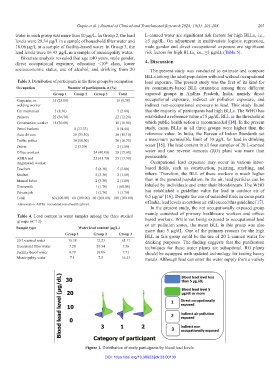
                                     Figure 1. Distribution of study participants by blood lead levels.
                                              DOI: https://doi.org/10.36922/jctr.23.00130

