


Page 32 - JCTR-10-3
P. 32
206                       Gupta et al. | Journal of Clinical and Translational Research 2024; 10(3): 201-208
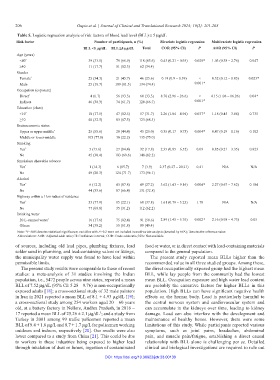
        Table 5. Logistic regression analysis of risk factors of blood lead level (BLL) ≥ 5 µg/dL
        Risk factor                      Number of participants, n (%)  Bivariate logistic regression  Multivariate logistic regression
                                     BLL <5 µg/dL  BLL ≥5 µg/dL  Total  COR (95% CI)  P     AOR (95% CI)    P
        Age (years)
         <40 ^                         39 (33.1)  79 (66.9)  118 (65.6)  0.43 (0.21 – 0.93)  0.029*  1.03 (0.38 – 2.76)  0.947
         ≥40                           11 (17.7)  51 (82.3)  62 (34.4)
        Gender
         Female ^                      25 (54.3)  21 (45.7)  46 (25.6)  0.19 (0.9 – 0.39)  <   0.32 (0.12 – 0.85)  0.023*
         Male                          25 (18.7)  109 (81.3)  134 (74.4)            0.001*
        Occupation (exposure)
         Direct ^                      4 (6.7)    56 (93.3)  60 (33.3)  8.70 (2.96 – 26.6)  <   4.15 (1.06 – 16.26)  0.04*
         Indirect                      46 (38.3)  74 (61.7)  120 (66.7)             0.001*
        Education (class)
         <10 ^                         10 (17.5)  47 (82.5)  57 (31.7)  2.26 (1.04 – 4.94)  0.037*  1.18 (0.45 – 3.08)  0.735
         ≥10                           40 (32.5)  83 (67.5)  123 (68.3)
        Socioeconomic status
         Upper or upper middle ^       25 (55.6)  20 (44.4)  45 (25.0)  0.35 (0.17 – 0.73)  0.004*  0.47 (0.19 – 1.16)  0.102
         Middle or lower-middle       105 (77.8)  30 (22.2)  135 (75.0)
        Smoking
         Yes ^                         5 (15.6)   27 (84.4)  32 (17.8)  2.35 (0.85 – 6.52)  0.09  0.85 (0.21 – 3.35)  0.823
         No                            45 (30.4)  103 (69.6)  148 (82.2)
        Smokeless chewable tobacco
         Yes ^                         1 (14.3)    6 (85.7)  7 (3.9)  2.37 (0.27 – 20.21)  0.41  N/A        N/A
         No                            49 (28.3)  124 (71.7)  173 (96.1)
        Alcohol
         Yes ^                         6 (12.2)   43 (87.8)  49 (27.2)  3.62 (1.43 – 9.16)  0.004*  2.27 (0.67 – 7.62)  0.184
         No                            44 (33.6)  87 (66.4)  131 (72.8)
        Highway within a 1 km radius of residence
         Yes ^                         53 (77.9)  15 (22.1)  68 (37.8)  1.61 (0.79 – 3.23)  1.78  N/A       N/A
         No                            77 (68.8)  35 (31.2)  112 (62.2)
        Drinking water
         20 L-canned water ^           16 (17.6)  75 (82.4)  91 (50.6)  2.89 (1.45 – 5.76)  0.002*  2.16 (0.98 – 4.73)  0.05
         Others                        34 (38.2)  55 (61.8)  89 (49.4)
        Note: *P<0.05 denotes statistical significance; variables with P>0.2 were not included in multivariate analysis (denoted by N/A);  denotes the reference value.
                                                                                 ^
        Abbreviations: AOR: Adjusted odds ratio; CI: Confidence interval; COR: Crude odds ratio; N/A: Not available.
        of  sources,  including  old  lead  pipes,  plumbing  fixtures,  lead   food or water, or in direct contact with lead-containing materials
        solder used in plumbing, and lead-containing valves or fittings,   compared to the general population.
        the municipality water supply was found to have lead within   The present study reported mean BLLs higher than the
        permissible limits.                                    recommended value in all three studied groups. Among these,
          The present study results were comparable to those of recent   the direct occupationally exposed group had the highest mean
        studies: a meta-analysis  of 31 studies involving the Indian   BLL, while lay people from the community had the lowest
        population, i.e., 5472 people across nine states, reported a mean   mean BLL. Occupation exposure and high water lead content
        BLL of 7.52 µg/dL (95% CI: 5.28 – 9.76) in non-occupationally   are probably the causative factors for higher BLLs in this
        exposed adults [18]; a cross-sectional study of 32 male painters   population. High BLLs can have significant negative health
        in Iran in 2021 reported a mean BLL of 8.1 ± 4.93 µg/dL [19];   effects  on  the  human  body.  Lead  is  particularly  harmful  to
        a cross-sectional study among 254 workers aged 20 – 60 years   the central nervous system and cardiovascular system and
        old, at a battery factory in Nellore, Andhra Pradesh, in 2016 –   can accumulate in the kidneys over time, leading to kidney
        17 reported a mean BLL of 25.26 ± 2.1 µg/dL ; and a study from   damage.  Lead  can  also  interfere  with  the  development  and
                                            3
        Turkey in 2001 among 99 traffic policemen reported a mean   maintenance of  healthy  bones.  However,  there  were  some
        BLL of 9.4 ± 1.6 µg/L and 8.7 ± 1.7 µg/L for policemen working   limitations of this study. While participants reported various
        outdoors and indoors, respectively [20]. Our results were also   symptoms, such as joint pains, headaches, abdominal
        lower compared to a study from China [21]. This could be due   pain, and muscle pain/fatigue, establishing a direct causal
        to  workers in  these  industries  being  exposed  to higher  lead   relationship with BLL alone is challenging per se. Detailed
        through inhalation of dust or fumes, ingestion of contaminated   clinical and biological investigations are required to rule out

                                              DOI: https://doi.org/10.36922/jctr.23.00130

