


Page 20 - JCTR-10-4
P. 20
242                       de Almeida et al. | Journal of Clinical and Translational Research 2024; 10(4): 237-245
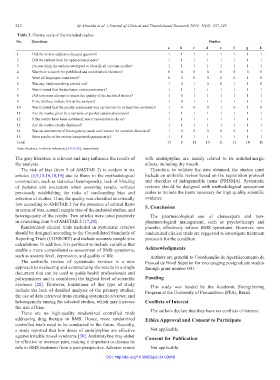
        Table 3. Glenny scale of the included studies
        No.   Questions                                                                   Studies
                                                                        a     b    c     d     e    f     g    h
        1      Did the review address a focused question?                1    1    1     1     1    1     1     1
        2      Did the authors look for appropriate papers?              1    1    1     1     1    1     1     1
        3      Do you think the authors attempted to identify all relevant studies?  1  1  1  1  1  1     1     1
        4      Was there a search for published and unpublished literature?  0  0  0     0     0    0     0     0
        5      Were all languages considered?                            0    0    0     0     0    0     1     0
        6      Was any hand-searching carried out?                       1    0    1     0     0    1     1     0
        7      Was it stated that the inclusion criteria reviewers?      1    1    1     1     1    1     1     1
        8      Did reviewers attempt to assess the quality of the included studies?  1  0  1  1  1  1     1     1
        9      If so, did they include this in the analysis?             1    0    1     1     1    1     1     1
        10     Was it stated that the quality assessment was carried out by at least two reviewers?  1  0  0  0  1  0  1  0
        11     Are the results given in a narrative or pooled statistical analysis?  1  1  1  1  1  1     1     1
        12     If the results have been combined, was it reasonable to do so?  1  1  1   1     1    1     1     1
        13     Are the results clearly displayed?                        1    1    1     1     1    1     1     1
        14     Was an assessment of heterogeneity made and reasons for variation discussed?  1  0  0  0  0  0  1  1
        15     Were results of the review interpreted appropriately?     1    1    1     1     1    1     1     1
        Total                                                           13    8    11    10   11    11    14   11
        Note: Studies a–h refer to references [5,9,15-20], respectively.
        The gray literature is relevant and may influence the results of   with  amitriptyline  are  mainly  related  to  its  anticholinergic
        the analysis.                                          effects, including dry mouth.
          The risk of bias (item 9 of AMSTAR 2) is evident in six   Therefore, to validate the data obtained, the studies must
        articles  [5,9,15,16,18,19]  due  to  flaws  in  the  methodological   include an umbrella review based on the registration protocol
        construction, such as statistical heterogeneity, lack of blinding   and  checklist  of  indispensable  items  (PRISMA).  Systematic
        of  patients  and  evaluators  when  assessing  results,  without   reviews should be designed with methodological  assessment
        previously  establishing  the  risks  of  confounding  bias  and   scales to include the items necessary for high-quality scientific
        selection of studies. Thus, the quality was classified as critically   evidence.
        low according to AMSTAR 2 for the presence of critical flaws   5. Conclusion
        in terms of bias, a small sample size of the included studies, and
        heterogeneity of the results. Two articles were rated positively   The  pharmacological  use  of  clonazepam  and  non-
        in evaluating item 9 of AMSTAR 2 [17,20].              pharmacological  management,  such  as  psychotherapy  and
          Randomized  clinical  trials  included  in  systematic  reviews   placebo,  effectively  relieve  BMS  symptoms.  However,  new
        should be designed according to the Consolidated Standards of   randomized clinical trials are suggested to investigate treatment
        Reporting Trials (CONSORT) and include accurate sample size   protocols for the condition.
        calculations. In addition, it is pertinent to include variables that
        enable a more comprehensive assessment of BMS symptoms,   Acknowledgments
        such as anxiety level, depression, and quality of life.  Authors are grateful to Coordenação de Aperfeiçoamento de
          The umbrella review of systematic reviews is a new   Pessoal de Nível Superior for encouraging postgraduate studies
        approach to evaluating and summarizing the results in a single   through grant number 001.
        document that can be used to guide health professionals and
        policymakers and is considered the highest level of scientific   Funding
        evidence [28].  However,  limitations  of  this  type  of  study   This study was funded by the  Academic  Strengthening
        include the lack of detailed analysis of the primary studies;   Program at the University of Pernambuco (PFA), Brazil.
        the use of data retrieved from existing systematic reviews; and
        heterogeneity among the selected studies, which may increase   Conflicts of Interest
        the risk of bias.
          There  are  no  high-quality  randomized  controlled  trials   The authors declare that they have no conflicts of interest.
        addressing  drug  therapy  in  BMS.  Hence,  more  randomized   Ethics Approval and Consent to Participate
        controlled trials need to be conducted in the future. Recently,
        a study reported that low doses of amitriptyline are effective   Not applicable.
        against irritable bowel syndrome [30]. Amitriptyline may either   Consent for Publication
        be effective or increase pain, making it important to discuss its
        role in BMS treatment from a pain perspective. Adverse events   Not applicable.

                                               DOI: http://doi.org/10.36922/jctr.24.00018

