


Page 14 - JCTR-11-1
P. 14
Journal of Clinical and
            Translational Research                                               Cannabinoids for cannabis use disorder


                                                               3.3.2. Abstinence
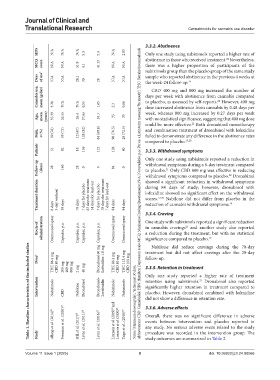
                 HDS    N/A  N/A  N/A  5.3  5.3   N/A  2.85    Only one study using nabiximols reported a higher rate of
                                                                                                 24
                 MCQ   score  N/A  N/A  51.9  4.1  41.25  N/A  N/A  abstinence in those who received treatment.  Nevertheless,
                                                               there was a higher proportion of participants of the
                                                               nabiximols group than the placebo group of the same study
                 Days   of use †  N/A  N/A  28.1  30  28  N/A  N/A  sample who reported abstinence in the previous 4 weeks at
                                                                                 24
                                                               the week-24 follow-up.
                 Cannabis use,   mean (g/day)  3.28  N/A  N/A  0.55  1.65  2.3  0.86  days per week with abstinence from cannabis compared
                                                                 CBD  400  mg  and  800  mg  increased  the  number  of
                                                               to placebo, as assessed by self-reports.  However, 400 mg
                                                                                              22
                                                               week, whereas 800  mg increased by 0.27  days per week
                 Age,   mean   (years)  35.39  26.55  26.4  37.65  35.1  35  33  dose increased abstinence from cannabis by 0.48 days per
                                                               with no statistical significance, suggesting that 400 mg dose
                                                               could be more effective.  Both dronabinol monotherapy
                                                                                   22
                 Male,    n (%)  39 (76)  59 (72)  12 (67)  128 (82)  84 (68.8)  98 (76.5)  29 (72.5)  and combination treatment of dronabinol with lofexidine
                                                               failed to demonstrate any difference in the abstinence rates
                                                               compared to placebo. 17,20
                 Patients  51  82  18  156  122   128  40      3.3.3. Withdrawal symptoms

                                                               Only one study using nabiximols reported a reduction in
                 Follow‑up   (days)  28  140  28  0  0  84  0  withdrawal symptoms during a 6-day treatment compared
                                                               to placebo.  Only CBD 800 mg was effective in reducing
                                                                        21
                                                               withdrawal symptoms compared to placebo.  Dronabinol
                                                                                                  22
                                                               showed a significant reduction in withdrawal symptoms
                 Treatment duration  3-day washout  7 days for placebo  63 days for treatment  14 days for lead-out  7 days for placebo  70 days for treatment  7 days for lead-out Abbreviations: CBD: Cannabidiol; HDS: Hamilton Depression scale; MCQ: Marijuana Craving Questionnaire; N/A: Not available; p.o.: Per os, a Latin term meaning “by mouth”; THC: Tetrahydrocannabinol.  during 84  days of study; however, dronabinol with
                                                               lofexidine showed no significant effect on the withdrawal
                                                                        Nabilone did not differ from placebo in the
                                                               scores.
                                                                    17,20
                            30 days
                                  70 days
                                                  84 days
                                                      84 days
                        6 days
                                                               reduction of cannabis withdrawal symptoms.
                                                                                                   18
                                                               3.3.4. Craving
                 Route of   administration  Oromucosal spray  Capsules, p.o.  Capsules, p.o.  Capsules, p.o.  Capsules, p.o.  Oromucosal spray  Oromucosal spray  One study with nabiximols reported a significant reduction
                                                               in cannabis cravings  and another study also reported
                                                                                21
                                                               a reduction during the treatment, but with no statistical
                                                               significance compared to placebo.
                                                                                          19
             Table 1. Baseline characteristics of the included studies
                                                                 Nabilone did reduce cravings during the 70-day
                        THC 86.4 mg  CBD 80 mg  200 mg  400 mg  800 mg  2 mg  40 mg  THC 86.4 mg  CBD 80 mg  THC 113.4 mg  CBD 105 mg  3.3.5. Retention in treatment
                 Dose §                    Dronabinol 60 mg  Lofexidine 1.8 mg  treatment but did not affect cravings after the 28-day
                                                               follow-up.
                 Intervention  Nabiximols  CBD  Nabilone  Dronabinol  Dronabinol+   Lorefexidin  Nabiximols  Nabiximols Notes:  § Maximum dose/mg/day;  † in the past 30 days.  Only one study reported a higher rate of treatment
                                                               retention using nabiximols.  Dronabinol also reported
                                                                                      21
                                                               significantly higher retention in treatment compared to
                                                               placebo. However, dronabinol combined with lofexidine
                                                               did not show a difference in retention rate.

                        Allsop et al. (2014) 21  Freeman et al. (2020) 22  Hill et al. (2017) 18  Levin et al. (2011) 20  Levin et al. (2016) 17  Lintzeris et al. (2019) 23  and   Lintzeris et al. (2020) 24  Trigo et al., (2018) 19  3.3.6. Adverse effects
                                                               Overall,  there  was  no  significant  difference  in  adverse
                                                               events between intervention and placebo reported in
                                                               any study. No serious adverse event related to the study
                 Study                                         procedure was recorded in the intervention group. The
                                                               study outcomes are summarized in Table 2.


            Volume 11 Issue 1 (2025)                        8                             doi: 10.36922/jctr.24.00066

