


Page 15 - JCTR-11-1
P. 15
Journal of Clinical and
            Translational Research                                               Cannabinoids for cannabis use disorder


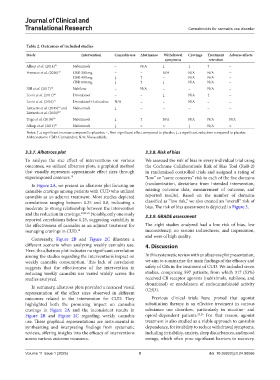
            Table 2. Outcomes of included studies
            Study                   Intervention  Cannabis use  Abstinence  Withdrawal   Cravings  Treatment   Adverse effects
                                                                       symptoms           retention
            Allsop et al. (2014) 21  Nabiximols   =          N/A      ↓          ↓       ↑         =
            Freeman et al. (2020) 22  CBD 200 mg  =          =        N/A        N/A     N/A       =
                                CBD 400 mg        ↓          ↑        =          N/A     N/A       =
                                CBD 800 mg        ↓          ↑        ↓          N/A     N/A       =
            Hill et al. (2017) 18  Nabilone       =          N/A      =          =       N/A       =
            Levin et al. (2011) 20  Dronabinol    =          =        ↓          N/A     ↑         =
            Levin et al. (2016) 17  Dronabinol+Lofexidine  N/A  =     =          N/A     =         =
            Lintzeris et al. (2019)  and   Nabiximols  ↓     =        =          =       =         =
                          23
            Lintzeris et al. (2020) 24
            Trigo et al. (2018) 19  Nabiximols    ↓          ↑        N/A        N/A     N/A       N/A
            Allsop et al. (2014) 21  Nabiximols   ↓          =        =          ↓       N/A       =
            Notes: ↑, a significant increase compared to placebo; =, Non-significant effect compared to placebo; ↓, a significant reduction compared to placebo.
            Abbreviations: CBD: Cannabidiol; N/A: Not available.


            3.3.7. Albatross plot                              3.3.8. Risk of bias
            To analyze the size effect of interventions on various   We assessed the risk of bias in every individual trial using
            outcomes, we utilized albatross plots, a graphical method   the  Cochrane  Collaboration’s  Risk  of  Bias  Tool  (RoB-2)
            that  visually represents  approximate  effect  sizes through   in randomized controlled trials and assigned a rating of
            superimposed contours. 15                          “low” or “some concerns” risk to each of the five domains
              In Figure 2A, we present an albatross plot focusing on   (randomization, deviations from intended intervention,
            cannabis cravings among patients with CUD who utilized   missing outcome data, measurement of outcome, and
            cannabis as an adjunct treatment. Most studies depicted   reported results). Based on the number of domains
            correlations  ranging  between  0.25  and  0.8,  indicating  a   classified as “low risk,” we also created an “overall” risk of
            moderate to strong relationship between the intervention   bias. The risk of bias assessment is depicted in Figure 3.
            and the reduction in cravings. 19,21,23  Notably, only one study   3.3.9. GRADE assessment
            reported correlations below 0.25, suggesting variability in
            the effectiveness of cannabis as an adjunct treatment for   The eight studies analyzed had a low risk of bias, low
            managing cravings in CUD. 18                       inconsistency, no serious indirectness, and imprecision,
                                                               and were of high quality.
              Conversely,  Figure  2B  and Figure  2C illustrate a
            different scenario when analyzing weekly cannabis use.   4. Discussion
            Here, the albatross plot indicates no significant correlation
            among the studies regarding the intervention’s impact on   In this systematic review with an albatross plot presentation,
            weekly cannabis consumption. This lack of correlation   we aim to summarize the main findings of the efficacy and
            suggests that the effectiveness of the intervention in   safety of CBs in the treatment of CUD. We included seven
            reducing weekly cannabis use varied widely across the   studies, comprising 597 patients, from which 317 (53%)
            studies analyzed.                                  received CB receptor agonists (nabiximols, nabilone, and
                                                               dronabinol) or modulators of endocannabinoid activity
              In summary, albatross plots provided a nuanced visual   (CBD).
            representation of the effect sizes observed in different
            outcomes related to the intervention for CUD. They   Previous clinical trials have proved that agonist
            highlighted both the promising impact on cannabis   substitution therapy is an effective treatment in various
            cravings in  Figure  2A and the inconsistent results in   substance use disorders, particularly in nicotine-  and
            Figure  2B  and  Figure  2C  regarding  weekly  cannabis   opioid-dependent patients. 25,26  For that reason, agonist
            use. These graphical representations are instrumental in   treatment is also studied as a viable approach to cannabis
            synthesizing  and  interpreting  findings  from  systematic   dependence, for its ability to reduce withdrawal symptoms,
            reviews, offering insights into the efficacy of interventions   including irritability, anxiety, sleep disturbances, and mood
            across various outcome measures.                   swings, which often pose significant barriers to recovery.


            Volume 11 Issue 1 (2025)                        9                             doi: 10.36922/jctr.24.00066

