


Page 28 - JCTR-11-1
P. 28
Journal of Clinical and
            Translational Research                                                Pesticides and ischemic heart disease


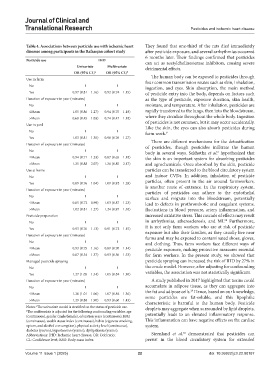
            Table 4. Associations between pesticide use with ischemic heart   They found that one-third of the rats died immediately
            diseases among participants in the Rafsanjan cohort study  after pesticide exposure, and several arrhythmias occurred
                                                               6  months later. Their findings confirmed that pesticides
            Pesticide use                  IHD                 can act as acetylcholinesterase inhibitors, causing severe
                                  Univariate   Multivariate    detrimental effects.
                                 OR (95% CL) a  OR (95% CL) b
                                                                 The human body can be exposed to pesticides through
            Use in farm                                        four common transmission routes such as skin, inhalation,
             No                      1             1           ingestion, and eyes. Skin absorption, the main method
             Yes                0.97 (0.81 – 1.16)  0.92 (0.74 – 1.15)  of pesticide entry into the body, depends on factors such
            Duration of exposure in year (minutes)             as the type of pesticide, exposure duration, skin health,
             No                      1             1           moisture, and temperature. After inhalation, pesticides are
             ≤Mean              1.05 (0.86 – 1.27)  0.94 (0.75 – 1.18)  rapidly transferred to the lungs, then into the bloodstream,
             >Mean              0.68 (0.45 – 1.03)  0.74 (0.47 – 1.18)  where they circulate throughout the whole body. Ingestion
            Use in yard                                        of pesticides is not common, but it may occur accidentally.
                                                               Like the skin, the eyes can also absorb pesticides during
             No                      1             1           farm work. 9
             Yes                1.03 (0.81 – 1.30)  0.98 (0.76 – 1.27)
                                                                 There are different mechanisms for the detoxification
            Duration of exposure in year (minutes)             of pesticides, though pesticides infiltrate the human
             No                      1             1           body in several ways. Sekhotha et al.  hypothesized that
                                                                                              8
             ≤Mean              0.94 (0.71 – 1.23)  0.87 (0.65 – 1.18)  the skin is an important system for absorbing pesticides
             >Mean              1.35 (0.88 – 2.07)  1.36 (0.85 – 2.17)  and agrochemicals. Once absorbed by the skin, pesticide
            Use at home                                        particles can be transferred to the blood circulatory system
             No                      1             1           and induce CVDs. In addition, inhalation of pesticide
             Yes                0.89 (0.76 – 1.04)  1.09 (0.92 – 1.29)  particles,  often  present  in  the  air  around  farmworkers,
            Duration of exposure in year (minutes)             is another route of entrance. In the respiratory system,
                                                               particles of pesticides can adhere to the endothelial
             No                      1             1           surface  and migrate  into the bloodstream, potentially
             ≤Mean              0.85 (0.72 – 0.99)  1.03 (0.87 – 1.23)  lead to defects in prothrombotic and coagulant systems,
             >Mean              1.02 (0.81 – 1.27)  1.24 (0.97 – 1.58)  fluctuations in blood pressure, artery inflammation, and
            Pesticide preparation                              increased oxidative stress. This cascade of effects may result
                                                                                                28
             No                      1             1           in arrhythmias, atherosclerosis, and MI.  Furthermore,
             Yes                0.93 (0.76 – 1.13)  0.91 (0.72 – 1.15)  it is not only farm workers who are at risk of pesticide
            Duration of exposure in year (minutes)             exposure but also their families, as they usually live near
                                                               farms and may be exposed to contaminated shoes, gloves,
             No                      1             1
                                                               and clothing. Thus, farm workers face different ways of
             ≤Mean              0.93 (0.75 – 1.16)  0.89 (0.70 – 1.14)  pesticide exposure, making protective measures essential
             >Mean              0.87 (0.54 – 1.37)  0.93 (0.56 – 1.53)  for farm workers. In the present study, we showed that
            Managed pesticide spraying                         pesticide spraying can increased the risk of IHD by 27% in
             No                      1             1           the crude model. However, after adjusting for confounding
             Yes                1.27 (1.05 – 1.54)  1.05 (0.84 – 1.30)  variables, the association was not statistically significant.
            Duration of exposure in year (minutes)               A study published in 2017 highlighted that toxins could
             No                      1             1           accumulate in adipose tissue, as they can aggregate into
                                                                                  29
             ≤Mean              1.26 (1.01 – 1.06)  1.07 (0.84 – 1.36)  the fat and adipose cells.  Hence, based on our knowledge,
                                                               some pesticides are fat-soluble, and this lipophilic
             >Mean              1.29 (0.88 – 1.90)  0.93 (0.60 – 1.43)  characteristic is harmful to the human body. Pesticide
            Notes:  The univariate model is stratified on the status of pesticide use.   droplets may aggregate when surrounded by lipid droplets,
                a
            b The multivariate is adjusted for the following confounding variables: age
            (continuous), gender (male/female), education years (continuous), BMI   potentially leads to an elevated inflammatory response.
            (continuous), wealth status index (continuous), habits (cigarette smoking,   This inflammation can have negative effects on the cardiac
            opium, and alcohol consumption), physical activity level (continuous),   system.
            diabetes (yes/no), hypertension (yes/no), dyslipidemia (yes/no).   30
            Abbreviations: IHD: Ischemic heart disease; OR: Odd ratio;   Steenland  et al.  demonstrated that pesticides can
            CL: Confidence level; BMI: Body mass index.        persist in the blood circulatory system for extended

            Volume 11 Issue 1 (2025)                        22                            doi: 10.36922/jctr.22.00187

