


Page 36 - JCTR-11-1
P. 36
Journal of Clinical and
            Translational Research                                                 Dexamethasone in critical COVID-19


            Table 1. (Continued)
            Features                                      Patient number (%)               Demise
                                                                                   Yes                No
                                                                                  n (%)              n (%)
            Urea
             Distribution - n (%)
               <48.5                                          5 (22.7)            1 (20.0)          4 (80.0)
               ≥48.5                                          17 (77.3)           8 (47.1)          9 (52.9)
            Abbreviations: AST: Aspartate aminotransferase; ALT: Alanine aminotransferase; CI: Confidence interval; BMI: Body mass index.

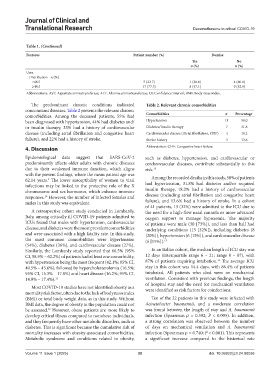
              The predominant chronic conditions indicated     Table 2. Relevant chronic comorbidities
            concomitant diseases. Table 2 presents the relevant chronic
            comorbidities. Among the deceased patients, 55% had   Comorbidities                  n   Percentage
            been diagnosed with hypertension, 44% had diabetes and/  Hypertension                11     50.0
            or insulin therapy, 33% had a history of cardiovascular   Diabetes/Insulin therapy   7      31.8
            disease (including atrial fibrillation and congestive heart   Cardiovascular disease (Atrial fibrillation, CHF)  4  18.2
            failure), and 22% had a history of stroke.         Stroke history                    3      13.6

            4. Discussion                                      Abbreviation: CHF: Congestive heart failure.
            Epidemiological  data  suggest  that  SARS-CoV-2   such as diabetes, hypertension, and cardiovascular or
            predominantly affects older adults with chronic diseases   cerebrovascular diseases, contribute substantially to this
            due  to  their  weakened  immune  function,  which  aligns   risk. 13
            with the present findings, where the mean patient age was
            62.14  years.  The  lower  susceptibility of  women  to viral   Among the recorded deaths in this study, 50% of patients
                     9
            infections may be linked to the protective role of the X   had hypertension, 31.8% had diabetes and/or required
            chromosome and sex hormones, which enhance immune   insulin therapy, 18.2% had a history of cardiovascular
            responses.  However, the number of infected females and   disease (including atrial fibrillation and congestive heart
                    10
            males in this study was equivalent.                failure), and 13.6% had a history of stroke. In a cohort
                                                               of 41 patients, 13 (32%) were admitted to the ICU due to
              A retrospective cohort study conducted in Lombardy,   the need for a high-flow nasal cannula or more advanced
            Italy, among critically ill COVID-19 patients admitted to   oxygen support to manage hypoxemia. The majority
            ICUs found that males with hypertension, cardiovascular   of patients were male (30 [73%]), and less than half had
            disease, and diabetes were the most prevalent comorbidities   underlying conditions (13 [32%]), including diabetes (8
            and were associated with a high fatality rate. In this study,   [20%]), hypertension (6 [15%]), and cardiovascular disease
            the  most  common  comorbidities  were  hypertension   (6 [15%]). 13
            (54%), diabetes (36%), and cardiovascular disease (27%).
            Similarly, the Lombardy study reported that 60.5% (95%   In an Italian cohort, the median length of ICU stay was
            CI, 58.9% – 62.2%) of patients had at least one comorbidity,   12  days (interquartile range 6 – 21; range 0 – 87), with
                                                                                             11
            with hypertension being the most frequent (42.1%; 95% CI,   87% of patients requiring intubation.  The average ICU
            40.5% – 43.6%), followed by hypercholesterolemia (16.5%;   stay in this cohort was 14.4 days, with 86.4% of patients
            95% CI, 15.3% – 17.8%) and heart disease (16.2%; 95% CI,   intubated. All patients who died were on mechanical
            14.9% – 17.4%). 11                                 ventilation. Consistent with previous findings, the length
                                                               of hospital stay and the need for mechanical ventilation
              Most COVID-19 studies have not identified obesity as a   were identified as risk factors for coinfections.
            mortality risk factor, often due to the lack of body mass index
            (BMI) or total body weight data, as in this study. Without   Ten of the 22 patients in this study were infected with
            BMI data, the degree of obesity in the population could not   Acinetobacter baumannii, and a moderate correlation
            be assessed.  However, obese patients are more likely to   was found between the length of stay and A. baumannii
                     12
            develop critical illness compared to nonobese individuals,   infection (Spearman  ρ = 0.592;  P < 0.005). In addition,
            and they frequently have other metabolic disorders, such as   a strong correlation was observed between the number
            diabetes. This is significant because the cumulative risk of   of days on mechanical ventilation and  A. baumannii
            mortality increases with obesity-associated comorbidities.   infection (Spearman ρ = 0.740; P < 0.001). This represents
            Metabolic syndrome and conditions related to obesity,   a  significant  increase  compared  to  the  historical  rate


            Volume 11 Issue 1 (2025)                        30                            doi: 10.36922/jctr.24.00036

