


Page 104 - JCTR-11-2
P. 104
Journal of Clinical and
            Translational Research                                             Review of research landscapes and quality


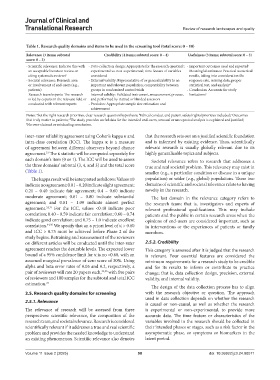
            Table 1. Research quality domains and items to be used in the screening tool (total score: 0 – 10)
            Relevance (3 items; subtotal     Credibility (4 items; subtotal score: 0 – 4)  Usefulness (3 items; subtotal score: 0 – 3)
            score: 0 – 3)
            -  Scientific relevance: Indicate this with  -  Data-collection design: Appropriate for the research question ;  -  Important outcomes used and reported c
                                                                               b
             an acceptable literature review or   experimental vs. non-experimental; time feature of variables   -  Meaningful estimates: Practical numerical
             citing systematic reviews a  considered                              results, taking into consideration the
            -  Societal relevance: Research area   -  External validity: Representative of or generalizability to an   response rate, missing data, proper
             or involvement of end-users (e.g.,   important and relevant population; comparability between   statistical test, and analysis d
             patients)                  groups in randomized control trials      -  Conclusion: Accounts for study
            -  Research team/experts: The research   -  Internal validity: Validated instrument, measurement process,   limitations e
             is led by experts in the relevant field or  and performed by trained or blinded assessors
             conducted with relevant experts  -  Precision: Appropriate sample size estimation and
                                        achievement
            Notes:  Set the right research priorities, clear research question/hypothesis;  Ethical conduct and patient safety/rights/priorities included;  Outcomes
                 a
                                                            b
                                                                                                    c
            that truly matter to patients;  The study provides useful data for the intended end-users, unusual or unexpected analysis is explained and justified;
                               d
            e No over-claimed or misleading conclusion.
            inter-rater reliability agreement using Cohen’s kappa κ and   that the research sets out on a justified scientific foundation
            intra-class correlation (ICC). The kappa  κ is a measure   and is informed by existing evidence. Thus, scientifically
            of agreement between different observers beyond chance   relevant research is usually globally relevant due to its
            agreement.  The κ statistic will be computed separately for   highly generalizable topics and subjects.
                     31
            each domain’s item (0 or 1). The ICC will be used to assess   Societal relevance refers to research that addresses a
            the three domains’ subtotal (3, 4, and 3) and the total score   true and real societal problem. This relevancy may exist in
            (Table 1).                                         smaller (e.g., a particular condition or disease in a unique
              The kappa result will be interpreted as follows: Values ≤0   population) or wider (e.g., global) populations. These two
            indicate no agreement; 0.01 – 0.20 indicate slight agreement;   domains of scientific and societal relevance relate to having
            0.21 –  0.40 indicate  fair agreement; 0.4 –  0.60 indicate   novelty in the research.
            moderate agreement; 0.61 – 0.80 indicate substantial   The last domain in the relevance category refers to
            agreement; and 0.81 – 1.00 indicate almost perfect   the research team; that is, investigators and experts of
            agreement. 32,33  For the ICC, values <0.40 indicate poor   relevant professional qualifications. This may include
            correlation; 0.40 – 0.59 indicate fair correlation; 0.60 – 0.74   patients and the public in certain research areas when the
            indicate good correlation; and 0.75 – 1.0 indicate excellent   opinions of end-users are considered important, such as
            correlation. 34,35  We specify that an a priori level of κ > 0.60   in interventions or the experiences of patients or family
            and ICC > 0.75 must be achieved before Phase 2 of the   members.
            study begins. Retraining and reassessment of the reviewers
            on different articles will be conducted until the inter-rater   2.5.2. Credibility
            agreement reaches the desirable levels. The expected lower   This category is assessed after it is judged that the research
            bound of a 95% confidence limit for κ is no <0.60, with an   is relevant. Four essential features are considered the
            assumed marginal prevalence of zero score of 30%. Using   minimum requirements for a research study to be credible
            alpha and beta error rates of 0.05 and 0.2, respectively, a   and for its results to inform or contribute to practice
            pair of reviewers will rate 20 papers each, 34,35  with five pairs   change; that is, data collection design, precision, external
            of reviewers and 100 samples for the subtotal and total ICC   validity, and internal validity.
            estimation. 33
                                                                 The design of the data collection process has to align
            2.5. Research quality domains for screening        with  the  research  objective  or  question.  The  approach
                                                               used in data collection depends on whether the research
            2.5.1. Relevance
                                                               is causal or non-causal, as well as whether the research
            The relevance of research will be assessed from three   is  experimental or  non-experimental, to provide more
            perspectives: scientific relevance, the composition of the   accurate data. The time feature or characteristics of the
            research team, and societal relevance. Research is considered   variables involved in the research should be collected in
            scientifically relevant if it addresses a true and real scientific   their intended phases or stages, such as a risk factor in the
            problem and provides the needed knowledge to understand   asymptomatic phase, or symptoms or biomarkers in the
            an existing phenomenon. Scientific relevance also denotes   latent period.


            Volume 11 Issue 2 (2025)                        98                            doi: 10.36922/jctr.24.00071

