


Page 19 - JCTR-11-2
P. 19
Journal of Clinical and
            Translational Research                                                        US-mediated drug delivery


            the trial intervention. Headaches were the most frequently   midbrain, leading to impaired motor control. A hallmark of
            reported  adverse  events.  Interestingly,  the  effects  of  the   PD is the presence of Lewy bodies, which are intracellular
            US in this study might be pleiotropic, involving actions   aggregates of misfolded proteins, including  α-synuclein
            of the therapeutic molecule, blood-borne factors entering   (synucleinopathy).
            cerebral tissue due to BBB opening, and neuromodulatory   The clinical presentation of PD primarily includes motor
            effects of the US itself through associated radiation forces. 97
                                                               symptoms, such as bradykinesia, cogwheel rigidity, resting
              In addition, a pilot study demonstrated the safety and   tremor, a slow shuffling gait, and imbalance. However, non-
            repeatability of BBB opening in the left supramarginal   motor symptoms are also present and include orthostatic
                                                  ®
            gyrus of mild AD patients using the SonoCloud -1 device   hypotension,  rapid  eye  movement  sleep  behavioral
                       ®
            and SonoVue  MBs  . Recently, Bae et al.   designed and   disorder, and hallucinations. 101,102  Present pharmacologic
                            69
                                              98
            validated  a  portable  clinical  neuronavigation-guided  US   treatments focus on increasing dopamine levels to address
            device for BBB opening using Definity  MBs. This device   the dopamine deficiency observed in PD patients. The most
                                           ®
            successfully opened the BBB in the right frontal lobe of AD   common treatment is levodopa (L-DOPA), a dopamine
            patients without severe side effects (Table 5)     pre-cursor that crosses the BBB, unlike dopamine itself.
            6. Applications in PD                              Dopamine agonists  and  enzyme  inhibitors,  such  as
                                                               DOPA decarboxylase inhibitor (carbidopa), catechol-O-
            6.1. PD                                            methyltransferase  inhibitors,  and  monoamine  oxidase  B
            PD is the second most common neurodegenerative     (MAO-B) inhibitors, are often prescribed as adjuvants to
            disease after AD. It affects approximately 4 million people   levodopa to manage motor complications. In addition,
            worldwide, with an average onset age of 60 years. While rare   numerous molecules with therapeutic potential are under
            cases occur in individuals under 40 years, 3% of people over   investigation for the treatment of PD. 103,104
            80 years are affected by PD.  The disease has a prevalence of   6.2. Pre-clinical phase
                                 99
            1 – 2/1000 and an incidence of 13.5/100,000 people/year.
                                                         100
            PD is an idiopathic neurodegenerative disorder primarily   MB-assisted US has been demonstrated to effectively deliver
            characterized by the degeneration of dopaminergic   therapeutics to neurotoxic-lesioned (i.e., 6-hydroxydopamine,
            neurons in the pars compacta of the substantia nigra in the   6-OHDA; 1-methyl-4-phenyl-1,2,3,6-tetrahydropyridine,


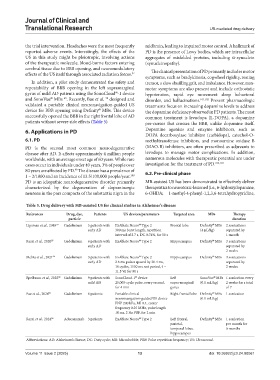
            Table 5. Drug delivery with MB‑assisted US for clinical studies in Alzheimer’s disease
            References       Drug, dye,   Patients    US devices/parameters  Targeted area  MBs     Therapy
                              particle                                                              duration
                                                            ®
                                                                                           ®
            Lipsman et al., 2018 74  Gadolinium  5 patients with   ExAblate Neuro  Type 2  Frontal lobe  Definity  MBs  2 sonications
                                      early AD    300 ms burst length, repetition     (4 µL/kg)  separated by
                                                  interval of 2.7 s, DC 0.74%, for 50 s          1 month
            Rezai et al., 2020 95  Gadolinium  6 patients with   ExAblate Neuro  Type 2  Hippocampus  Definity  MBs  3 sonications
                                                                                           ®
                                                            ®
                                      early AD                                                   separated by
                                                                                                 2 weeks
            Mehta et al., 2021 94  Gadolinium  3 patients with   ExAblate Neuro  Type 2  Hippocampus  Definity  MBs  3 sonications
                                                                                           ®
                                                            ®
                                      early AD    2.6 ms pulses spaced by 30.4 ms,               separated by
                                                  10 cycles, 1550 ms rest period, 4 –            2 weeks
                                                  11.5 W, for 90 s
            Epelbaum et al., 2022 69  Gadolinium  9 patients with   SonoCloud-1  device  Left   SonoVue  MBs  1 sonication every
                                                                                            ®
                                                           ®
                                      mild AD     25,000-cycle pulse, every second,   supra-marginal   (0.1 mL/kg)  2 weeks for a total
                                                  for 4 min              gyrus                   of 7
                                                                                           ®
            Bae et al., 2024 98  Gadolinium  6 patients  Portable clinical   Right frontal lobe Definity  MBs  1 sonication
                                                  neuronavigation-guided US device    (0.1 mL/kg)
                                                  PNP 200 kPa, MI 0.4, center
                                                  frequency 0.25 MHz, pulse length
                                                  10 ms, 2 Hz PRF, for 2 min
            Rezai et al., 2024 96  Aducanumab 3 patients  ExAblate Neuro  Type 2  Left frontal,   Definity  MBs  1 sonication
                                                            ®
                                                                                           ®
                                                                         parietal,               per month for
                                                                         temporal lobes,         6 months
                                                                         hippocampus
            Abbreviations: AD: Alzheimer’s disease; DC: Duty cycle; MB: Microbubble; PRF: Pulse repetition frequency; US: Ultrasound.
            Volume 11 Issue 2 (2025)                        13                            doi: 10.36922/jctr.24.00061

