


Page 22 - JCTR-11-2
P. 22
Journal of Clinical and
            Translational Research                                                        US-mediated drug delivery


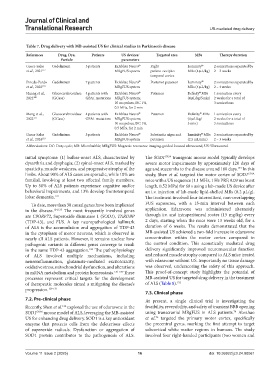
            Table 7. Drug delivery with MB‑assisted US for clinical studies in Parkinson’s disease
            References    Drug, Dye,    Patients     US devices/   Targeted area    MBs       Therapy duration
                           Particle                  parameters
            Gasca-Salas    Gadolinium  5 patients  ExAblate Neuro    Right       Luminity    2 sonications separated by
                                                                                       ®
                                                            ®
            et al., 2021 117                      MRgFUS system  parieto-occipito-   MBs (4 µL/kg)  2 – 3 weeks
                                                                 temporal cortex
            Pineda-Pardo   Gadolinium  7 patients  ExAblate Neuro    Posterior putamen  Luminity    2 sonications separated by
                                                            ®
                                                                                       ®
            et al., 2022 118                      MRgFUS system                  MBs (4 µL/kg)  2 – 4 weeks
                                                            ®
                                                                                      ®
            Huang et al.,   Glucocerebrosidase  4 patients with   ExAblate Neuro    Putamen  Definity  MBs   1 sonication every
            2022 120   (GCase)       GBA1 mutations MRgFUS system;               (4 µL/kg/5 min) 2 weeks for a total of
                                                  10 ms pulses, DC 1%,                      3 sonications
                                                  0.5 MPa, for 2 min
                                                                                      ®
                                                            ®
            Meng et al.,   Glucocerebrosidase  4 patients with   ExAblate Neuro    Putamen  Definity  MBs  1 sonication every
            2022 121   (GCase)       GBA1 mutations MRgFUS system;               (4 µL/kg/   2 weeks for a total of
                                                  10 ms pulses, DC 1%,           5 min)     3 sonications
                                                  0.5 MPa, for 2 min
            Gasca-Salas    Gadolinium  3 patients  ExAblate Neuro    Substantia nigra and   Luminity  MBs  2 sonications separated by
                                                                                       ®
                                                            ®
            et al., 2024 119                      MRgFUS system  putamen         (2.5 mL/min)  2 – 3 weeks
            Abbreviations: DC: Duty cycle; MB: Microbubble; MRgFUS: Magnetic resonance imaging-guided focused ultrasound; US: Ultrasound.
            initial symptoms: (1) bulbar-onset ALS, characterized by   The SOD1 G93A  transgenic mouse model typically develops
            dysarthria and dysphagia; (2) spinal-onset ALS, marked by   severe motor impairments by approximately 120 days of
            spasticity, muscle weakness, and progressive atrophy of the   age and succumbs to the disease around 160 days.  In this
                                                                                                      133
            limbs. About 90% of ALS cases are sporadic, while 10% are   study, Shen et al. targeted the motor cortex of SOD1 G93A
            familial,  involving  at  least  two  affected  family  members.   mice with a US sequence (1.1 MHz, 1 Hz PRF, 9.09 ms burst
            Up  to 50%  of  ALS  patients  experience  cognitive and/or   length, 0.52 MPa) for 60 s using a lab-made US device after
            behavioral impairments, and 13% develop frontotemporal   an i.v. injection of lab-made lipid-shelled MBs (0.2 µL/g).
            lobar dementia. 123                                The treatment involved four intermittent, non-overlapping
              To date, more than 30 causal genes have been implicated   FUS exposures, with a 15-min interval between each
            in  the  disease. 124,125   The  most  frequently  involved  genes   application. Edaravone  was administered  alternately
            are C9ORF72, Superoxide dismutase 1 (SOD1), TARDBP   through i.v. and intraperitoneal routes (15 mg/kg) every
            (TDP-43), and  FUS. A  key neuropathological hallmark   2 days, starting when the mice were 13 weeks old, for a
            of ALS is the accumulation and aggregation of TDP-43   duration of 6  weeks. The results demonstrated that the
            in the cytoplasm of motor neurons, which is observed in   MB-assisted US achieved a two-fold increase in edaravone
            nearly all ALS patients. However, it remains unclear how   concentration within the motor cortex compared to
            pathogenic variants in different genes converge to result   the control condition. This acoustically mediated drug
            in the same TDP-43 aggregation.  The pathophysiology   delivery significantly improved neuromuscular function
                                       126
            of ALS involved multiple mechanisms, including     and reduced muscle atrophy compared to ALS mice treated
            neuroinflammation, glutamate-mediated excitotoxicity,   with edaravone without US. Importantly no tissue damage
            oxidative stress, mitochondrial dysfunction, and alterations   was  observed,  underscoring  the  safety  of  this  approach.
            in mRNA metabolism and protein homeostasis. 126-128  These   This proof-of-concept study highlights the potential of
            processes represent critical targets for the development   MB-assisted US for targeted drug delivery in the treatment
            of therapeutic molecules aimed a mitigating the disease’s   of ALS (Table 8). 132
            progression. 129-131
                                                               7.3. Clinical phase
            7.2. Pre-clinical phase                            At present, a single clinical trial is investigating the
            Recently, Shen et al.  explored the use of edaravone in the   feasibility, reversibility, and safety of transient BBB opening
                            132
            SOD1 G93A  mouse model of ALS, leveraging the MB-assisted   using transcranial MRgFUS in ALS patients.  Abrahao
                                                                                                    76
            US for enhancing drug delivery. SOD1 is a key antioxidant   et al.  targeted the primary motor cortex, specifically
                                                                   76
            enzyme that protects cells from the deleterious effects   the precentral gyrus, marking the first attempt to target
            of superoxide radicals. Dysfunction or aggregation of   subcortical white matter regions in humans. The study
            SOD1  protein  contributes  to  the  pathogenesis  of  ALS.   involved four right-handed participants (two women and


            Volume 11 Issue 2 (2025)                        16                            doi: 10.36922/jctr.24.00061

