


Page 15 - JCTR-11-2
P. 15
Journal of Clinical and
            Translational Research                                                        US-mediated drug delivery


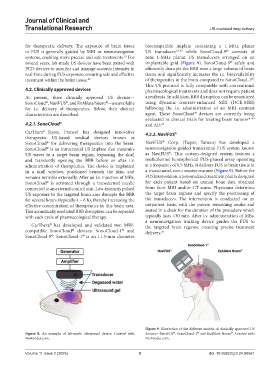
            for therapeutic delivery. The exposure of brain tissue   biocompatible implant containing a 1-MHz planar
                                                                                                 ®
            to FUS is generally guided by MRI or neuronavigation   US transducer, 64,65  while SonoCloud-9  consists of
            systems, enabling more precise and safe treatments.  For   nine 1-MHz planar US transducers arranged on an
                                                      63
                                                                                                   ®
            several years, lab-made US devices have been paired with   implantable grid (Figure  9). SonoCloud-9  safely and
            PCD devices to monitor and manage acoustic intensity in   efficiently disrupts the BBB over a large volume of brain
            real-time during FUS exposure, ensuring safe and effective   tissue and significantly increases the i.c. bioavailability
            treatment within the brain tissue. 29              of therapeutics in the brain compared to SonoCloud-1 .
                                                                                                            ®
                                                               This US protocol is fully compatible with conventional
            4.2. Clinically approved devices                   pharmacological treatments and does not require patient
            At  present, three clinically approved US devices—  anesthesia. In addition, BBB disruption can be monitored
                    ®
                             ®
                                              ®
            SonoCloud , NaviFUS , and ExAblate Neuro —are available   using dynamic contrast-enhanced MRI (DCE-MRI)
            for i.c. delivery of therapeutics. Below, their distinct   following the i.v. administration of an MRI contrast
                                                                                    ®
            characteristics are described.                     agent. These SonoCloud  devices are currently being
                                                               evaluated in clinical trials for treating brain tumors 66-68
            4.2.1. SonoCloud ®                                 and AD. 69
            CarThera (Lyon, France) has designed innovative    4.2.2. NaviFUS ®
                   ©
            therapeutic US-based medical devices known as
                                                                      ®
            SonoCloud  for delivering therapeutics into the brain.   NaviFUS  Corp. (Taipei, Taiwan) has developed a
                     ®
            SonoCloud  is an intracranial US implant that transmits   neuronavigation-guided transcranial FUS system known
                     ®
                                                                         ®
            US waves  to a target brain  region, bypassing  the skull   as NaviFUS . This custom-designed system features a
            and transiently opening the BBB before or after i.v.   multichannel hemispherical FUS-phased array operating
            administration of therapeutics. The device is implanted   at a frequency of 0.5 MHz. It delivers FUS to brain tissue in
            in a skull window, positioned beneath the skin, and   a transcranial, non-invasive manner (Figure 9). Before the
            remains invisible externally. After an i.v. injection of MBs,   FUS intervention, a personalized treatment plan is designed
            SonoCloud  is activated through a transdermal needle   for  each  patient  based on  cranial bone  data  obtained
                     ®
            connected to an external control unit. Low-intensity pulsed   from  their  MRI  and/or  CT  scans.  Physicians  determine
            US exposure to the targeted brain area disrupts the BBB   the target brain regions and specify the positioning of
            for several hours (typically 4 – 6 h), thereby increasing the   the transducers. The intervention is conducted on an
            effective concentration of therapeutics in this brain area.   outpatient basis, with the patient remaining awake and
            This acoustically mediated BBB disruption can be repeated   seated in a chair for the duration of the procedure which
            with each cycle of pharmacological therapy.        typically lasts <30 min. After i.v. administration of MBs,
                                                               a neuronavigation tracking device guides the FUS to
              CarThera  has developed and validated two MRI-   the targeted brain regions, ensuring precise treatment
                      ©
                                ®
            compatible SonoCloud  devices: SonoCloud-1  and    delivery. 70
                                                     ®
            SonoCloud-9 . SonoCloud-1  is an 11.5-mm diameter
                       ®
                                    ®


                                                               Figure 9. Illustration of the different models of clinically approved US
            Figure  8. An example of lab-made ultrasound device. Created with   devices—NaviFUS , SonoCloud-1  and ExAblate Neuro . Created with
                                                                                                   ®
                                                                           ®
                                                                                     ®
            BioRender.com.                                     BioRender.com.
            Volume 11 Issue 2 (2025)                        9                             doi: 10.36922/jctr.24.00061

