


Page 109 - JCTR-11-4
P. 109
Journal of Clinical and
            Translational Research                                                      COVID-19 impact on SBDSPs


            3.2. De-implementation and crisis management       that SBDSPs are adjacent to the central crisis, and it is
            development                                        atypical for such programs to have crisis management
                                                               plans in advance of a crisis. In addition, none of the cases
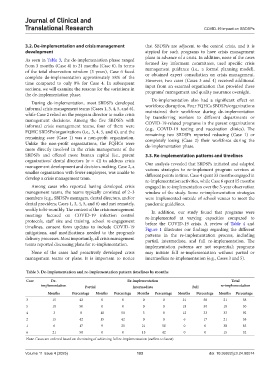
            As seen in Table 3, the de-implementation phase ranged
            from 3 months (Case 4) to 21 months (Case 6). In terms   formed key informant committees, used specific crisis
            of the  total observation window (3  years), Case  6 faced   management guidance (i.e., a formal planning model),
            complete de-implementation approximately 58% of the   or obtained expert consultation on crisis management.
                                                               However, two cases (Cases 3 and 4) received additional
            time  compared  to  only  8%  for  Case  4.  In  subsequent   input from an external organization that provided these
            sections, we will examine the reasons for the variations in
            the de-implementation phase.                       programs’ management and quality assurance oversight.
                                                                 De-implementation also had a significant effect on
              During de-implementation, most SBDSPs  developed
            informal crisis management teams (Cases 1, 3, 4, 5, and 6),   workforce disruption. Four FQHCs SBDSPs/organizations
                                                               maintained their workforce during de-implementation
            while Case 2 relied on the program director to make crisis
            management decisions. Among the five SBDSPs with   by transferring  workers  to different departments  or
                                                               COVID-19-related programs in the parent organizations
            informal crisis management teams, four of them were   (e.g., COVID-19 testing and vaccination clinics). The
            FQHC SBDSPs/organizations (i.e., 3, 4, 5, and 6), and the   remaining two SBDSPs reported reducing (Case  1) or
            remaining case (Case 1) was a non-profit organization.   completely  losing  (Case  2)  their  workforce  during  the
            Unlike the non-profit organizations, the FQHCs were   de-implementation phase.
            more directly involved in the crisis management of the
            SBDSPs and offered more human capital (i.e., parent   3.3. Re-implementation patterns and timelines
            organizations’ dental directors [n = 4]) to address crisis   Our analysis revealed that SBDSPs initiated and adapted
            management development and decision-making. Case 2, a   various  strategies  to re-implement  program  services  at
            smaller organization with fewer employees, was unable to   different points in time. Case 4 spent 33 months engaged in
            develop a crisis management team.
                                                               re-implementation activities, while Case 6 spent 15 months
              Among cases who reported having developed crisis   engaged in re-implementation over the 3-year observation
            management  teams,  the  teams  typically  consisted  of  2–3   window of the study. Some re-implementation strategies
            members (e.g., SBDSPs managers, dental directors, and/or   were implemented outside of school venues to meet the
            dental providers; Cases 1, 3, 4, 5, and 6) and met remotely,   pandemic guidelines.
            weekly to bi-monthly. The content of the crisis management   In addition, our study found that programs were
            meetings focused on COVID-19 infection control     re-implemented at varying capacities compared to
            protocols, staff  size and training, school  re-engagement   before the COVID-19 crisis. A  review of  Table 4 and
            timelines, consent form updates to include COVID-19   Figure  1 illustrates our findings regarding the  different
            mitigations, and modifications needed to the program’s   patterns  in  the  re-implementation  process,  including
            delivery processes. Most importantly, all crisis management   partial, intermediate, and full re-implementation. The
            teams reported discussing plans for re-implementation.
                                                               implementation patterns are not sequential; programs
              None of the cases had proactively developed crisis   may initiate full re-implementation without partial or
            management  teams  or  plans.  It  is  important to  notice   intermediate re-implementation (e.g., Cases 3 and 5).


            Table 3. De‑implementation and re‑implementation pattern timelines by months
            Case       De‑                             Re‑implementation                           Total
                   implementation    Partial             Intermediate              Full        re‑implementation
                     Months     Percentage  Months  Percentage  Months  Percentage  Months  Percentage  Months  Percentage
            3          15          42       0        0        0       0        21       58      21      58
            5          18          50       0        0        0       0        18       50      18      50
            4           3          8        18       50       3       8        12       33      33      92
            2          15          42       15       42       0       0        6        17      21      58
            1           6          17       9        25      21       58       0        0       30      83
            6          21          58       0        0       15       42       0        0       15      52
            Note: Cases are ordered based on the timing of achieving full re-implementation (earliest to latest).


            Volume 11 Issue 4 (2025)                       103                            doi: 10.36922/jctr.24.00074

