


Page 40 - JCTR-11-4
P. 40
Journal of Clinical and
            Translational Research                                                        Physical exercise on COPD


            in oxidative muscle fibers, along with decreased   improvement in the 6-min walk distance was observed,
            vascularization and oxygen transport capacity, is one   but there was no change in the perception of dyspnea. This
            of the main causes of the decline in functional capacity   suggests that, despite improvements in physical endurance,
            in these patients. In this context, aerobic exercise, as   Nordic  walking  may  not  be  sufficiently  effective  in
            proposed by Zwerink et al.,  improves muscle perfusion   improving the sensation of shortness of breath, a common
                                  16
            and oxygenation, partially reversing this “phenotype” and,   symptom in COPD. This finding is important, as dyspnea
            consequently, increasing exercise capacity.        is one of the main limiting factors of functional capacity in
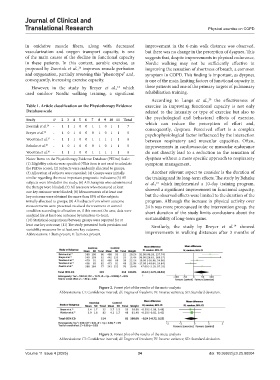
              However, in the study by Breyer  et al.,  which   these patients and one of the primary targets of pulmonary
                                                   14
            used outdoor Nordic walking training, a significant   rehabilitation training.
                                                                 According to Lange  et al.,  the effectiveness of
                                                                                          20
            Table 1. Article classification on the Physiotherapy Evidence   exercise in improving functional capacity is not only
            Database scale                                     related to the intensity or type of exercise but also to
                                                               the psychological and behavioral effects of exercise,
            Study       1 a  2  3  4  5  6  7  8  9 10 11  Total
            Zwerink et al. 16  -  1  1  1  0  0  1  1  0  1  1  7  which  can  reduce  the  perception  of  effort  and,
                                                               consequently, dyspnea. Perceived effort is a complex
            Breyer et al. 14  -  1  0  1  0  0  0  1  0  1  1  5  psychophysiological factor influenced by the interaction
            Wootton et al. 17  -  1  1  1  0  0  1  1  1  1  1  8  between respiratory and muscular capacities. Often,
            Behnke et al. 15  -  1  0  1  0  0  0  1  0  1  1  5  improvements in cardiovascular or muscular endurance
            Wootton et al. 18  -  1  1  1  0  0  1  1  1  1  1  8  do not directly lead to a reduction in the sensation of
            Notes: Items on the Physiotherapy Evidence Database (PEDro) Scale:   dyspnea without a more specific approach to respiratory
            (1) Eligibility criteria were specified ( This item is not used to calculate   symptom management.
                                    a
            the PEDro score); (2) Subjects were randomly allocated to groups;
            (3) Allocation of subjects was concealed; (4) Groups were initially   Another relevant aspect to consider is the duration of
            similar regarding the most important prognostic indicators; (5) All   the training and its long-term effects. The study by Behnke
            subjects were blinded in the study; (6) All therapists who administered   et al.,   which implemented  a 10-day  training  program,
                                                                   15
            the therapy were blinded; (7) All assessors who measured at least   showed a significant improvement in functional capacity,
            one key outcome were blinded; (8) Measurements of at least one
            key outcome were obtained for more than 85% of the subjects   but the observed effects were limited to the duration of the
            initially allocated to groups; (9) All subjects from whom outcome   program. Although the increase in physical activity over
            measurements were presented received the treatment or control   24 h was more pronounced in the intervention group, the
            condition according to allocation or, if this was not the case, data were   short duration of the study limits conclusions about the
            analyzed for at least one outcome by intention-to-treat;
            (10) Statistical comparisons between groups were reported for at   sustainability of long-term gains.
            least one key outcome; (11) The study presented both precision and   Similarly, the study by Breyer  et al.  showed
                                                                                                    14
            variability measures for at least one key outcome.
            Abbreviations: 1:Item present; 0: Item not present.  improvements in walking distances after 3 months of


                                           Figure 2. Forest plot of the results of the meta-analysis
                          Abbreviations: CI: Confidence interval; df: Degree of freedom; IV: Inverse variance; SD: Standard deviation.


                                           Figure 3. Forest plot of the results of the meta-analysis
                          Abbreviations: CI: Confidence interval; df: Degree of freedom; IV: Inverse variance; SD: Standard deviation.


            Volume 11 Issue 4 (2025)                        34                            doi: 10.36922/jctr.25.00004

