


Page 78 - JCTR-11-5
P. 78
Journal of Clinical and
            Translational Research                                          Fibromyalgia: Examination across life domains


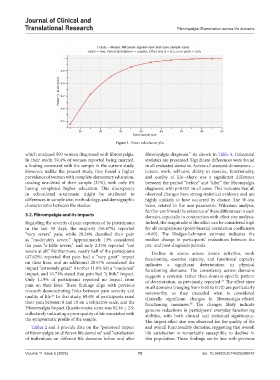
                                                  Figure 1. Power calculation plot

            which analyzed 500 women diagnosed with fibromyalgia.   fibromyalgia diagnosis.” As shown in Table 4, inferential
            In their study, 59.4% of women reported being married,   statistics are presented. Significant differences were found
            a finding consistent with the sample in the current study.   in all evaluated domains. Across all assessed dimensions—
            However, unlike the present study, they found a higher   leisure,  work, self-care, ability to  exercise,  functionality,
            prevalence of women with complete elementary education,   and quality of life—there was a significant difference
            totaling one-third of their sample (37%), with only 8%   between the period “before” and “after” the fibromyalgia
            having completed higher education. This discrepancy   diagnosis, with p<0.001 in all cases. This indicates that all
            in  educational  attainment  might  be  attributed  to   observed changes have strong statistical evidence and are
            differences in sample size, methodology, and demographic   highly unlikely to have occurred by chance. The  W-test
            characteristics between the studies.               value, related to the non-parametric Wilcoxon analysis,
                                                               further confirmed the existence of these differences in each
            3.2. Fibromyalgia and its impacts                  domain, especially in conjunction with effect size analysis.
            Regarding the severity of pain experienced by participants   Indeed, the magnitude of the effect can be considered high
            in the last 30  days, the majority (56.47%) reported   for all comparisons (point-biserial correlation coefficients
            “very  severe”  pain,  while  28.24%  classified  their  pain   >0.60). The Hodges-Lehmann estimate indicates the
            as “moderately severe.” Approximately 13% considered   median change in participants’ evaluations between the
            the pain “a little severe,” and only 2.35% reported “not   pre- and post-diagnosis periods.
            severe at all.” Furthermore, nearly half of the participants   Decline in scores across leisure activities, work
            (47.62%) reported that pain had a “very great” impact   functioning, exercise capacity, and functional capacity
            on their lives, and an additional 28.57% considered the   indicates a significant deterioration in physical
            impact “extremely great.” Another 11.9% felt a “moderate”   functioning domains. The consistency across domains
            impact, and 10.71% stated that pain had “a little” impact.   suggests a systemic rather than  domain-specific  pattern
            Only 1.19% of participants reported no impact from   of deterioration, as previously reported.  The effect sizes
                                                                                               37
            pain on their lives. These findings align with previous   in all domains (ranging from 0.60 to 0.70) are particularly
            research demonstrating links between pain severity and   noteworthy, as they exceeded what is considered
            quality of life.  In that study, 69.6% of participants rated   clinically significant changes in fibromyalgia-related
                       36
            their pain between 8 and 10 on a subjective scale, and the   functioning measures.  The changes likely indicate
                                                                                  38
            Fibromyalgia Impact Questionnaire score was 82.46 ± 2.9,   genuine reductions in participants’ everyday functioning
            collectively indicating a poor quality of life associated with   abilities, with both clinical and statistical significance.
            the symptomatic profile of the sample.             The largest effect size was observed for the quality of life
              Tables 2 and 3 provide data on the “perceived impact   and overall functionality domains, suggesting that overall
            of fibromyalgia on different life domains” and “satisfaction   life satisfaction is remarkably susceptible to decline in
            of individuals on different life domains before and after   this population. These findings are in line with previous


            Volume 11 Issue 5 (2025)                        72                         doi: 10.36922/JCTR025290042

