


Page 79 - JCTR-11-5
P. 79
Journal of Clinical and
            Translational Research                                          Fibromyalgia: Examination across life domains


            Table 1. Sociodemographic characteristics of study   Table 2. Perceived impact of fibromyalgia on different life
            participants                                       domains
            Variables                      n      Percentage   Parameters      Mean   SD   Minimum   Maximum
            Gender                                             Leisure          8.26  1.64    1.00     10.00
             Male                          3         3.53      Ability to work  8.32  1.55    3.00     10.00
             Female                        82       96.47      Self-care        8.82  1.37    5.00     10.00
            Single                                             Overall functionality  8.43  1.35  5.00  10.00
             No                            61       71.76      Ability to exercise  8.40  1.53  4.00   10.00
             Yes                           24       28.24      Quality of life  8.83  1.54    4.00     10.00
            Physically active (>150 min per week)              Abbreviation: SD: Standard deviation.
             No                            40       47.62
             Yes                           44       52.38      Table 3. Satisfaction of individuals in different life domains
                                                               before and after fibromyalgia diagnosis
            Education
             Complete primary education    16       19.28      Parameters           Mean  SD  Minimum  Maximum
             Complete secondary education  25       30.12      Before fibromyalgia diagnosis
             Complete higher education     38       45.78       Leisure             8.27  2.55  0.00   10.00
             Incomplete higher education   3         3.61       Ability to work     8.50  2.39  0.00   10.00
             Prefer not to respond         1         1.20       Self-care           8.46  2.48  0.00   10.00
            Children                                            Overall functionality  8.59  2.45  0.00  10.00
             No                            7         8.24       Ability to exercise  8.40  2.64  0.00  10.00
             Yes                           78       91.76       Quality of life     8.27  2.67  0.00   10.00
            Family history of psychiatric disorder             After fibromyalgia diagnosis
             No                            37       54.41       Leisure             6.48  3.05  0.00   10.00
             Yes                           31       45.59       Ability to work     6.55  3.10  0.00   10.00
            Comorbidities                                       Self-care           6.09  3.38  0.00   10.00
             No                            7         8.24       Overall functionality  6.38  3.14  0.00  10.00
             Yes                           75       97.76       Ability to exercise  6.06  3.35  0.00  10.00
            Diagnosis psychiatric disorder                      Quality of life     5.96  3.26  0.00   10.00
             No                            43       63.24      Abbreviation: SD: Standard deviation.
             Yes                           25       36.76
                                                                                      41
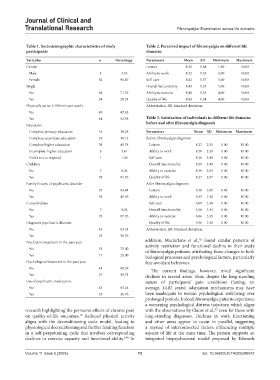
            Psychiatric treatment in the past year             addition, Macfarlane  et al.,  found similar patterns of
             No                            51       75.00      activity restriction and functional decline in their study
                                                               of fibromyalgia patients, attributing these changes to both
             Yes                           17       25.00      biological processes and psychological factors, particularly
            Psychological treatment in the past year           fear-avoidant behaviors.
             No                            41       60.29        The  current  findings,  however,  reveal  significant
             Yes                           27       39.71      declines in several areas. Thus, despite the long-standing
            Use of psychiatric medication                      nature of participants’ pain conditions (lasting, on
             No                            43       63.24      average, 14.82  years), adaptation mechanisms may have
             Yes                           25       36.76      been inadequate to sustain psychological well-being over
                                                               prolonged periods. Indeed, fibromyalgia patients experience
                                                               a worsening psychological distress trajectory, which aligns
            research highlighting the pervasive effects of chronic pain   with the observations by Clauw et al.,  even for those with
                                                                                            42
            on  quality-of-life outcomes.   Reduced  physical  activity   long-standing  diagnoses.  Declines  in  work  functioning
                                   39
            aligns with the deconditioning cycle model, leading to   and other areas appear to occur in parallel, suggesting
            physiological deconditioning and further limiting function   a myriad of interconnected factors influencing multiple
            in a self-perpetuating cycle that involves corresponding   aspects of life at the same time. The pattern supports an
            declines in exercise capacity and functional ability.  In   integrated biopsychosocial model proposed by Edwards
                                                      7,40

            Volume 11 Issue 5 (2025)                        73                         doi: 10.36922/JCTR025290042

