


Page 32 - JCTR-9-4
P. 32
248                       Shuster | Journal of Clinical and Translational Research 2023; 9(4): 246-252
        differ. All  things  being  equal,  the  one  with  the  greater  sample   (patients) with the same eligibility criteria. The inference is to this
        variance in true effect sizes will have weights closer to equality   target population.”
        than the other, thanks to a larger between-study variance. As a   Our universe is a large conceptual population  of completed
        concrete example, when the number of studies combined is eight,   studies and the actual  studies are a conceptual  random sample
        there is a 61% probability that one sample variance for these true   from this universe. Our inference is to the target parameter in the
        effect sizes will be at least 50% higher than the other. Assumption   entire conceptual population. Our estimate is the corresponding
        A4 requires these to be the same to a near certainty. The derivation   value in the sample of studies in the analysis. The target metric
        of the 61% figure is in the Appendix for those with biostatistical   simply projects what the relative  risk (or difference in means
        expertise. The between-study variance is a major determinant of   or difference in proportions) would be if all patients  received
        the weights and clearly differs between repetitions of obtaining   the experimental therapy versus that if all patients received the
        the meta-analysis data under Assumptions A1-A3.         control therapy. This framework is different from the mainstream,
          Support for the fact that weights are seriously random variables   and hence, it is important to note that the ratio method targets a
        comes  from  an  unlikely  source, lead  developer  of perhaps  the   different population parameter than the mainstream.
        most popular software product for this subject, Comprehensive   Note that this setup can accommodate any distribution of means
        meta-analysis (CMA), Borenstein [2], who states this assumption   or proportions for the two treatment arms, making it a model-free
        in Section 7.4.3, “The studies that were performed are a random   random effects framework for meta-analysis.  The mainstream
        sample from the universe.” This concedes the point that mainstream   imposes severe restrictions through its five Assumptions A1-A5.
        weights, which are functions of the studies, are seriously random   7.1. Illustration for relative risk (risk ratio)
        variables,  not constants. This potentially  invalidates  the claims
        of no bias in the overall effect size estimate and legitimacy of   For each study in the universe, if we had the number of failures
        confidence intervals and P-values.                      on each treatment (experimental and control), we could project
          In short, the  mainstream  relies on theory  that  was never   the number of “failures” that would occur if every subject was
        intended for this type of application and as such, the distribution   in the experimental group (control group), respectively. For each
        theory is used off label.                               individual study, this would be the total sample size (treatment +
                                                                control) for the study multiplied by the proportion failing in the
        5. Why Assumption A5 is False                           experimental  group  (control  group),  respectively. For example,
          This one should be clear  from the  fact  that  the  weights are   in the first study in Table 1, we see that the experimental group
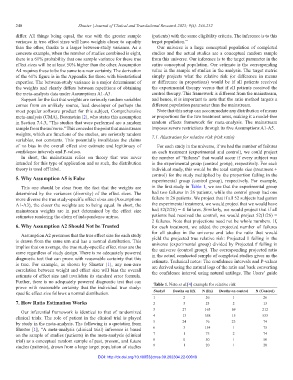
        determined by the variances (diversity) of the effect sizes. The   had two failures in 26 patients, while the control group had one
        more diverse the true study-specific effect sizes are (Assumptions   failure in 26 patients. We project that if all 52 subjects had gotten
        A1-A3), the closer the weights are to being equal. In short, the   the experimental treatment, we would project that we would have
        mainstream  weights are in part determined  by the effect size   had 52(2/26) = 4 failures. Similarly, we would project that if all
        estimates rendering the claim of independence untrue.   patients had received the control, we would project 52(1/26) =
                                                                2 failures. Note that projections need not be whole numbers. If,
        6. Why Assumption A2 Should Not be Trusted              for each  treatment,  we added  the  projected  number  of failures
          Assumption A2 presumes that the true effect size for each study   for all  studies in  the  universe  and take  the  ratio  that  would
        is drawn from the same urn and has a normal distribution. This   yield the projected  true relative  risk: Projected  # failing  in the
                                                                universe (experimental group) divided by Projected # failing in
        implies that on average, the true study-specific effect sizes are the   the universe (control group). The corresponding projected ratio
        same regardless of study design. There is no adequately powered   in the actual conducted sample of completed studies gives us the
        diagnostic test that can prove with reasonable certainty that this   estimate. Technical notes: The confidence intervals and P-values
        is true. For  example, as shown  by Shuster [1], any non-zero   are derived using the natural logs of the ratio and back converting
        correlation between weight and effect size will bias the overall   the confidence interval using natural antilogs. The Users’ guide
        estimate of effect size and invalidate its standard error formula.
        Further, there is no adequately powered diagnostic test that can   Table 1. Neto et al.[4] example for relative risk
        prove  with  reasonable  certainty  that  the  individual  true  study-
        specific effect size follows a normal distribution.      Study#  Deaths on RX  N (Rx)  Deaths on control  N (Control)
                                                                 1            2        26         1            26
        7. How Ratio Estimation Works                            2            3        23         2            13
          Our inferential framework is identical to that of randomized   3   27        163        69           212
        clinical  trials. The role of patient  in the clinical  trial  is played   4  13  558     15           533
        by study in the meta-analysis. The following is a quotation from   5  24       76         23           74
        Shuster [1], “A meta-analysis  (clinical  trial)  inference  is based   6  3   154        1            75
        on the sample of studies (patients) in the meta-analysis (clinical   7  1      75         2            74
        trial) as a conceptual random sample of past, present, and future   8  0       50         1            50
        studies (patients), drawn from a large target population of studies   9  1     20         1            20
                                           DOI: http://dx.doi.org/10.18053/jctres.09.202304.22-00019

