


Page 34 - JCTR-9-4
P. 34
250                       Shuster | Journal of Clinical and Translational Research 2023; 9(4): 246-252
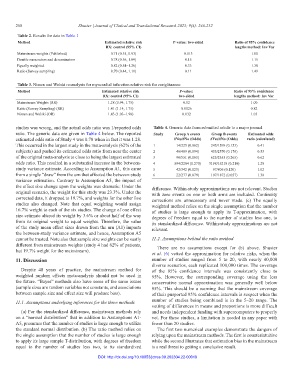
        Table 2. Results for data in Table 1
        Method                               Estimated relative risk     P‑value: two‑sided        Ratio of 95% confidence
                                             RX: control (95% CI)                                  lengths method: Inv Var
        Mainstream weights (Published)         0.71 (0.55, 0.93)              0.013                       1.00
        Double numerators and denominators     0.78 (0.56, 1.09)              0.15                        1.15
        Equally weighted                       0.82 (0.54–1.26)               0.33                        1.38
        Ratio (Survey sampling)                0.70 (0.44, 1.11)              0.11                        1.49

        Table 3. Nissen and Wolski re-analysis for myocardial infarction relative risk for rosiglitazone
        Method                              Estimated relative risk         P‑value:               Ratio of 95% confidence
                                            RX: control (95% CI)            two‑sided              lengths method: Inv Var
        Mainstream Weights (RR)               1.28 (0.94, 1.75)               0.12                        1.00
        Ratio (Survey Sampling) (RR)          1.41 (1.14, 1.75)              0.0026                       0.82
        Nissen and Wolski (OR)                1.43 (1.03–1.98)               0.032                        1.03

        studies was wrong, and the actual odds ratio was 1/reported odds   Table 4. Generic data from submitted article to a major journal
        ratio. The generic data are given in Table 4 below. The reported   Study  Group A events  Group B events  Estimated odds
        estimated odds ratio of Study 4 was 0.78 when in fact it was 1.28.   #Yes/#No (Odds)  #Yes/#No (Odds)  ratio (calculated)
        This occurred in the largest study in the meta-analysis (62% of the   1  14/225 (0.062)  245/1599 (0.153)  0.41
        subjects) and pushed its estimated odds ratio from near the center   2  46/489 (0.094)  453/2570 (0.176)  0.53
        of the original meta-analysis to close to being the largest estimated   3  90/551 (0.163)  625/2355 (0.265)  0.62
        odds ratio. This resulted in a substantial increase in the between-  4  594/2204 (0.270)  3198/15218 (0.210)  1.28
        study variance estimate. According to Assumption A1, this came   5  42/342 (0.123)  97/806 (0.120)   1.02
        from a single “draw” from the urn that affected the between-study   6  22/277 (0.079)  107/1872 (0.057)  1.38
        variance estimation. Contrary to Assumption A5, the impact of
        the effect size change upon the weights was dramatic: Under the   difference. Within-study approximations are not relevant. Studies
        original scenario, the weight for this study was 23.3%. Under the   with zero events on one or both arms are included. Continuity
        corrected data, it dropped to 19.7%, and weights for the other five   corrections  are  unnecessary  and  never  made.  (c)  The  equally
        studies  also  changed.  Note  that  equal  weighting  would assign   weighted method relies on the single assumption that the number
        16.7% weight to each of the six studies. The change of one effect   of studies is large enough to apply its  T-approximation,  with
        size estimate altered its weight by 3.6% or about half of the way   degrees of freedom equal to the number of studies less one, to
        from  its  original  weight  to  equal  weights. Therefore,  the  value   its standardized difference. Within-study approximations are not
        of the study mean effect sizes drawn from the urn (A1) impacts   relevant.
        the between-study variance estimate, and hence, Assumption A5
        cannot be trusted. Note also that sample size weights can be vastly   11.2. Assumptions behind the ratio method
        different from mainstream weights (study 4 had 62% of patients,   There  are  no  assumptions  except  for (b)  above.  Shuster
        but 19.7% weight for the mainstream).
                                                                et al. [6] vetted the approximation for relative risks, when the
        11. Discussion                                          number  of  studies  ranged  from  5  to  20,  with  nearly  40,000
                                                                diverse scenarios, each replicated 100,000 times. The coverage
          Despite  48  years  of  practice,  the  mainstream  method  for   of  the  95%  confidence  intervals  was  consistently  close  to
        weighted  random  effects  meta-analysis  should  not  be  used  in   95%.  However,  the  corresponding  coverage  using  the  less
        the future. “Bayes” methods also have some of the same issues   conservative normal approximation was generally well below
        (sample sizes are random variables not constants, and associations   95%. This should be a warning that the mainstream coverage
        between sample size and effect size will produce bias).  of their purported 95% confidence intervals is suspect when the
        11.1. Assumptions underlying inferences for the three methods  number  of  studies  being  combined  is  in  the  5–20  range.  The
                                                                vetting of differences in means and proportions is more difficult
          (a) For the standardized difference, mainstream methods rely   and needs independent funding with supercomputers to properly
        on a “normal distribution” that in addition to Assumptions A1-  vet. For these studies, a limitation is needed in any paper with
        A5, presumes that the number of studies is large enough to utilize   fewer than 20 studies.
        the standard normal distribution. (b) The ratio method relies on   The first two numerical examples demonstrate the dangers of
        the single assumption that the number of studies is large enough   relying upon the mainstream methods. The first is counterintuitive
        to apply its large sample T-distribution, with degrees of freedom   while the second illustrates that estimation bias in the mainstream
        equal to the number of studies less two, to its standardized   is a real threat to getting a conclusive result.
                                           DOI: http://dx.doi.org/10.18053/jctres.09.202304.22-00019

