


Page 51 - JCTR-9-5
P. 51
Iyngkaran et al. | Journal of Clinical and Translational Research 2023; 9(5): 347-356   353


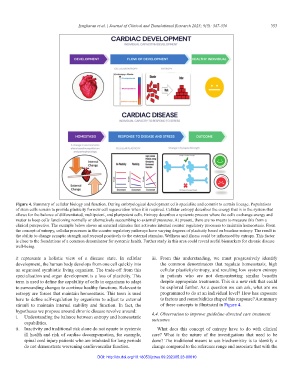
        Figure 4. Summary of cellular biology and function. During embryological development cells specialise and commit to certain lineage. Populations
        of stem cells remain to provide plasticity for new cell regeneration when it is required. Cellular entropy describes the energy that is in the system that
        allows for the balance of differentiated, multipotent, and pluripotent cells. Entropy describes a systemic process where the cells exchange energy and
        matter to keep cells functioning normally or alternatively succumbing to external pressures. At present, there are no means to measure this from a
        clinical perspective. The example below shows an external stimulus that activates internal counter regulatory processes to maintain homeostasis. From
        the concept of entropy, cellular processes in the counter regulatory pathways have varying degrees of plasticity based on baseline entropy. The result is
        the ability to change synaptic strength and respond positively to the external stimulus. Wellness and illness could be influenced by entropy. This factor
        is close to the foundations of a common denominator for systemic health. Further study in this area could reveal useful biomarkers for chronic disease
        well-being.

        it represents a holistic  view of a disease state.  In cellular   iii.  From this understanding,  we must progressively identify
        development, the human body develops from one cell quickly into   the common denominators that regulate  homeostasis, high
        an organised symbiotic living organism. The trade-off from this   cellular plasticity/entropy, and resulting low system entropy
        specialisation and organ development is a loss of plasticity. This   in  patients  who  are  not  demonstrating  similar  benefits
        term is used to define the capability of cells in organisms to adapt   despite appropriate treatments. This is a new risk that could
        to surrounding changes to continue healthy functions. Relevant to   be explored further. As a question we can ask, what are we
        entropy are forces that maintain homeostasis. This term is used   programmed to do at an individual level? How has exposure
        here to define self-regulation by organisms to adjust to external   to factors and comorbidities shaped this response? A summary
        stimuli  to maintain  internal  stability  and function.  In fact,  the   of these concepts is illustrated in Figure 4.
        hypotheses we propose around chronic disease revolve around:  4.4. Observation to improve guideline-directed care treatment
        i.   Understanding the balance between entropy and homeostatic   outcomes
           capabilities.
        ii.  Inactivity and traditional risk alone do not equate to systemic   What  does  this  concept  of  entropy  have  to  do  with  clinical
           ill health and risk of cardiac decompensation, for example,   care?  What  is the nature of the  investigations  that  need to  be
           spinal cord injury patients who are intubated for long periods   done? The traditional means to use biochemistry is to identify a
           do not demonstrate worsening cardiovascular function.  change compared to the reference range and associate that with the

                                          DOI: http://dx.doi.org/10.18053/jctres.09.202305.23-00010

