


Page 7 - JCTR-9-5
P. 7
Songtanin et al. | Journal of Clinical and Translational Research 2023; 9(5): 308-316   309
        alter the balance that controls immune tolerance from gut antigens   cancer vs. rectal cancer). The proximal colon consists of cecum,
        and gut inflammation, a process considered to be a mechanism for   ascending  colon,  hepatic  flexure,  and  transverse  colon  whereas
        the development of colorectal cancer [7]. Appendectomy may be   the distal colon consists of splenic flexure, descending colon, and
        a potential risk factor in developing colorectal cancer; however,   sigmoid colon.
        differences in study design, such as the definition of the interval   The  consistency  of  the  findings  of  all  meta-analyses  was
        between appendectomy  and the initial  diagnosis of colorectal   further examined using leave-one-out  sensitivity analyses.  The
        cancer, follow-up period, and location of colorectal cancer, need   likelihood  of publication  bias was explored  using funnel plots,
        consideration. Therefore, we performed a systematic review and   and the effect sizes of missing (i.e., unpublished/unreported)
        meta-analysis to evaluate the association between appendectomy   studies  were  imputed  through  the  trim-and-fill  method  [11,12].
        and the development of colorectal cancer.               Funnel plot asymmetry was confirmed using Egger’s tests [13].
                                                                Heterogeneity  of  effect  sizes  was  quantified  by  calculating  the
        2. Methods
                                                                Higgins’ I  statistic  [14,15]. Meta-regression analyses were not
                                                                         2
          We conducted this meta-analysis according to Cochrane’s   attempted due to the small number of studies included in each
        manual of diagnostic test accuracy, and the manuscript was   meta-analysis [15,16].
        prepared according to the preferred reporting items for systematic   3. Results
        reviews and meta-analysis of diagnostic test accuracy (PRISMA-
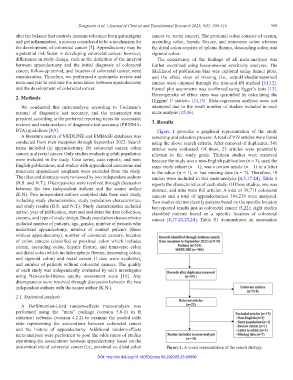
        DTA) guidelines [8,9].                                     Figure  1 provides a  graphical representation  of the  study
          A literature search of MEDLINE and EMBASE databases was   screening and selection process. A total of 919 articles were found
        conducted from their inception through September 2022. Search   using the above search criteria. After removal of duplicates, 541
        terms  included  (a) appendectomy, (b) colorectal  cancer, colon   articles  were evaluated.  Of these,  23 articles  were potentially
        cancer, and rectal cancer. Only studies evaluating adult population   relevant  to the study goals.  Thirteen  studies were removed
        were included in the study. Case series, case reports, and non-  because the study was a non-English publication (n = 3), used the
        English publications, and studies with appendiceal carcinoma and   same study cohort (n = 1), was a review article (n = 1) or a letter
        mucinous appendiceal neoplasm were excluded from the study.   to the editor (n = 1), or had missing data (n = 7). Therefore, 10
        The titles and abstracts were reviewed by two independent authors   studies were included in this meta-analysis [4,5,17-24]. Table 1
        (B.S. and N.T.). Discrepancies were resolved through discussion   reports the characteristics of each study. Of these studies, one was
        between  the  two  independent  authors  and  the  senior  author   abstract, and nine were full articles. A total of 39,711 colorectal
        (K.N). Two independent authors compiled data from each study,   cancers and a total of appendectomies  384,278 were analyzed.
        including study characteristics, study population characteristics,   Two studies did not classify patients based on the specific location
        and study results (B.S. and N.T.). Study characteristics included   but reported results just as colorectal cancer [5,22]; eight studies
        author, year of publication, start and end dates for data collection,   classified  patients  based  on  a  specific  location  of  colorectal
        country, and type of study design. Study population characteristics   cancer  [4,17-21,23,24].  Table  S1 demonstrates  an association
        included number of patients, age, gender, number of patients who
        underwent  appendectomy, number  of control  patients  (those
        without appendectomy),  number of colorectal  cancers, location
        of  colon  cancers  (classified  as  proximal  colon  which  includes
        cecum,  ascending  colon,  hepatic  flexure,  and  transverse  colon
        and distal colon which includes splenic flexure, descending colon,
        and sigmoid colon) and rectal  cancer if data were available),
        and number of patients without colorectal cancers. The quality
        of each study was independently evaluated by each investigator
        using Newcastle-Ottawa  quality assessment scale  [10]. Any
        discrepancies were resolved through discussion between the two
        independent authors with the senior author (K.N.).
        2.1. Statistical analysis

          A DerSimonian-Liard random-effects meta-analysis  was
        performed using the “meta”  package (version  5.0-1) in R
        statistical  software  (version  4.2.2) to  examine  the  pooled  odds
        ratio  representing  the  associations  between  colorectal  cancer
        and  the  history of  appendectomy.  Additional  random-effects
        meta-analyses were performed to pool the odds ratios of studies
        examining the associations between appendectomy based on the
        anatomical site of colorectal cancer (i.e., proximal vs. distal colon   Figure 1. A visual representation of the search strategy.
                                          DOI: http://dx.doi.org/10.18053/jctres.09.202305.23-00090

