


Page 9 - JCTR-9-5
P. 9
Songtanin et al. | Journal of Clinical and Translational Research 2023; 9(5): 308-316   311


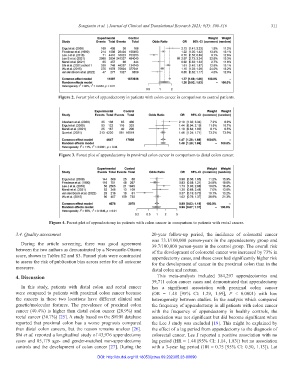
                         Figure 2. Forest plot of appendectomy in patients with colon cancer in comparison to control patients.


                          Figure 3. Forest plot of appendectomy in proximal colon cancer in comparison to distal colon cancer.


                      Figure 4. Forest plot of appendectomy in patients with colon cancer in comparison to patients with rectal cancer.

        3.4. Quality assessment                                 20-year follow-up period, the incidence  of colorectal  cancer
                                                                was 73.1/100,000 person-years in the appendectomy group and
          During the article screening, there was  good agreement   39.7/100,000 person-years in the control group. The overall risk
        between the two authors as demonstrated by a Newcastle-Ottawa   of the development of colorectal cancer was increased by 73% in
        score, shown in Tables S2 and S3. Funnel plots were constructed   appendectomy cases, and these cases had significantly higher risk
        to assess the risk of publication bias across series for all outcome   for the development of cancer in the proximal colon than in the
        measures.                                               distal colon and rectum.
        4. Discussion                                              This meta-analysis included 384,297 appendectomies  and
                                                                39,711 colon cancer cases and demonstrated that appendectomy
          In this study, patients  with distal colon and rectal  cancer   has  a  significant  association  with  proximal  colon  cancer
        were compared to patients with proximal colon cancer because   (OR = 1.48 [95% CI: 1.29, 1.69],  P < 0.0001) with low
        the cancers in these two locations  have different clinical  and   heterogeneity between studies. In the analysis which compared
        genetic/molecular  features.  The prevalence  of proximal  colon   the frequency of appendectomy in all patients with colon cancer
        cancer (40.4%) is higher than distal colon cancer (28.9%) and   with  the  frequency  of  appendectomy  in  healthy  controls,  the
        rectal cancer (30.7%) [25]. A study based on the SEER database   association was not significant but did become significant when
        reported  that  proximal  colon  has  a  worse prognosis compared   the Lee J study was excluded [19]. This might be explained by
        than distal colon cancers, but the reason remains unclear [26].   the effect of a lag period from appendectomy to the diagnosis of
        Shi et al. reported a longitudinal study of 43,976 appendectomy   colorectal cancer. Lee J reported a positive association with no
        cases and 85,179 age-  and gender-matched  non-appendectomy   lag period (HR = 1.44 [95% CI: 1.14, 1.83]) but no association
        controls and the development of colon cancer [27]. During the   with a 3-year lag period (HR = 0.75 [95% CI: 0.50, 1.13]). Lai
                                          DOI: http://dx.doi.org/10.18053/jctres.09.202305.23-00090

