


Page 8 - JCTR-9-5
P. 8
310                       Songtanin et al. | Journal of Clinical and Translational Research 2023; 9(5): 308-316
                                                                between appendectomy and colorectal cancer in each study group.
                                                                These studies did not report the indication for appendectomy or
                                                                the histology of the resected appendices.
                    Duration between   appendectomy and time   of diagnosis of CRC  NR  3 years  9.8 years  No lag period  1 year  40.9 years  NR  1 year  NR  30 months  3.1. Association between colorectal cancer and history of

                                                                appendectomy
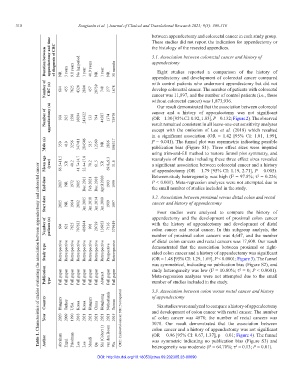
                                                                   Eight  studies reported  a comparison of the history of

                    Number of   CRC (n)  604  455  7625  4324  2804  457  20739  748  277  1678  appendectomy  and development  of colorectal  cancer  compared
                                                                with control patients who underwent appendectomy but did not
                                                                develop colorectal cancer. The number of patients with colorectal
                                                                cancer was 11,897, and the number of control patients (i.e., those
                                                                without colorectal cancer) was 1,873,936.
                                                                   Our result demonstrated that the association between colorectal
                    Number of   appendectomy (n)  100  205  1590  16094  243422  133  794  44587  1374  75979  cancer  and  a  history  of  appendectomy  was  not  significant
                                                                (OR = 1.30 [95% CI: 0.92, 1.83], P = 0.132; Figure 2). The observed
                                                                result remained consistent in all leave-one-out sensitivity analyses
                                                                except with the omission of Lee  et al. (2018) which resulted
                                                                in  a  significant  association  (OR  =  1.42  [95%  CI:  1.01,  1.99],
                    Male (n)  350  410  3256  347411  284546  515  12360  NR  2836  196317  P = 0.041). The funnel plot was asymmetric indicating possible
                                                                publication  bias  (Figure  S1).  Three  effect  sizes  were  imputed
                                                                using trim-and-fill method to restore funnel plot symmetry, and
                    Mean age   (year)  66.5±11.5  NR  40.2  41.7±14.7  32.4±17.0  70.2  61.5  NR  69.8±9.3  31.8  reanalysis of the data including these three effect sizes revealed
                                                                a significant association between colorectal cancer and a history
                 Table 1. Characteristics of studies evaluating the association between appendectomy and colorectal cancer
                                                                of appendectomy (OR = 1.79 [95% CI: 1.19, 2.71], P = 0.005).
                                                                                                             2
                                                                                                  2
                    End date  2017  NR  1972  2015  Dec 2013  Feb 2021  Dec 2018  April 2020  1993  1999  Between-study heterogeneity was high (I  = 97.8%; τ  = 0.226;
                                                                P < 0.001). Meta-regression analyses were not attempted due to
                                                                the small number of studies included in the study.
                    Start date  2015  NR  1964  2002  Jan 2005  Jan 2018  Jan 2014  Jan 2000  1989  1997  3.2. Association between proximal versus distal colon and rectal
                                                                cancer and history of appendectomy
                                                                   Four studies were analyzed  to compare the history of
                    Number of   patients (n)  604  621  7625  707633  486844  901  20739  136953  7136  379619  appendectomy  and the development of proximal colon cancer
                                                                with the  history of appendectomy  and development  of distal
                                                                colon  cancer  and  rectal  cancer. In this subgroup analysis,  the
                                                                number of proximal  colon cancers was 4,647, and the number

                    Study type  Retrospective  Retrospective  Retrospective  Retrospective  Retrospective  Retrospective  Retrospective  Retrospective  Prospective  Retrospective  of distal colon cancers and rectal cancers was 17,608. Our result
                                                                demonstrated  that  the  association  between  proximal  or right-
                                                                sided colon cancer and a history of appendectomy was significant
                                                                (OR = 1.48 [95% CI: 1.29, 1.69], P < 0.0001; Figure 3). The funnel
                                                                was symmetrical, indicating no publication bias (Figure S2), and
                    Publication   type  Full paper  Full paper  Full paper  Full paper  Full paper  Full paper  Full paper  Abstract  Full paper  Full paper  study heterogeneity was low (I  = 10.80%; τ  = 0; P < 0.0001).
                                                                                                     2
                                                                                          2
                                                                Meta-regression  analyses  were  not  attempted  due  to  the  small
                                                                number of studies included in the study.

                                                                of appendectomy
                    Country  Hungary  Turkey  USA  Korea  Korea  Hungary  China  Hongkong  Netherlands  Taiwan  3.3. Association between colon versus rectal cancer and history
                                                                   Six studies were analyzed to compare a history of appendectomy

                    Year   2020  2009  1990  2018  2021  2021  2021  2021  2021  2015 CRC: Colorectal cancer; NR: Not reported  and development of colon cancer with rectal cancer. The number
                                                                of colon cancer was 4676; the number of rectal  cancers was
                                                                3078. Our result  demonstrated that  the  association  between
                                                                colon cancer and a history of appendectomy was not significant
                    Author  Abraham  Ergul  Friedman  Lee  Lee  Mandi  Qu  Shi (Cohort 1)  van den Boom  Wu  (OR  = 0.96 [95% CI: 0.67, 1.37], p = 0.01; Figure 4). The funnel
                                                                was symmetric  indicating  no publication  bias (Figure S3) and
                                                                heterogeneity was moderate (I  = 64.70%; τ  = 0.13; P = 0.01).
                                                                                                   2
                                                                                         2
                                          DOI: http://dx.doi.org/10.18053/jctres.09.202305.23-00090

